The author argues in this essay, that one of the main achievements of the Black Protests is that they have not only offered powerful examples of active rejections of the exclusionary articulation of “the people” as articulated by the illiberal regime and conservative Christian movements, but also an alternative collective identity — another, feminist and transnational version of “the people” — that has proven effective in mobilizing broadly nationally and transnationally on democratic issues far beyond sexual and reproductive rights.
Essay by
Jenny Gunnarsson Payne
May 24, 2020
Conversation with Slavenka Drakulić, Croatia; Samirah Kenawi, Germany; Tamara Hundorova, Ukraine; Ewa Kulik-Bielińska, Poland; and Olga Lipovskaia, Russia.
By
Witness Seminar
February 27, 2020
Second World, Second Sex: Socialist Women’s Activism and Global Solidarity during the Cold War. Kristen Ghodsee. Duke University Press, 2019, 328 pages.
By
Marie Láníková
December 30, 2019
After announcing her presidential campaign in October 2017, Sobchak, perhaps unsurprisingly, was represented in mainstream Russian media as an “unruly woman”19 who was transgressing the existing patriarchal norms and rules, and she was explicitly reminded by male journalists and TV anchors of the “real” and “traditional” role a woman is supposed to play.
Essay by
Liudmila Voronova and Emil Edenborg
March 7, 2019
Agnieszka Graff and Elżbieta Korolczuk in an interview about the phenomenon of anti-genderism: a topic they written together on and both try to understand as it is spreading in Poland but also widely elsewhere
By
Eva Karlberg
March 7, 2018
Analize – Journal of Gender and Feminist Studies, New Series, Issue no. 7, 2016, The Romanian Society for Feminist Analyses AnA, 2016, 101 pages.
By
Madina Tlostanova
November 9, 2017
Solidarity in Struggle: Feminist Perspectives on Neo-liberalism in East-Central Europe, EszterKováts (ed.), Friedrich-Ebert-Stiftung, 2016,115 pages
By
Weronika Grzebalska
February 3, 2017
Poet, essayist, film critic, journalist, feminist activist, researcher at Polish Academy of Science, literary researcher at Jewish Historical Institute and lecturer in gender studies at Warsaw University — Bożena Keff’s professional career is as multifaceted as it is interdisciplinary, and her interests impressively manifold.
By
Renata Ingbrant
November 19, 2015
Here it is suggested that the greatest crisis of social consensus that the Pussy Riot action produced, and the deepest collective anxiety that surfaced in the discussion, was the fear of the active and politically conscious woman, a woman who does not hesitate to use violence in claiming her subjectivity from the authority of the church, the family, the establishment, or the state. Concerning one principal issue, the public opinion was especially dramatically polarized, and that is what the three authors want to look closer at, namely, Pussy Riot’s feminist agenda.
Essay by
Yulia Gradskova Irina Sandomirskaja Nadezda Petrusenko
February 20, 2013
Comment on Pussy Riot: Reflections on Receptions Again, Samutsevich’s testimony evokes a similarity between the Pussy Riot case and women […]
By
Nadezda Petrusenko
December 20, 2012

 Issue 2026, 1:
 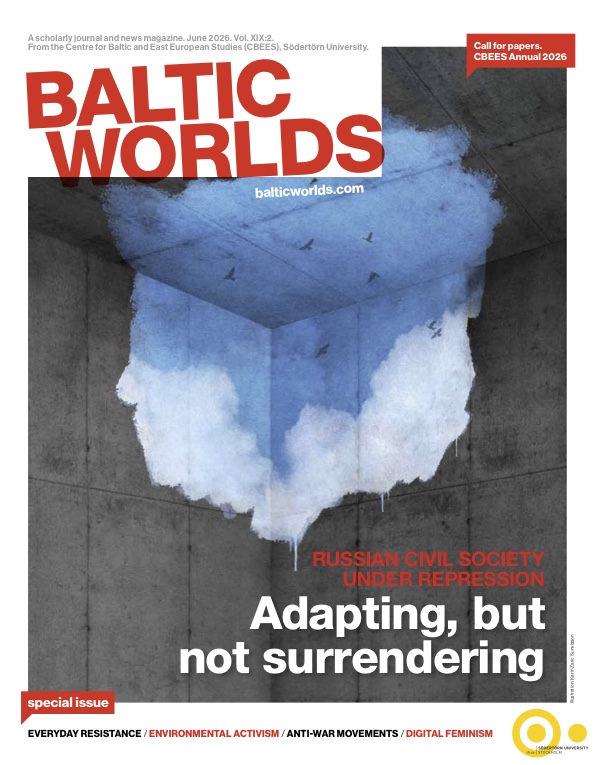 Issue 2026, 2:
  Baltic Worlds covers; the Baltic Sea Region, Eastern Europe, Russia, CentralAsia, Caucasus and the Balkan area.