Trying to understand where post-Soviet Russia is going seems to be a matter of understanding how the society is redefining itself: contradictory pictures are circulating of what precisely Russia and “Russianness” are. The official picture of a united and multicultural Russia is being challenged from several directions.
By
Tove Stenqvist
October 3, 2011
On June 15–17, 2011, the Advanced Cultural Studies Institute of Sweden (ACSIS) organized its biennial conference, this year dedicated to “Current Issues in European Cultural Studies”. This report highlights some of the issues that were discussed at the panel session “East European Cultural Studies: The ‘New’ Europe”, chaired by Professor Irina Sandomirskaya of CBEES.
By
Egle Rindzevičiūtė
October 3, 2011
Sven Eliaeson & Nadezhda Georgieva (eds.) New Europe: Growth to Limits? Oxford: The Bardwell Press 2010, 454 pages
By
Uffe Østergaard
June 30, 2011
Is Russia part of Europe? Russians answer this question in different ways. For many of them, Russia is not Europe but Eurasia, which is an alternate unit of civilization. I do not share this opinion, writes Adam Michnik here.
By
Adam Michnik
May 13, 2011
Today, Pomerania is divided between Germany and Poland, but the German and Polish populations have few factors in common that might serve to unify them. Nevertheless, in some respects the region is gradually becoming more interwoven. To study the development of these cross-border flows, a series of interviews is being conducted as part of a on-going research project
By
Péter Balogh
September 21, 2010
Andrei Zubov, (ed. and author), Istoriia Rossii, XX vek. 1894–1939, Istoriia Rossii, XX vek. 1939–2007, [The history of Russia:
The 20th century. 1894– 1939; The history of Russia: The 20th century. 1939–2007] Moscow: Astrel 2009, 1,023+829 pages
By
Lennart Samuelson
July 1, 2010
+ Julia Obertreis & Anke Stephen (eds.) Erinnerungen nach der Wende: Oral History und (post)sozialistische Gesellschaften, Essen: Klartext Verlag 2009, 401 pages.
By
Kristian Gerner
March 24, 2010
Thomas Acton describes how Romanies are always outsiders. He contends that it is impossible to be engaged in Romani Studies without also becoming part of the Romanies’ struggle.
By
Ninna Mörner
February 19, 2010

 Issue 2026, 1:
 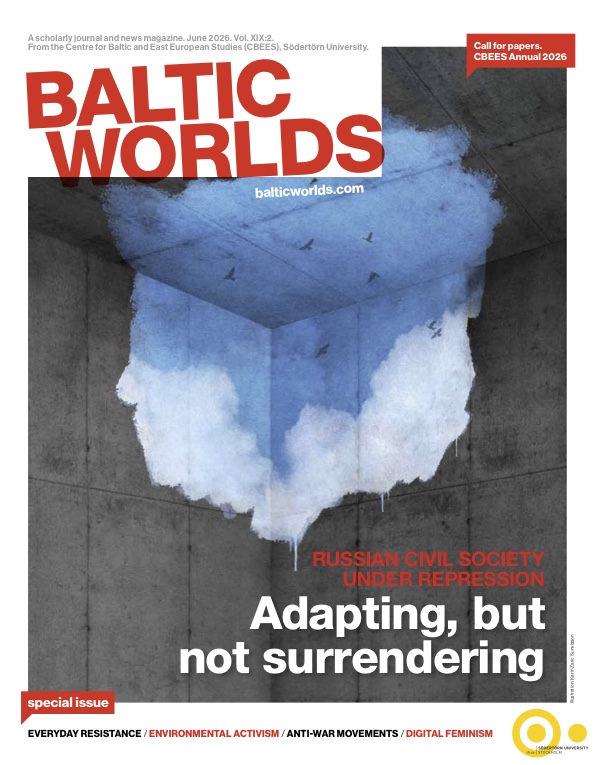 Issue 2026, 2:
  Baltic Worlds covers; the Baltic Sea Region, Eastern Europe, Russia, CentralAsia, Caucasus and the Balkan area.