Over 40 researchers representing countries spanning from Ukraine to the United States and from Sweden to Serbia gathered in Prague to explore the changing roles of rural and urban cultural heritages in post-socialist countries.
By
Paul Sherfey
March 7, 2019
Usually, this triennial takes place in Lithuania, as it has since its foundation in the year 1979. But now, due to the celebration of the centennial of the restored three Baltic states, Kestutis Kuizinas, the leader of the Contemporary Art Centre, decided to suggest that they work collaboratively. Thematically, the 13th Baltic Triennial’s three-part format also shaped the way it was realized.
By
Charlotte Bydler
March 7, 2019
Among many topics in the concluding discussion, there were some reflections from the participants on how to relate to the changing definitions and redefinitions of concepts like regionalism and nation as well as the relevance of these ideas in a period of speedy change. A suggestion was that that the populations in the Baltic Sea region perhaps practice regionalism in everyday life but think in nation-state terms when it comes to politics, and this is but one of many challenges for historians and political scientists to address in future research.
By
Anna Hedén and Thomas Lundén
March 7, 2019
“Postsocialist Revolutions of Intimacy: Sexuality, Rights and Backlash”, Workshop October 1–2, 2018. The workshop was organized by CBEES, Centre for […]
By
Yulia Gradskova
March 7, 2019
What the symposium emphasized was the processes that led to the emergence of the cultural techniques and institutions as well as the conceptual apparatus to deal in practice with the suddenly highly desired Russian cultural heritage. Another focus was on the reception of the Western tradition by the Russian educated society, which took place in parallel with, and sometimes conceptually intertwined with, the re-opening of the Russian tradition.
By
Anna Kharkina
March 7, 2019
The Museum of Contemporary Art in Skopje has created a new program named ‘Radical Education’, designed by Tihomir Topuzovski and Kumjana Novakova. The program started on October 17, 2018 with a lecture “The Art of Political Imagination” by professor Stephen Duncombe. It continued on October 29 and 30 with a workshop by Forensic Architecture, an independent research agency.
By
Tihomir Topuzovski
March 7, 2019
The Swedish National Commission for UNESCO and the Young Academy of Sweden arranged a symposium “The Shrinking Academic Freedom in Europe” November 9, 2018 in Stockholm. This symposium was one of many that have been organized lately on the topic threats to academic freedom, which can be seen as a sign and an acknowledgement that there is cause for worry.
By
Ninna Mörner
March 5, 2019
Academic freedom is under attack. One example of mobilizing in order to protect academic freedom is the roundtable that was organized in connection with 2017 CBEES Annual conference Competing Futures: From Rupture to Re-articulation, at Södertörn University November 30 to December 1.
By
Ninna Mörner
March 8, 2018
The conference Nuclear Legacies: Community, Memory, Waste, and Nature took place from September 14 to 16, 2017, at Södertörn University. It gathered about forty scholars engaged in nuclear issues, coming from twelve different countries and representing many different disciplines.
By
Florence Fröhlig
March 8, 2018
We believed that a conference on arts and aesthetics is hardly imaginable without a cultural program and therefore included one, comprising a dance performance, Breakin’ Revolution, on the opening night at Färgfabriken on October 19, and a public screening of the art film To The New Horizons at the closing session at Moderna Museet on October 21, conceptually marking the beginning and the end of the Russian Revolution.
By
Ekaterina Kalinina
December 18, 2017

 Issue 2026, 1:
 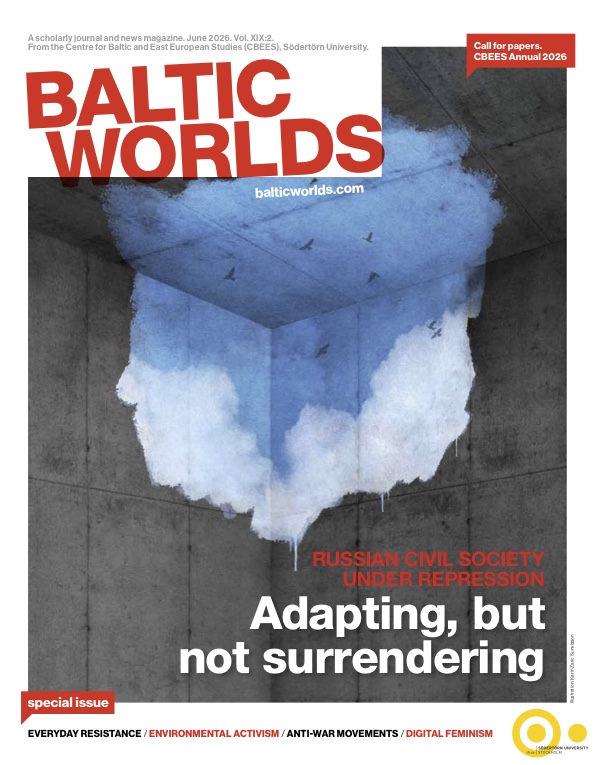 Issue 2026, 2:
  Baltic Worlds covers; the Baltic Sea Region, Eastern Europe, Russia, CentralAsia, Caucasus and the Balkan area.