Agnieszka Graff and Elżbieta Korolczuk in an interview about the phenomenon of anti-genderism: a topic they written together on and both try to understand as it is spreading in Poland but also widely elsewhere
By
Eva Karlberg
March 7, 2018
Early this fall Irina Seits, Russian PhD candidate at CBEES, Södertörn University met with Gustaf Nobel, Ludvig’s great-grandson, in order to talk about the Russian period in the life of his prominent family.
By
Irina Seits
November 7, 2017
Paromita Chakrabarti and Yulia Gradskova discuss the Bakhtin Circle with five experts in the field: Caryl Emerson, university professor emeritus of Slavic languages and literatures, Princeton University; Lakshmi Bandlamudi, professor of psychology at LaGuardia Community College, City University of New York; Ken Hirschkop, professor of English at the University of Waterloo, Ontario; Craig Brandist, professor of cultural theory and intellectual history and director of the Bakhtin Centre, at the University of Sheffield; and Galin Tihanov, the George Steiner professor of comparative literature at Queen Mary University of London.
By
Paromita Chakrabarti
June 19, 2017
In this interview, Laura Sintija Černiauskaitė shares her experience of becoming a writer in the post-Soviet conditions of 1990s Lithuania. Her development as a writer coincided with a drastic change in what it meant to be a writer: from being a political spokesperson to being an economic entity.
By
Stephan Collishaw
January 30, 2017
"Business is not particulary concerned with democratic values, but rather with the existence of stable rules of the game and secured property rights for investors, says professor Andrei Yakovlev, head of the Institute for Industrial and Market Studies at the higher School of Economics in Moscow.
By
Ilja Viktorov
November 19, 2015
Poet, essayist, film critic, journalist, feminist activist, researcher at Polish Academy of Science, literary researcher at Jewish Historical Institute and lecturer in gender studies at Warsaw University — Bożena Keff’s professional career is as multifaceted as it is interdisciplinary, and her interests impressively manifold.
By
Renata Ingbrant
November 19, 2015
Today there is a new reign of terror against the Crimean Tatars, as well as against the Ukrainian population in Crimea. Mustafa Jemiloglu has once again been forced out from Crimea. He was after a meeting in Ankara in March refused to enter Crimea and come back to his home in Bakhchisaray.
By
Peter Johnsson
November 2, 2014
Iryna Dovgan is one of several women that helped Ukrainian soldiers. But she was caught and imprisoned for several days. She was beaten, injured and humiliated. Today she stands up for her rights and is running in the election campaign.
By
Peter Johnsson
October 25, 2014
The Russian researcher Olga Kryshtanovskaya discusses Russian political elites and their role in the political process in Russia. According to Kryshtanovskaya, a new class of rich people is emerging, a hereditary aristocracy which has yet to be legitimized in the Russian collective consciousness.
By
Ilja Viktorov
October 18, 2014
In her book on the East German experiment, The People’s State, Fulbrook launched a concept that owes a lot to her life-long preoccupation with Max Weber’s theories of Herrschaft. She calls it “participatory dictatorship”. An unbelievably large proportion of the population — roughly one in six, she calculated — took an active part in activities that had to be carried out to uphold the political system as such.
By
Anders Björnsson
April 29, 2014

 Issue 2026, 1:
 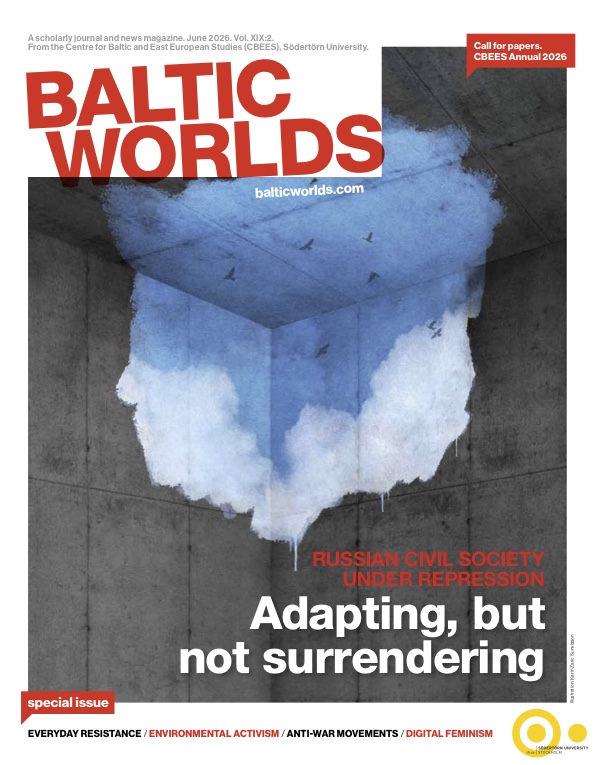 Issue 2026, 2:
  Baltic Worlds covers; the Baltic Sea Region, Eastern Europe, Russia, CentralAsia, Caucasus and the Balkan area.