With a career spanning more than 20 years, Robert Chandler is one of the best known and most prolific translators of Russian into English. He has translated classic authors such as Pushkin and Leskov, as well as more contemporary writers like Grossman, and his translations of Platonov have won prizes. He recently completed a translation of Velimir Khlebnikov’s poem about the Volga famine.
By
Henriette Cederlöf
May 17, 2013
Perspectives on the past are charged, not least in Romania. Vladimir Tismaneanu, former chair for the Scientific Council of the Institute for the Investigation of Communist Crimes and the Memory of the Romanian Exile (IICCMER) is here interviewed about the links between history and politics in Romania.
By
Francesco Zavatti
May 13, 2013
Anna Kharkina visits an exhibition about childhood and sees artifacts from the Romanian countryside. The exhibition opens doors to an individual and a shared past for those with common memories of childhood in a country that no longer exists.
By
Anna Kharkina
May 13, 2013
Human rights activism in Russia can be a dangerous ordeal for those involved in it. How do these dedicated people nonetheless manage to advance human rights in Russia? Here an interview with three human rights activists.
By
Freek van der Vet
January 8, 2013
Södertörn University, where Baltic Worlds is published, now has a chairman of the governing board, a Swedish former Social Democratic career politician, who grew up the Montenegro of Yugoslavia: Ilija Batljan. Here he is profiled in an interview
By
MarieLouise Samuelsson
June 14, 2012
Though once very controversial in the context of the Cold War, Fitzpatrick’s view of totalitarianism in the Soviet Union as something complex, full of contradictions and of different kinds of agency, has now become a commonplace in Russian studies.
By
Johan Öberg
April 10, 2012
János Kornai certainly has been taking risks, and he definitely got his chance to develop in a most unusual way. He started out as a very young journalist in communist Hungary, and he eventually became a professor at Harvard.
By
Björn Kumm
June 30, 2011
Elske Rosenfeld was 15 when the Berlin Wall came down. She realized that this was the end of the critical discourse that the citizens’ movements had brought to life in the GDR. When the 1990 election results were announced in the media, she cried. Today the topic of 1989 is her professional project as an artist.
By
Unn Gustafsson
April 11, 2011
Russian financial markets have been a completely new element in the Russian post-Soviet economy. The level of development and the character of the financial market institutions in this country can tell us much about whether Russia will succeed or fail in evolving towards a well-functioning market economy. Professor Alexandr Abramov from the Higher School of Economics in Moscow is one of Russia’s leading experts on Russian financial markets. Ilja Viktorov from CBEES met him in Moscow to pose some questions concerning developments in the field.
By
Ilja Viktorov
April 8, 2011
Professor Adam Przeworski often asks the questions most of us are a little embarrassed to ask. We see democracy as the natural state of affairs. To Adam Przeworski, who came from New York to Uppsala in late September 2010 to receive this year’s Johan Skytte Prize in political science, no such truths are taken for granted.
By
Anders Mellbourn
January 11, 2011

 Issue 2026, 1:
 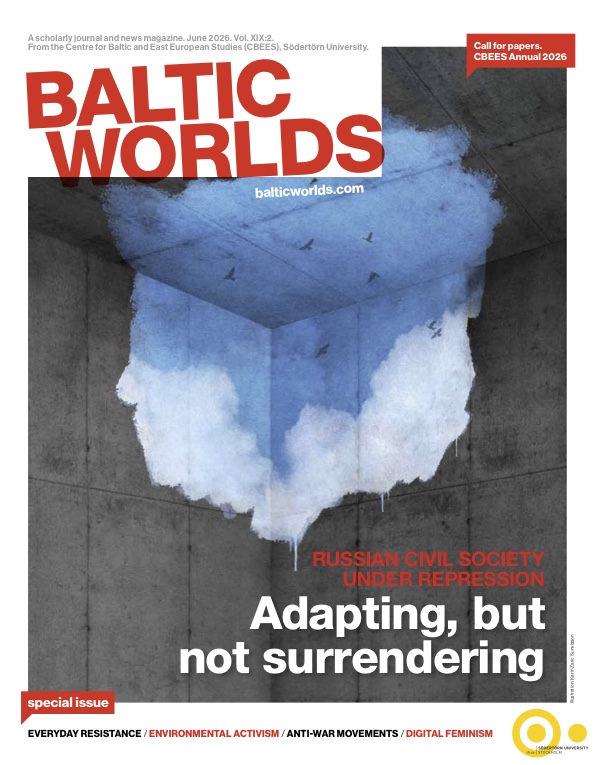 Issue 2026, 2:
  Baltic Worlds covers; the Baltic Sea Region, Eastern Europe, Russia, CentralAsia, Caucasus and the Balkan area.