35 articles tagged with art were found.
Art in the Soviet Union was the mirror of the official communist party policy. However, Maria Prymachenko was successfully hiding the critique of the system behind “naive” pictures. She was one of the few artists who truly depicted the consequences of the Chornobyl catastrophe: from environmental issues to commemorating the dead, from illnesses to corruption surrounding liquidator certificates.
Essay by
Oksana Semenik
April 23, 2026
The article examines the deliberate process of depoliticizing contemporary art in Russia. The repressive laws introduced also target art, especially certain themes, and there is heightened censorship: furthermore, law enforcement exerts direct pressure on individual art institutions and artists. Simultaneously, the state is implementing large-scale programs to support (state-approved) contemporary art: constructing new museums, organizing street art competitions, and supporting the art market. At times, the authorities employ a form of “agenda hijacking,” adopting globally relevant themes in the art world, such as decolonization. For the average citizen, an illusion of a vibrant contemporary art scene is created. Meanwhile, over the two years of the full-scale invasion of Ukraine, the ideological component of art, built on propaganda or stylistic canons, has not become central.
Essay by
Olga Alter
April 16, 2025
The essay analyzes the role of Western art institutions in supporting and promoting imperialist views on both the cultural and political history of what once was the Russian Empire, then the Soviet Union, and then the so-called “post-Soviet” space while they universalized and homogenized the multiple, complex, heterogenic, interconnected voices that temporally and spatially fell within the boundaries of the Russian Empire in its various forms. It looks into the case of the market-driven umbrella terms of “Russian art” and “Russian avant-garde,” as presented in several exhibitions in major Western museums between 2016 and 2019, dedicated to the centennial of the October Revolution, often called the Russian Revolution. The research focuses on the artists connected to Ukraine. It attempts to do them epistemic justice by restoring the complexity of the interconnections, contexts, and traditions they grew out of and were inspired by, as well as the ones they reworked, deconstructed, and revolutionized. By referring to decolonial thinkers, it combines and compares how imperial thinking, frames of reference, and coloniality work in symbolic and knowledge production.
Essay by
Kateryna Botanova
December 10, 2024
Street artists have demonstrated their condemnation of Russia’s invasion of a neighbor with murals, both in Ukraine and abroad. The most famous of these artists is Banksy. On a wall of what was once a kindergarten, he has sprayed the image of a child in a judo match overcoming a seemingly far more powerful opponent (an adult with some resemblance to the Russian leader). Although such works of street artists in Ukraine sometimes also show Putin, children are a common theme – often a girl with two stiff braids. Some of these works are presented in this essay, considering the role of the child in them, seeking to understand the role of art in protest as an appropriation and reconfiguration of public space.
Essay by
Lisa Källström
June 20, 2023
The essay presents a new reflection on aesthetics within the wider understanding of the role of political rhythms in hybrid regimes. Aesthetics and politics “are not two permanent and separate realities about which it might be asked if they must be put in relation to one another”. On the contrary, the argument the author proposes in this essay presents an idea of how a political establishment disposes a new set of spatial practices through the field of aesthetics.
Essay by
Tihomir Topuzovski
October 25, 2021
This essay analyses two texts by the Polish art historian Piotr Piotrowski (1952–2015) articulating theoretical stances towards art museography. Reflecting on how they deal with psychological as well as openly political issues, I interpret and assess their joint contribution to the broader interdisciplinary field of (critical) museography. The texts are “New Museums in New Europe” and “Making the National Museum Critical”. Together the texts developed Piotrowski’s concept of “the critical museum” as a way of dealing with the challenges of running an old national art museum based on masterpieces while also striving to engage with pressing contemporary issues. which is a prerequisite for critical intervention.
By
Dan Karlholm
October 25, 2021
Eglė Rindzevičiūtė talks to Ele Carpenter about the strong correlation between the experience of imperialism and colonial power, high technology and cultural responsibility.
By
Egle Rindzevičiūtė
April 22, 2021
The Division of Prints and Drawings of the Swedish National Museum contains a collection with just over 200 hand painted images of the peoples of the Russian Empire which, up to the present time, has been largely unknown to scholars. The images, dating from the first half of the 18th century, are associated with the name of Friedrich Wilhelm Bergholtz (1699–1772) a courtier and collector who served as a tutor to the Grand Duke Petr Fedorovich (the future Peter III). In this article, the authors describe the contents of the collection, consider its' possible origin, and assess its significance, particularly with regard to its depictions of Siberian peoples and Ukrainians.
Essay by
Edward Kasinec and Nathaniel Knight
April 22, 2021
Memory can be retained and archived. You can, however, also manipulate it, obliterate its fragments and sometimes whole segments, using its stores as a tool in a political fight with minorities. Historical memory is only seemingly a domain of objective knowledge.
The point of departure for my artivistic practice is always work with archival material. With time, my experiences led me to outline a specific understanding of historical memory as a process in which the most important role is played by the migration of ideas, a peculiar kind of nomadism.
Essay by
Zuzanna Hertzberg
February 12, 2021
In 1949–1950, the Yugoslavian Chamber of Commerce commissioned architects Vjenceslav Richter (1917–2002) and Zvonimir Radić (1921–85) together with artists Ivan Picelj (1924–2011) and Alexandar Srnec (1924–2010) to shape several pavilions at various international trade fairs; in Stockholm twice. This text departs from a rich photographic documentation of the 1950 fair, discussing how and why Yugoslavia turned to modernism, why the artists shaped the pavilion the way they did, how it was received in Sweden. It also places the pavilion in a political context. As Yugoslavia was expelled from the Eastern Bloc in 1948, it had to find new alliances. The turn to modernism could be seen as a sign of this, but such reading also risks diminishing the role of modernism, leaving it as something that belongs to the liberal democracies in the West. The text argues against such narrow reading. It also discusses the role art history has played in forming a quite stereotype image of modernism and finally, it uses Roland Barthes “myth” as a way of looking at modernism from a multiple perspective.
By
Håkan Nilsson
October 8, 2020

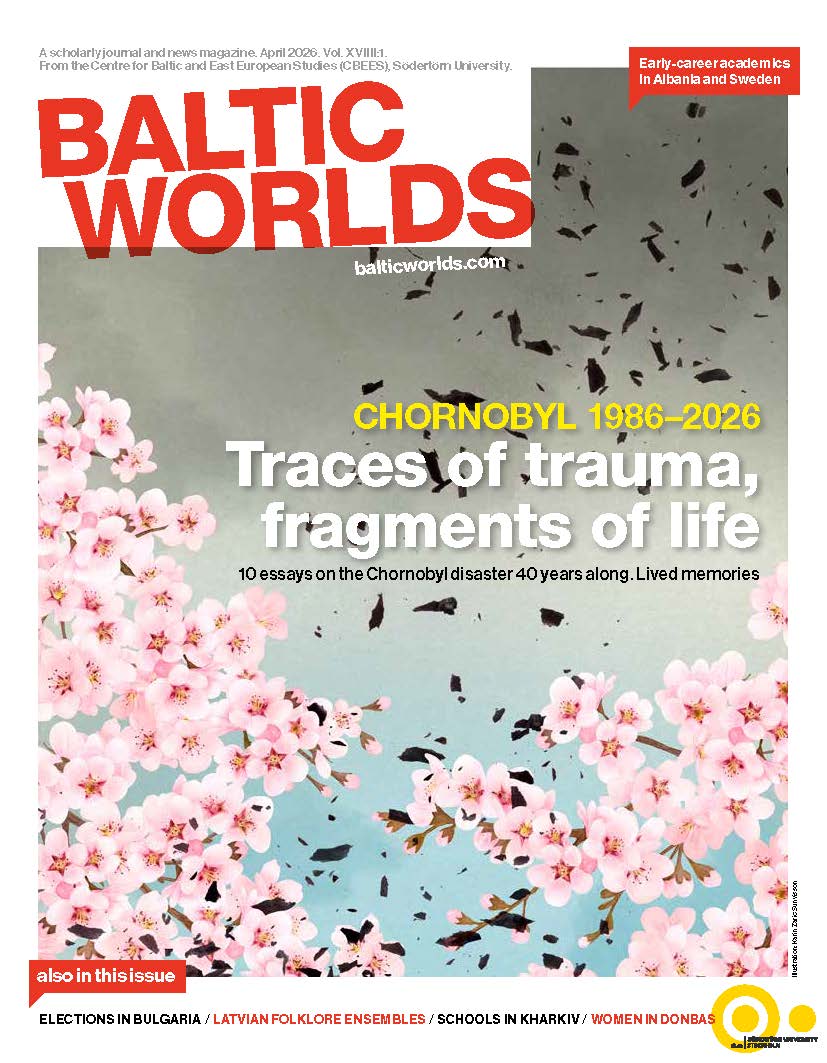 Issue 2026, 1:
 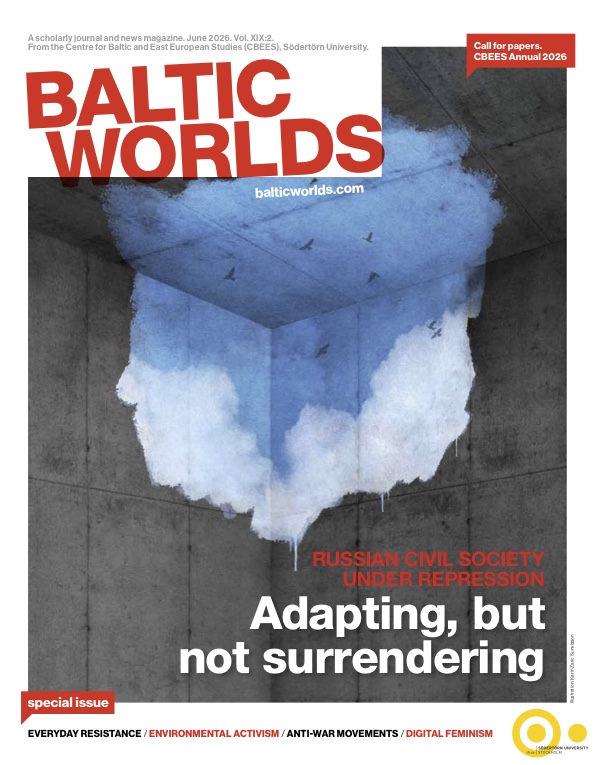 Issue 2026, 2:
  Baltic Worlds covers; the Baltic Sea Region, Eastern Europe, Russia, CentralAsia, Caucasus and the Balkan area.