15 articles tagged with energy were found.
Conference name: Stocktaking of Research on Energy Security, Justice and Sustainability in The Baltic Sea Region and Eastern Europe: What Is Missing?
Date and location: October 24–25, 2024, Södertörn University.
Organizer: The Energy and Climate Hub at Södertörn University .
Funding: Centre for Baltic and East European Studies, Södertörn University.
By
Sara Persson et al
April 16, 2025
This paper focuses on the notions of “time” and “temporality” of nuclear waste, as well as the different time horizons implied by practitioners of nuclear waste storage. In doing so, the paper develops understandings of a key problem defining nuclear waste storage in C21: namely, how to communicate information and memory over the 100,000 years that highly radioactive nuclear matter remains a threat to organic life. This question is notable not least because it involves the proposition of communicating with “deep time” future scenarios in which contemporary representational systems are ineffectual, and even the existence of the “human” is in doubt.
By
Thomas Keating et al
April 7, 2025
Since its announcement in 2015, Nord Stream 2 (NS2) has fueled European public debate about the EU’s role in a multipolar world, the scope and limits of transnational governance, and the trade-off between environment and climate protection vs. economic growth and fossil fuel lobbying. Whereas much has been said and written about the security and military risks issued by the project, the environmental and climate impact of the Russian pipeline has received limited attention. This article analyzes to what extent both institutions and civil societies of the Baltic countries (in particular, those directly involved in the permit process) developed forms of transnational cooperation in order to tackle environmental and climate challenges issued by the planned pipeline. The aim is to contribute to the following research fields: the role of environment and climate in international relations; multiple notions of “security” in the Baltic region; and transnational governance in the face of global challenges. The sources are ENGOs’ publications and statements, official reports as well as media, which are analyzed according to Critical Discourse Analysis.
By
Monica Quirico
September 18, 2024
The workshop Large-scale energy project: A view from society, on 24-25 April 2014 at Södertörn University became a forum for addressing a number of significant issues related to large-scale energy projects including international cooperation, energy supply, trust, energy governance and public participation, just as local and global dimensions on the issue of interest.
By
Ekaterina Tarasova & Karin Edberg
June 27, 2014
Infrastructure forms a link between the open global economic space and the non-public Russian political space. The question of how to manage the most important trade flows and understand their social importance is not, of course, solely seen as a matter of Russian politics. The research on Russia is also connected to the recent debate on the importance of increasing globalization and the mutual dependence of societies.
By
Katri Pynnöniemi
January 16, 2012
“Market Reform and Socio-Economic Change in Russia” was the subject of an ambitious full-day seminar held October 6, focusing on the period since the fall of the Soviet Union.
By
Per Jönsson
January 16, 2012
Is it possible to imagine a disused nuclear power plant as a monument or memory site, a trace in the landscape that tells of days gone by? Have our notions of what constitutes history and cultural heritage expanded to the degree that we can also include a physical setting whose meaning is so controversial, especially considering the current political relevance of nuclear power technology?
Essay by
Anna Storm
January 31, 2011
The EU wants the Baltic region to have a common energy sector, something the region does not have today. Political governance is weak and the people making the investments have yet to prioritize regional cooperation. This is the view of Michael Bradshaw, professor of human geography at Leicester University, who opened the first Baltic Worlds Annual Round Table on November 24 at Södertörn University in Stockholm.
By
Kristoffer Morén
January 10, 2011
The Russian energy strategy for the next few years includes lofty goals. While other countries are investing 1.5 percent of their GDP in the energy sector, Russia is spending 5 percent. This was noted at the Norwegian Institute of International Affairs (NUPI) Annual Conference on Russian and Eurasian Studies.
By
Ninna Mörner
January 10, 2011
In Michael Madsen’s film Into Eternity, the safe storage of nuclear waste has gone awry: distant descendants of ours from a civilization unknown to us have penetrated the defenses of Onkalo, the final repository of nuclear waste on Finland’s west coast.
By
Thomas Borchert
January 10, 2011

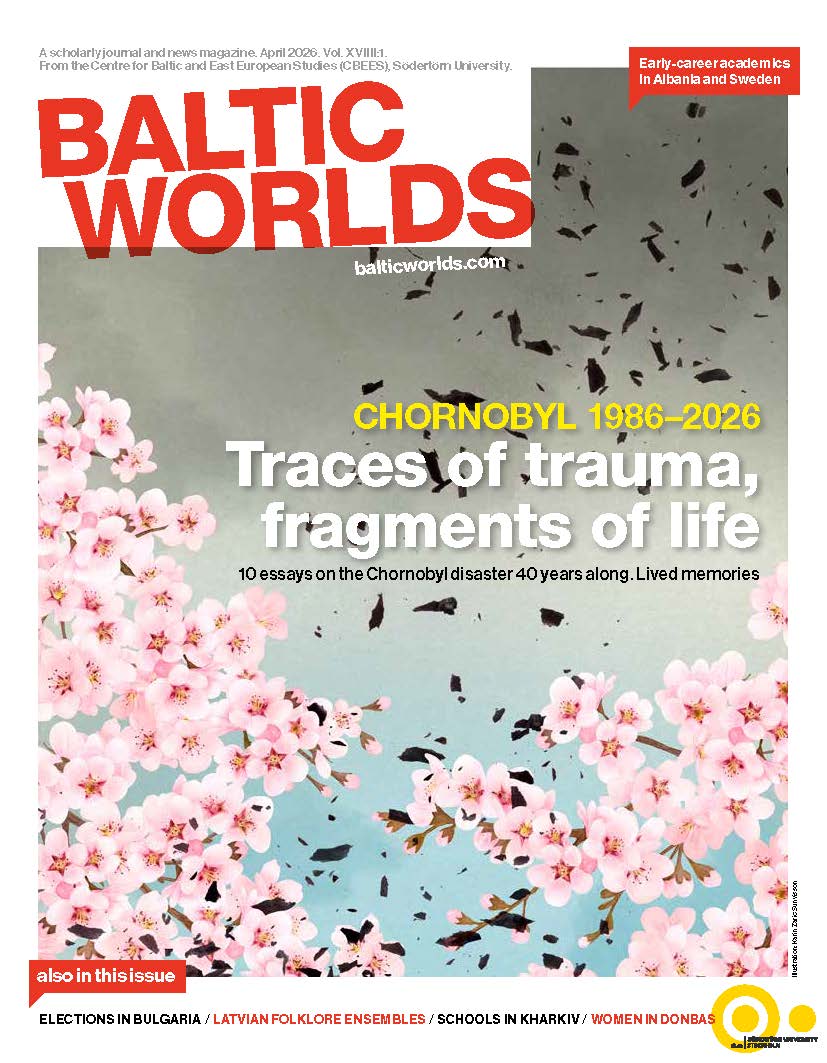 Issue 2026, 1:
 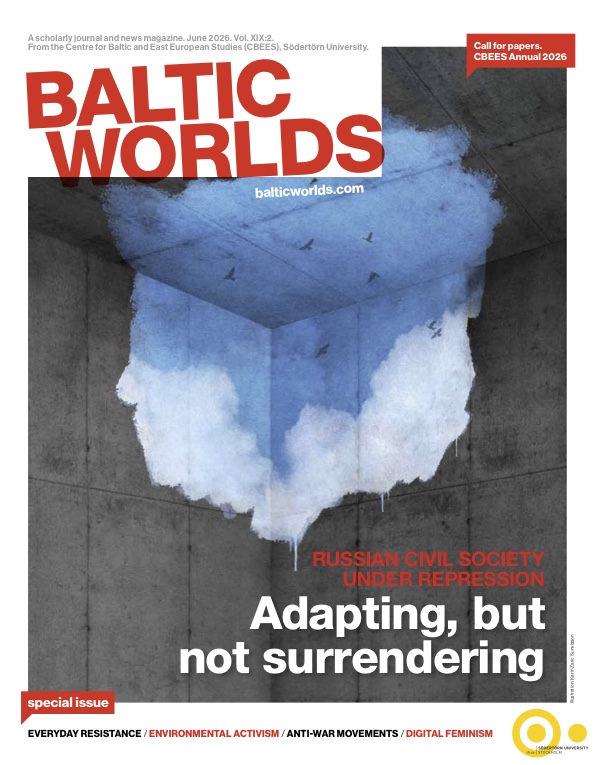 Issue 2026, 2:
  Baltic Worlds covers; the Baltic Sea Region, Eastern Europe, Russia, CentralAsia, Caucasus and the Balkan area.