The post-Soviet Estonian politics of memory have centered on the themes of national suffering and heroism, which function as a “dominant narrative and state-supported memory regime”. The fixation on victimhood has served as a screen memory18 for avoiding questions about the Holocaust in Estonian territory and the collaboration of Estonians in Soviet rule.
Essay by
Eneken Laanes
June 27, 2012
In order to ascend another rung on the development ladder, all three Baltic countries are engaged in higher education reform. Latvia has the furthest to go.
By
Påhl Ruin
June 27, 2012
Journal of Baltic Studies, March 2009, Journal of the Association for the Advancement of Baltic Studies
By
Li Bennich-Björkman
June 27, 2012
Andres Kasekamp, A History of the Baltic States, London , Palgrave Macmillan 2010, xi + 251 pages, Andrejs Plakans, A Concise History of the Baltic States, Cambridge, Cambridge University Press 2011, xvi
+ 474 pages
By
Kristian Gerner
January 18, 2012
Ene Kõresaar (ed.)Soldiers of Memory World War II and its Aftermath in , Estonian Post-Soviet Life Stories, Amsterdam & New York Rodopi 2011, 441 pages
By
Yulia Gradskova
January 18, 2012
About Estonia’s endeavors to become part of the staid but stable Scandinavia – an effort based on the belief that the country actually has a special affinity with Scandinavia. One sign of this, Pärtel Piirimäe points out, is the use of the word jõul (cognate to English “Yule”). The Estonians, like the Swedes, Norwegians, Danes, and Finns, thus live in Yule Land.
Essay by
Pärtel Piirimäe
January 16, 2012
While negotiations and controversies about the future of Linnahall in Talinn continue, people, not only traceurs but also beer-drinking youths and lovers, are mounting an opposition to the visions of investors and planners of remaking the space into an attractive enclave for the affluent.
By
Beate Feldmann
June 30, 2011
2011 elections in Estonia is a distinct indication of a political development in very much the right direction. The government coalition did ´deliver´ to the voters, and in a relation of reciprocity, the voters delivered back.
By
Li Bennich-Björkman
March 12, 2011
A specter is haunting the Baltic States. It appears in different forms and with different names: Air Baltic, Mažeikių Nafta, Lattelecom, Ventspils Nafta, Latvenergo, Estonian Air. With their independence in 1991, the Baltic nations inherited enormous state enterprises, built to serve large parts of the Soviet Union, and thus too big for small republics like Lithuania, Latvia, and Estonia.
By
Arne Bengtsson
January 11, 2011
+ Estonian Life Stories, Edited and translated by Tiina Kirss, Compiled by Rutt Hinrikus Budapest: Central European University Press 2009, 539 pages
By
Maija Runcis
March 24, 2010

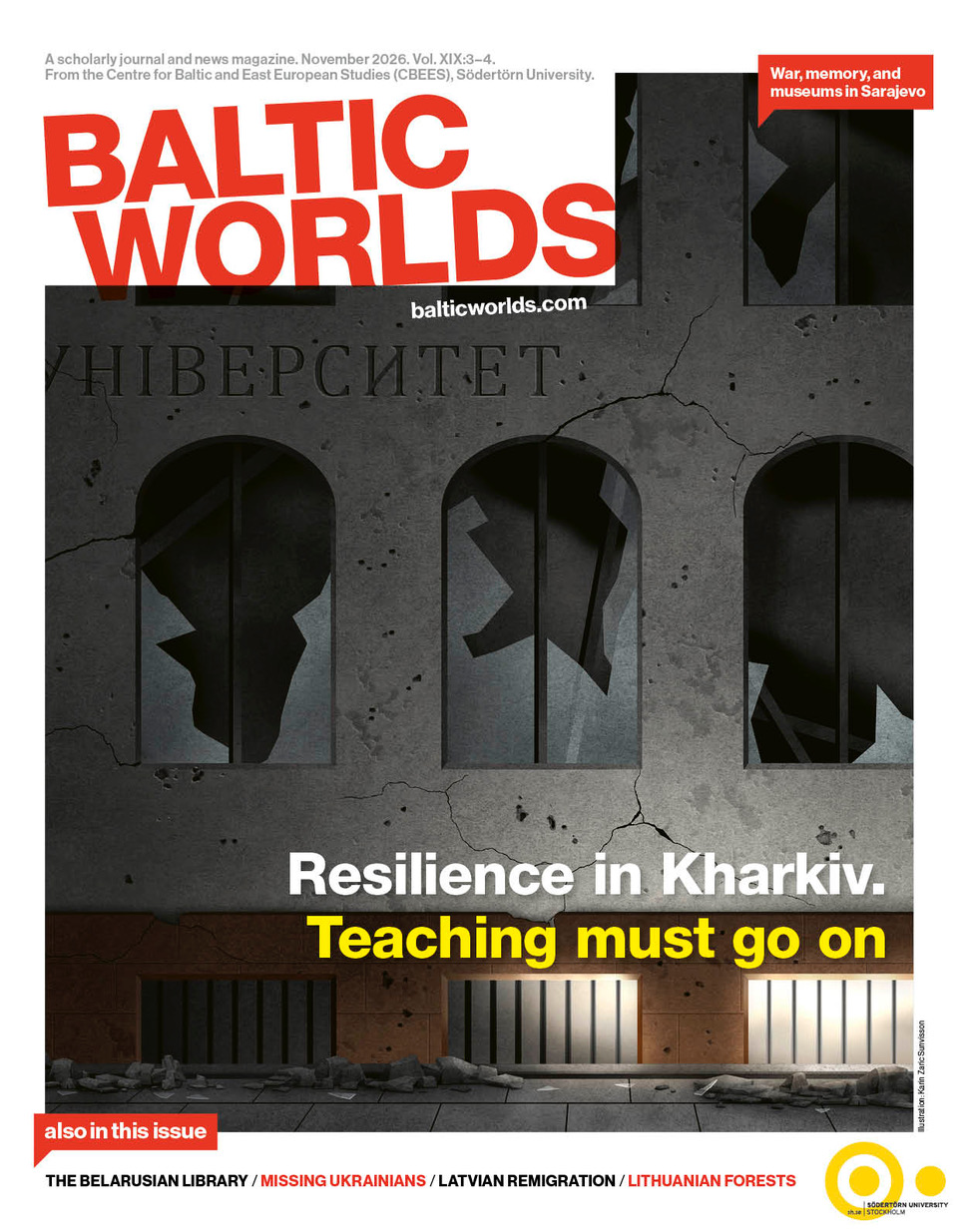 Issue 2026, 3-4:
 Baltic Worlds covers; the Baltic Sea Region, Eastern Europe, Russia, CentralAsia, Caucasus and the Balkan area.