The article is devoted to how Uzbekistan’s constructivist foreign policy contributed to fundamental changes in the Central Asian region. The main purpose of the article is to examine the transition from realpolitik to a constructivist approach in Uzbekistan, as well as in Central Asia in general. The author seeks to outline potential scenarios for future developments in the changing political landscape in the region. In the work, he reveals the significance of the school of constructivism, comparing it with other theories of international relations. According to him, this theory is the most suitable for explaining the current political status quo in the region. The key concepts in the article are identity, perception, ideology, culture and national interest.
Essay by
Islomhkon Gafarov
August 26, 2025
The 13th Annual Aleksanteri Conference “Russia and the World”, which took place in the main building of the University of Helsinki, October 23–25, was dedicated first and foremost to Russian foreign policy.
By
Irina Kotkina
January 21, 2014
Rationality versus irrationality, emotions versus calculations – these were the main issues to be discussed under a seminar in May, organized by the Aleksanteri Institute (Helsinki). Actually, the emotions theme became a starting point for the participants to approach the nature of Russian foreign policy and decision-making inside the post-Soviet bureaucracy.
By
Ilja Viktorov
June 1, 2011
Einar Maseng, Utsikt over de nord-europeiske staters utenrikespolitikk i de siste århundrer
[An overview of the Northern European States’ foreign policy during the last centuries]. I–III
Oslo: Universitets-forlaget 2005: 323, 291, 353 pages
By
Sven Eliaeson
July 1, 2010

 Issue 2026, 1:
 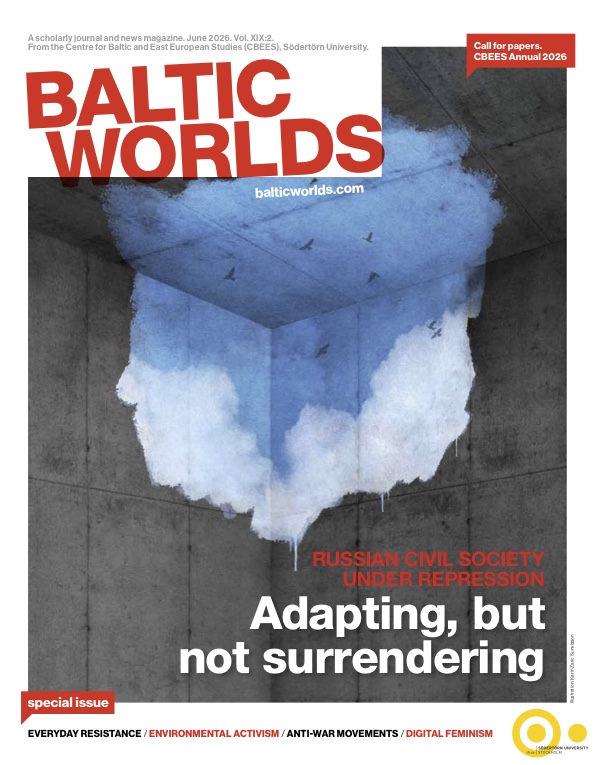 Issue 2026, 2:
  Baltic Worlds covers; the Baltic Sea Region, Eastern Europe, Russia, CentralAsia, Caucasus and the Balkan area.