The article explores how the ongoing Russian–Ukrainian war is transforming the discussion around the oral history method under the conditions of an active war and analyzes the potential of the graphic novel as a new form of publishing oral history sources. The focus is on the theoretical, methodological, and practical dimensions of oral history, as well as on the question of which forms of public representation become relevant in the situation of an ongoing event. Drawing on the project “Graphic Narratives about the War” (archival interviews from the 1990s and new recordings from 2022–2024, created in cooperation with the NeuengammeConcentration Camp Memorial), the article demonstrates how the combination of interviews and original graphic art influences the construction, interpretation, and affective perception of narratives. The theoretical section of the article outlines key conceptualizations of oral history as theory, method, and practice, distinguishes between “documentation” and “oral history” within the context of the “unfinished past,” and argues for the ethical foundations for choosing the graphic format. The empirical section describes the working process — from selecting and transcribing interviews to script adaptation, collaboration with artists, and decisions regarding content, form, format, and dissemination of the publication. The study contributes to current discussions on oral history in times of crisis, and public humanities, proposing the graphic narrative as a safe and meaningful tool for representing oral testimonies in the context of an ongoing war.
By
Svitlana Telukha
December 18, 2025
The thematic bookstalls, on the eve of International Holocaust Remembrance Day in the Italian city of Turin, January 2025, show a range of covers, some only rather vaguely connected with the traumatic past in the context that they are displayed in. The Storyteller of Auschwitz is just one of many in the same vein, blending real events with fictionalized narratives. The Italian version sold at Milan airport as an on-the-plane read has a title that literally translates as “a girl who wrote love stories in Auschwitz”, and the cover shows the image of a malnourished child in bedraggled clothes with the eerie Birkenau gate contour as background. This leads to reflections on the many layers of Holocaust portrayal, 80 years after the end of WWII, and its implications.
By
Olga Bubich
April 16, 2025
Ashort article by the Australian historian Dirk Moses published on May 23, 2021, in the Swiss journal Geschichte der Gegenwart has sparked a heated debate among German intellectuals and historians on the singularity of the Holocaust. The debate partly presents itself as an updated version of the German historians’ debate (Historikerstreit) from the late 1980s.
Essay by
Ann-Judith Rabenschlag
January 24, 2022
Silvia Kučėnaitė Foti it the author of the book The Nazi’s Granddaughter: How I discovered my Grandfather was a War Criminal. After going through major trauma when discovering her grandfather was not the war hero she heard about but a Nazi collaborator, she started to investigate her grandfather’s past. Considering Jewish sources along with the Lithuanian sources Foti questions the Lithuanian official narrative denying any involvement in the Holocaust.
By
Martina Urbinati
October 25, 2021
On the Watchpost. The complicity of the Polish and Polish Criminal Police in the Holocaust. Review of Na posterunku. Udział polskiej policji granatowej i kryminalnej w zagładzie Żydów Jan Grabowski 432 pages. Wydawnictwo Czarne, Wolowiec 2020.
By
Piotr Wawrzeniuk
April 22, 2021
The photo albums from German soldiers during WW II have, 75 years after the war’s ending, increasingly been auctioned off at internet auctions. Several photo albums contain traces of Eastern Europe’s Jewish life and how this is suddenly set against the rapidly emerging terror. Throughout many of the images, the photographer’s gaze is on something that is seen as inferior, laughable, exotic, war tourists’ motives worth documenting to show them at home: Eastern European Jews.
By
Peter Handberg
April 21, 2021
The narrative in this article is based on a reconstruction of my personal curatorial experience while working on the exhibition “A Difficult Age: Vilnius, 1939–1949”. The exhibition’s chronological framework – 1939 to 1949 – was established with a focus on historical realities and aimed to frame the narrative of the guest exhibition. The public knowledge of the history of multi-national Vilnius is full of conscious and unconscious omissions, in large part caused by oblivion, but no less by the unwillingness to remember, ignorance, and the refusal to know or even fear of finding out. The narrative based on the history of visual art and artists’ lives is a way to bring up controversial topics and open new perspectives.
By
Giedre Jankeviciute
February 15, 2021
In his book of reportage: Białystok. White Power, Black Memory Marcin Kącki documents oblivion and denial of the memory of the former Jewish inhabitants of the city; paradoxically, it is also a call for this memory to be restored. In other words, we are dealing here with the two basic attitudes and forms of remembering historical trauma, distinguished by LaCapra: The first results in the process of “working-through”; the other is based on denial and results in “acting-out”.
By
Jan Miklas-Frankowski
February 15, 2021
This article addresses the problem of the underrepresentation of the traumatic past in the example of the official commemoration of the Holocaust in Belarus. The silenced memories hinder the process of reconciliation and have real consequences for urban planning and cultural life. Thus, in order to address the tragedy that has been excluded from the official commemoration in Belarus, artists and journalists have created projects to fill the void in remembrance. The article describes how art and media projects have resolved the problem of the underrepresentation of certain events in the official culture and make vernacular memory available to many people.
By
Elisabeth Kovtiak
February 15, 2021
The Grodzka Gate-NN Theater in Lublin is displaying maps about the memory of Jewish Central and Eastern Europe in an online exhibition. Martin Englund from Baltic Worlds meets curator and educator Piotr Nazaruk in a conversation about the memory maps, educating people about the Jewish history of Poland, nostalgia, and anti-Semitism.
By
Martin Englund
October 7, 2020

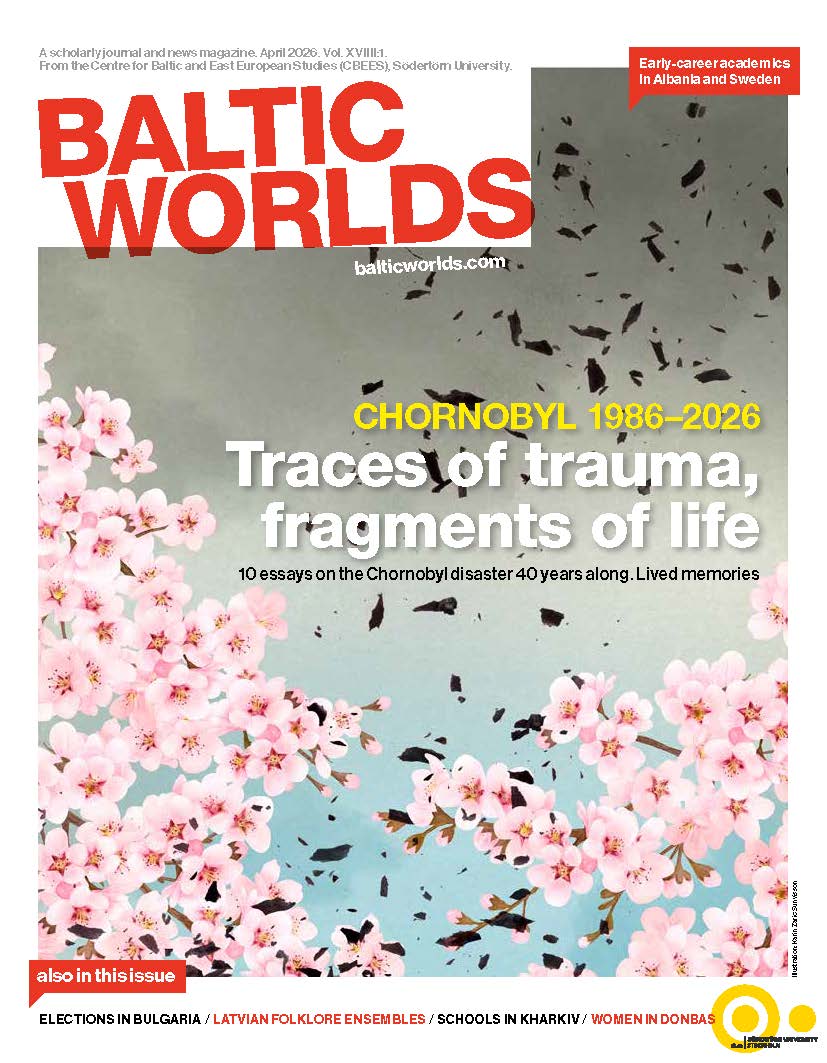 Issue 2026, 1:
 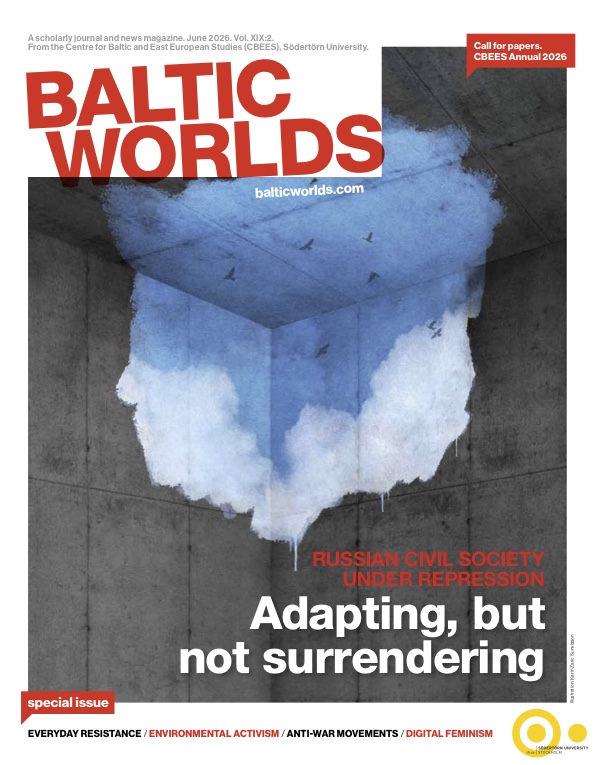 Issue 2026, 2:
  Baltic Worlds covers; the Baltic Sea Region, Eastern Europe, Russia, CentralAsia, Caucasus and the Balkan area.