Hungary before the Change?
I have been monitoring academic freedom and institutional autonomy in the region for the past few decades. Hungary stood out […]

A scholarly journal from the Centre for Baltic and East European Studies (CBEES) Södertörn University, Stockholm.
 Issue 2026, 1: Download.
29 articles tagged with hungary were found.
I have been monitoring academic freedom and institutional autonomy in the region for the past few decades. Hungary stood out […]
The article examines the role of Euroscepticism in the construction of an illiberal hegemonic regime by the Hungarian government, and its operationalization by right wing public intellectuals in their professional and subjective geopolitical analyses. Building on Alexei Yurchak’s concept of hypernormalisation, it argues that Hungarian Eurosceptic narratives have become part of a formalized authoritative discourse that provides a guiding framework for the regime’s intellectuals to voice their opinion about global politics and contemporary history, while leaving space for a set of diverse and often contradictory meanings to emerge in relation to Europe and the European Union.
Hadley Z. Renkin on Hungarian sexual politics, geotemporal belonging, and the impending reemergence of fascism.
New Conservatives in Russia and East Central Europe. Eds. Katharina Bluhm and Mihai Varga (London: Routledge, 2019), 309 pages.
The author argues that stigmatization of “gender” as ideology has become a central element of political discourse in Hungary since 2010 — resulting in the ban of the MA in Gender Studies in the Official Gazette on October 12, 2018. For a critical reading, the author situates the strategic attack in relation to three junctures of meaning-making of “feminism” and “gender” since the system change in 1989 that have eventually crystalized into the commonsense discourses of “gender ideology” and “gender-craze” of right-wing populism.
The author traces the transformation of vineyard hills and their change of function through the example of a small village close to Lake Balaton. Under the impact of tourism these areas are gaining a new function: besides agricultural production they are now acquiring a recreational role. As part of this process there have also been substantial changes in the use of the buildings used to process grapes and store wines as the new owners have converted them into second homes or holiday homes. In certain respects the buildings on the vineyard hill also reflect this transformation in the relationship between the landscape and man. The newcomers no longer look on the landscape as a source of livelihood but as a kind of refuge where they can escape urban life from now and then.
In my contribution I would like to provide an assessment of what has happened over the past two years in Hungary, how academics have been reacting, and finish with a few thoughts regarding academia in that country and beyond. My focus should and will be on the Hungarian Academy of Sciences.
Inaugurated in October 2012, the statue was one of the first publicly-funded right-wing monuments to adorn a public square in postwar Hungary, and only one example of the current Hungarian government’s determined campaign to reformulate public discourse and memory politics.
Among decided voters, the overwhelming popularity of Fidesz-KDNP has been rather stable since 2015. The opposition tried to push topics other than migration - such as healthcare - that are still important to Hungarian voters, and where real progress during the past eight years of Fidesz-KDNP rule is questionable at best. Nevertheless the winner of the elections is the governing coalition of Fidesz-KDNP. Oppositionist leaders and candidates, including several (re)gaining their mandate in parliament, have been resigning one after another or plan to do so very soon.
In 2016, commemorations of the 60th anniversary of the 1956 Hungarian Revolution brought new conflicts in memory politics. This article analyzes the reasons for women’s absence from the historiography of the 1956 Revolution and discusses how the polypore state is using the populist turn to introduce hegemonic narratives and to include women in the narrative of “national feminism”.
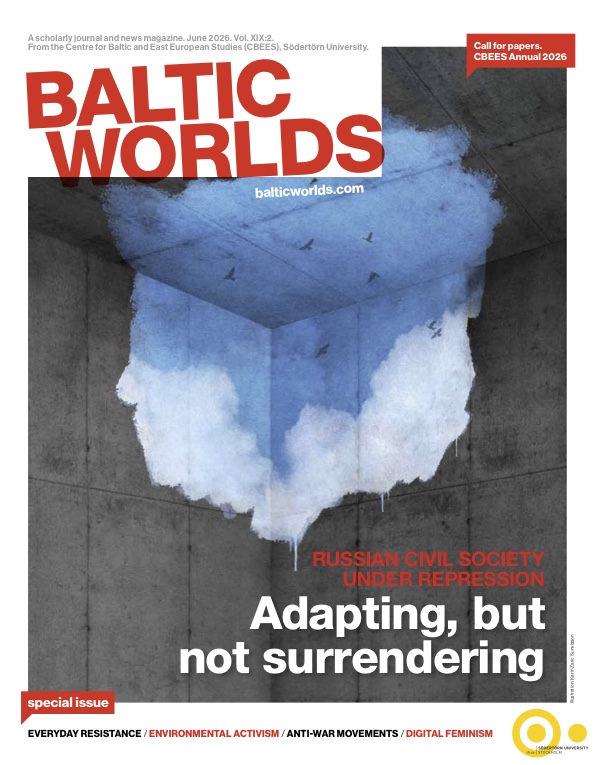 Issue 2026, 2: Download.
 Baltic Worlds covers; the Baltic Sea Region, Eastern Europe, Russia, CentralAsia, Caucasus and the Balkan area.