Why is it so easy to remember war and so hard to remember peace? In order to bring forth memories of peace we need to reconceptualize what we mean by peace. I propose the term wild peace as a conceptual and potentially radical move that engage our imagination and capture the lived, embodied and agential dimensions of peace. Memories of wild peace are unruly as they hold the power to unsettle hegemonic narratives and point to alternative futures. I argue that unruly memories of wild peace are important at the present time, when the very idea of peace is contested and undermined.
By
Johanna Mannergren
March 7, 2026
Conference name: Secure Horizons: Ukraine’s Peace & Infosecurity Confluence Date and location: Symposium arranged February 6, 2024, at Södertörn University/hybrid […]
By
Anastasiia Chupis and Alyona Hurkivska
April 16, 2025
Serhii Plokhy, professor in Ukrainian history at Harvard University and director of the Harvard Ukrainian Research Institute, in a conversation on the history of Ukraine, knowledge production, decolonization, the role of the Church and the ongoing war, with Professor Barbara Törnquist-Plewa.
By
Barbara Törnquist-Plewa
April 16, 2025
The article examines the deliberate process of depoliticizing contemporary art in Russia. The repressive laws introduced also target art, especially certain themes, and there is heightened censorship: furthermore, law enforcement exerts direct pressure on individual art institutions and artists. Simultaneously, the state is implementing large-scale programs to support (state-approved) contemporary art: constructing new museums, organizing street art competitions, and supporting the art market. At times, the authorities employ a form of “agenda hijacking,” adopting globally relevant themes in the art world, such as decolonization. For the average citizen, an illusion of a vibrant contemporary art scene is created. Meanwhile, over the two years of the full-scale invasion of Ukraine, the ideological component of art, built on propaganda or stylistic canons, has not become central.
Essay by
Olga Alter
April 16, 2025
Tetiana Kalenychenko, an expert in religion and conflict resolution, in conversation with Yuliya Yurchuk on how religion can be an instrument in conflict transformation.
By
Yuliya Yurchuk
October 8, 2020
The 400th anniversary of the peace treaty between Sweden and Russia has for obvious reasons been in the shadow of […]
By
Thomas Lundén
November 8, 2017
David Holloway, professor of international history at Stanford University, has been specializing as a Cold War scholar for a long time. He has recently delved into many archives in an attempt to find the answer to the question of the significance of the atom bomb during the Cold War. He presented part of his findings at a research seminar at CBEES in September.
By
Rebecka Lettevall
January 10, 2011
+ Rebecka Lettevall & My Klockar Lidner (eds.). The Idea of Kosmopolis: History, Philosophy and Politics of World Citizenship. Stockholm 2008. Södertörn Academic Studies 37. 181 pages.
By
Vesa Oittinen
February 18, 2010

 Issue 2026, 1:
 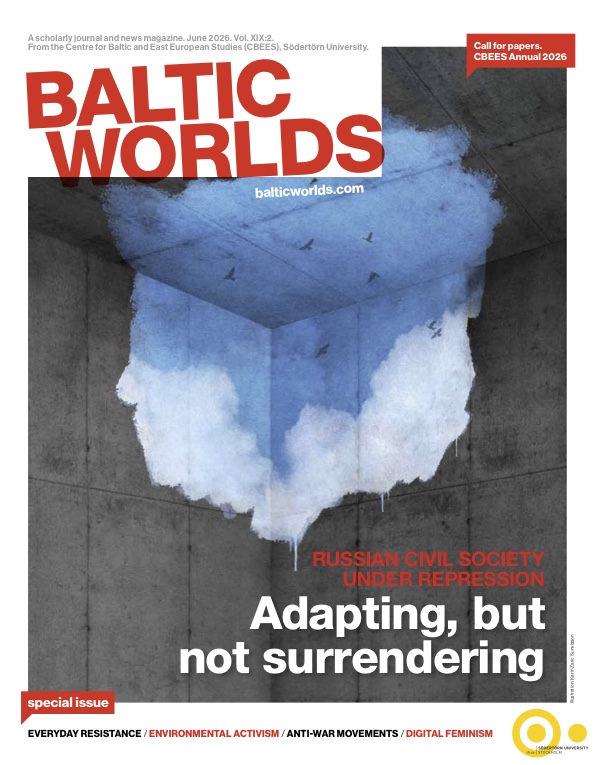 Issue 2026, 2:
  Baltic Worlds covers; the Baltic Sea Region, Eastern Europe, Russia, CentralAsia, Caucasus and the Balkan area.