112 articles tagged with ukraine were found.
This article delves into the folk music community of Latvia and its reaction to Russia’s full-scale invasion of Ukraine in 2022. Rooted in the 20th-century folklore revival movement, during which Latvians revitalized their cultural heritage as a form of opposition to Soviet ideology, the community of Latvian folklore ensembles, musicians and enthusiasts has joined the broader civic initiative of giving aid to Ukraine and expressing solidarity with the Ukrainian people. Since February 2022, at least 80 initiatives linked to folklore (concerts, dance events, protests etc.) have been carried out that are directly connected to gathering support for or expressing solidarity with Ukraine. The analysis of these events reveals how the folklore community engages with political issues, using folklore as a medium to express its views in the contemporary political context.
By
Ilga Vālodze Abelkina
April 23, 2026
This essay examines innovative educational adaptations implemented in Kharkiv to ensure children’s right to education, considered as a manifestation of resilience in wartime. The research methodology employed a descriptive case study approach utilizing multiple data sources to ensure triangulation, including official reports from educational authorities; press releases; Ukrainian and foreign mass media platforms; documented observations of facilities and stakeholder testimonials; and personal notes, videos, and photos. The results indicate the interventions successfully provided safe learning environments for approximately 15,000 schoolchildren (30% of school-aged learners) by December 2025 The experience in Kharkiv offers transferable insights for educational continuity planning in conflict zones worldwide.
Essay by
Ilona Kostikova et al
April 23, 2026
In 2018 and 2021, I wrote two articles for Baltic Worlds on Ukraine and the Ukrainian attitude climate in the context of the ongoing Russian attack on Ukraine, launched in 2014. The empirical data used in the articles was largely taken from the website of the Kyiv International Institute of Sociology (KIIS), whose press releases and reports are accessible in Ukrainian, Russian, and English. The KIIS surveys covered the territory governed by the Government of Ukraine before February 2022. One of the key purposes of the articles was to give the Ukrainian population a more international voice, taking into account the pro-Russian bias of the international research community as pointed out e.g. in the Kuzio-Sakwa debate.(See Taras Kuzio, Crisis in Russian studies? Nationalism (Imperialism), Racism and War (Bristol: E-International Relations Publishing, 2020); Richard Sakwa, Frontline Ukraine: Crisis in the Borderlands (London: B. Tauris, 2015).
Now, it may be interesting to take a new look at the attitude climate in Ukraine and how it has changed; the war has continued since 2014 and escalated in 2022, and while the international community keeps speaking about peace and security guarantees, there is no real perspective of the war ending.
By
Simo Mannila
April 23, 2026
Drawing on five narrative interviews with women from Ukraine’s Donbas, this article explores how belonging and national identification shift across three temporalities: everyday life before 2014, the outbreak of war in 2014, and the full-scale invasion in 2022. Using grounded theory coding, it traces how conflicting Ukrainian and Russian nation-making projects are experienced through domestic routines, media consumption, and encounters with state institutions. Before 2014, regional pride and Russophone familiarity distanced Ukrainian narratives, until war shattered this normality and forced difficult, morally charged choices. After 2022, respondents describe intensified fear, betrayal, and a reconfiguration of home and belonging, while distinguishing survival from political loyalty under occupation. The article argues that identity in Donbas is neither binary nor linear, but a gendered, emotional, and relational process shaped through everyday practices and retrospective moral evaluation. By centring women’s voices, the study complicates top-down accounts of nationhood and shows why reconciliation must address mistrust, recognition, and personal repair and dignity.
By
Eva Ievgeniia Babenko
April 23, 2026
The article explores how the ongoing Russian–Ukrainian war is transforming the discussion around the oral history method under the conditions of an active war and analyzes the potential of the graphic novel as a new form of publishing oral history sources. The focus is on the theoretical, methodological, and practical dimensions of oral history, as well as on the question of which forms of public representation become relevant in the situation of an ongoing event. Drawing on the project “Graphic Narratives about the War” (archival interviews from the 1990s and new recordings from 2022–2024, created in cooperation with the NeuengammeConcentration Camp Memorial), the article demonstrates how the combination of interviews and original graphic art influences the construction, interpretation, and affective perception of narratives. The theoretical section of the article outlines key conceptualizations of oral history as theory, method, and practice, distinguishes between “documentation” and “oral history” within the context of the “unfinished past,” and argues for the ethical foundations for choosing the graphic format. The empirical section describes the working process — from selecting and transcribing interviews to script adaptation, collaboration with artists, and decisions regarding content, form, format, and dissemination of the publication. The study contributes to current discussions on oral history in times of crisis, and public humanities, proposing the graphic narrative as a safe and meaningful tool for representing oral testimonies in the context of an ongoing war.
By
Svitlana Telukha
December 18, 2025
The international conference “Russia Through the Eyes of Its Neighbours: The Ongoing War and Regional Security” which was held in Stockholm on September 18–19, 2025, brought together leading scholars and policy experts from across Europe, providing a platform to assess how Russia’s ongoing war against Ukraine continues to reshape the geopolitical and security landscape of the region.
By
Victoria Leukavets and Joakim Ekman
December 9, 2025
Yurii Latysh, PhD (Candidate of Historical Sciences), visiting Professor of State University of Londrina (Brazil), deputy editor-in-chief of the journal Historical Expertise (Istoriceskaja Ekspertiza), in a discussion with Denys Kiryukhin on how the Russo-Ukrainian war has affected the politics of memory in Eastern Europe.
By
Denys Kiryukhin
November 21, 2025
This essay, based on broader research on independent radio stations from Kyiv, Gasoline Radio and 20ft Radio, and an independent label, Shukai, looks at how these sound media can engage with cultural history and offer different ways to think about archiving. Through applying Diana Taylor’s use of repertoire to three specific sound examples (a radio show, an installation, and a record), I argue that these alternative sound media formats allow an open and dynamic reading of cultural works of the past. The role practitioners seem to take up is to look for and fill gaps they see in mainstream public discourse in relation to Ukrainian music, culture, and sound media history. Listening for the missing knowledge from the past allows the audience to attune it with imaginations of the future.
Essay by
Ieva Gudaitytė
October 23, 2025
This research note investigates the revival of Ukrainian folk music in the (re)invented military funeral rituals during the ongoing war on Ukraine. Since the 2022 full-scale invasion, elements of folk music – such as historical Cossack songs, the Carpathian trembita, and lullabies – have re-emerged in urban civic mourning, symbolizing national grief, resistance, and identity. Drawing on concepts of revival, postrevival, and (re)invention (Livingston, Bithell & Hill, Hobsbawm, Prickett), the article examines how these musical forms are recontextualized in response to trauma and loss. Through three specific case studies, the article explores how Ukrainian folk music has been adapted to contemporary urban ritual settings and examines its role in shaping symbolic expressions of memory, resilience, and cultural continuity in wartime Ukraine. The study contributes to the broader discourse on the role of music in ritual transformation in the context of war and conflict.
By
Inna Shvorak
October 23, 2025
This research examines the uncharted phenomenon of rave tolokas, where electronic dance music practice merges with cleaning war-torn villages in Ukraine, fostering community, resistance, and cultural identity amidst the full-scale war in Ukraine. It interprets rave tolokas as embodied, physicalaffective experiences that intertwine dance and labor to restore cultural spaces. Through music and sonic material, participants actively confront war, challenging narratives of rave culture as escapism. Contributing to (ethno)musicology and conflict studies, this work highlights music’s multifaceted roles in armed conflict. It draws on participatory digital ethnographic methods, including in-depth interviews, addressing the challenges of conducting wartime research.
By
Emma C. Schrott
October 23, 2025

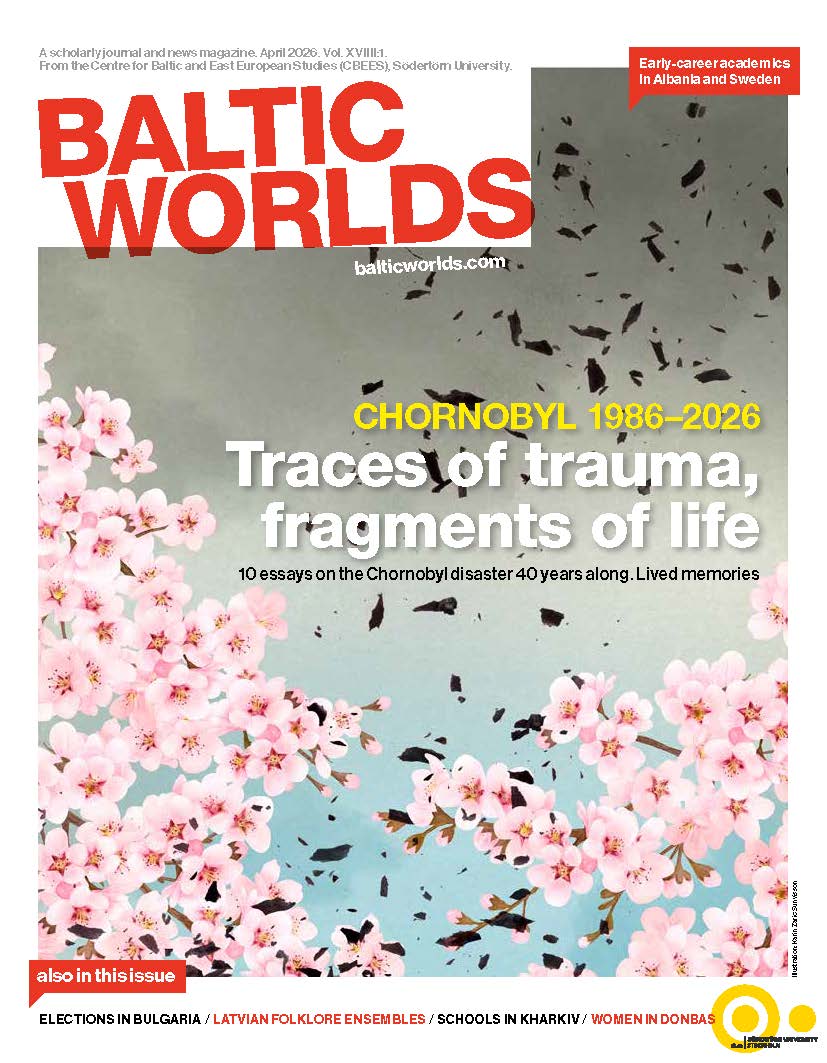 Issue 2026, 1:
 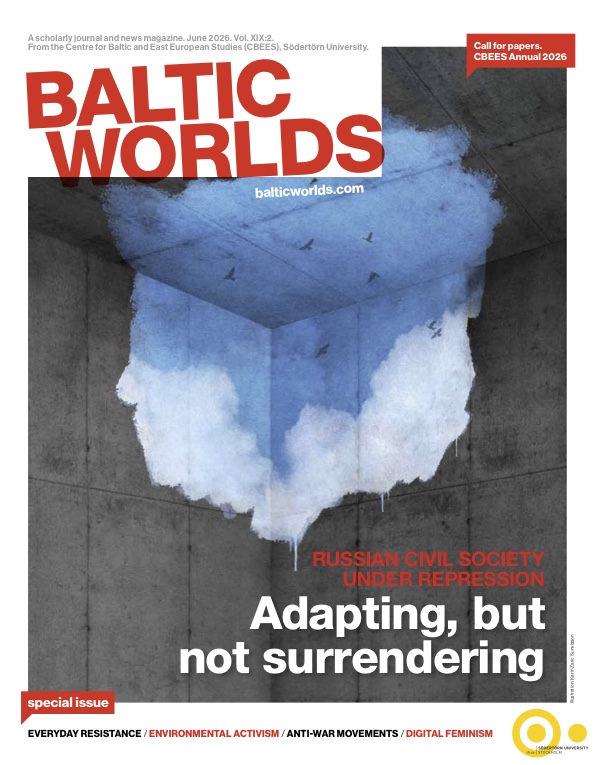 Issue 2026, 2:
  Baltic Worlds covers; the Baltic Sea Region, Eastern Europe, Russia, CentralAsia, Caucasus and the Balkan area.