12 articles tagged with university were found.
The repression in Belarus is targeting academia. Olga Shparaga is one of the co-founders of the European College of Liberal Arts in Minsk (ECLAB), and former lecturer at the European Humanities University (EHU), that was forcibly closed 2004 and moved into exile in Vilnius. In a conversation with Friedrich Cain, she describes how the Belarusian exile Academia, although persecuted even abroad, still works to educate Belarusian students and support teachers inside Belarus as well as in exile through various networks and strategies.
By
Friedrich ´ Cain
April 16, 2025
This article argues for the relevance of new materialist theories and onto-epistemologies in understanding the workings of political status. The issue of political status is interrogated at the confluence of the university’s status, the status of the Russian state through references to its “glorious” and “rich” history, and the materialities of the imperial cityscape of St. Petersburg. More specifically, I analyze how the spatio-temporal position of universities within the imperial cityscape of St. Petersburg plays out as a status-enhancing or undermining mechanism. The analysis in this article traverses three sites: St. Petersburg State University, St. Petersburg State Institute of Culture, and European University in St. Petersburg. The universities appear to be embedded within the imperial cityscape of St. Petersburg, which speaks to both the universities’ status and, more importantly, the idea of the state that lives in and through them, through the effects of beauty, glory, and rich history. However, while material durability allows the past to be actualized in the present, materialities are also subject to decay over time, leading to physical processes of deterioration and downgrading. This decay acts as a status undermining mechanism.
By
Iuliia Gataulina
April 16, 2025
In 2015, the Albanian government enacted a higher education reform accompanied by intense public disputes. This article employs the concept of hegemony to question: What political articulation became hegemonic in Albania’s higher education policy between 2010 and 2015, and what elements constituted such an articulation? It argues that the government’s articulation became hegemonic through its claim of establishing a regulated higher education market where all participants would compete as equals, thereby addressing all the challenges facing the sector that arose from the chaotic and tumultuous governance of the political opponent.
By
Pavjo Gjini
April 16, 2025
As the economic crisis in socialist Yugoslavia escalated in the late 1970s, the role of education, science, and technology in revitalizing self-management socialism and the economy became a hotly debated issue. Just as the number of universities more than doubled during the 1970s, they started to be criticized for producing unemployable graduates who burdened the economy instead of contributing to it, and for curtailing the upward social mobility of working-class youth. The paper examines the contemporary discussions of the economic purpose of higher education and presents “technocratic” and “anti-technocratic” positions in the debate which occasionally depicted the universities as responsible for the crisis, but also as potentially uniquely suited for resolving it– and thus reversing what many commentators saw as the country’s slide towards scientific, technological, and economic dependency and peripheralization.
By
Vedran Duančić
April 16, 2025
This special theme focuses on a regional context, whose academic history has so far been viewed primarily from a “Western” perspective. We argue, however, that the universities in the area that was supposed to be “integrated” after 1989 under the banner of Europeanisation have a history of their own. This history is shaped not only by different layers of imperial and national history, but above all by the shared experience of decades of socialist rule with its own ideas about the function of the university under socialism.
The authors of this special theme present case studies from different universities in the socialist countries of Central, Eastern, and Southeast Europe and their successor states. It aims to critically assess concepts and practices of “university” within the scientific systems of these (post-)socialist countries on the one hand, and the reciprocal effects that have occurred in the exchange with political or economic discourses on the other.
By
Friedrich Cain and Elisa Satjukow
April 16, 2025
The roundtable “Universities at War”, held in Vienna on September 27, 2023, provided a panorama of case studies analyzing how universities have been implicated and affected by wars and conflicts. The speakers reflected on the way academic communities have been affected and the role of European academic institutions as sites, agents, collaborators, resisters, and victims of military conflicts from the Second World War to Russia’s war against Ukraine.
By
Yuchen Li
April 23, 2024
The crucial matter of creating a Latvian “national” university in the aftermath of World War I may be seen as an example of the way this new nation was structured in both symbolic and practical terms. This academic institution provided an arena for rewriting the nation’s past history and recreating its folklore customs — both essential to Latvian culture.
By
Per Bolin
June 27, 2012
In order to ascend another rung on the development ladder, all three Baltic countries are engaged in higher education reform. Latvia has the furthest to go.
By
Påhl Ruin
June 27, 2012
Södertörn University, where Baltic Worlds is published, now has a chairman of the governing board, a Swedish former Social Democratic career politician, who grew up the Montenegro of Yugoslavia: Ilija Batljan. Here he is profiled in an interview
By
MarieLouise Samuelsson
June 14, 2012
If one wants to understand the arguments for institutional and ideological change propagated today, a closer study of the developments during the “long 19th century” is crucial, simply because this particular period in the history of higher learning continues to play a central role in the ongoing discussions on the future of the European university — Wilhelm Freiherr von Humboldt certainly casts a very long shadow.
Essay by
Thorsten Nybom
September 22, 2010

 Issue 2026, 1:
 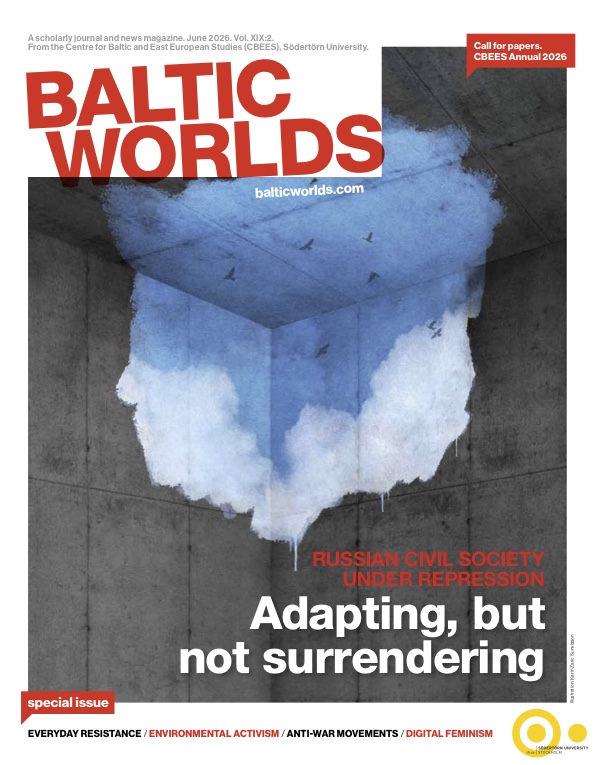 Issue 2026, 2:
  Baltic Worlds covers; the Baltic Sea Region, Eastern Europe, Russia, CentralAsia, Caucasus and the Balkan area.