
Download back issue of Baltic Worlds
 Issue 2026, 1: Download.
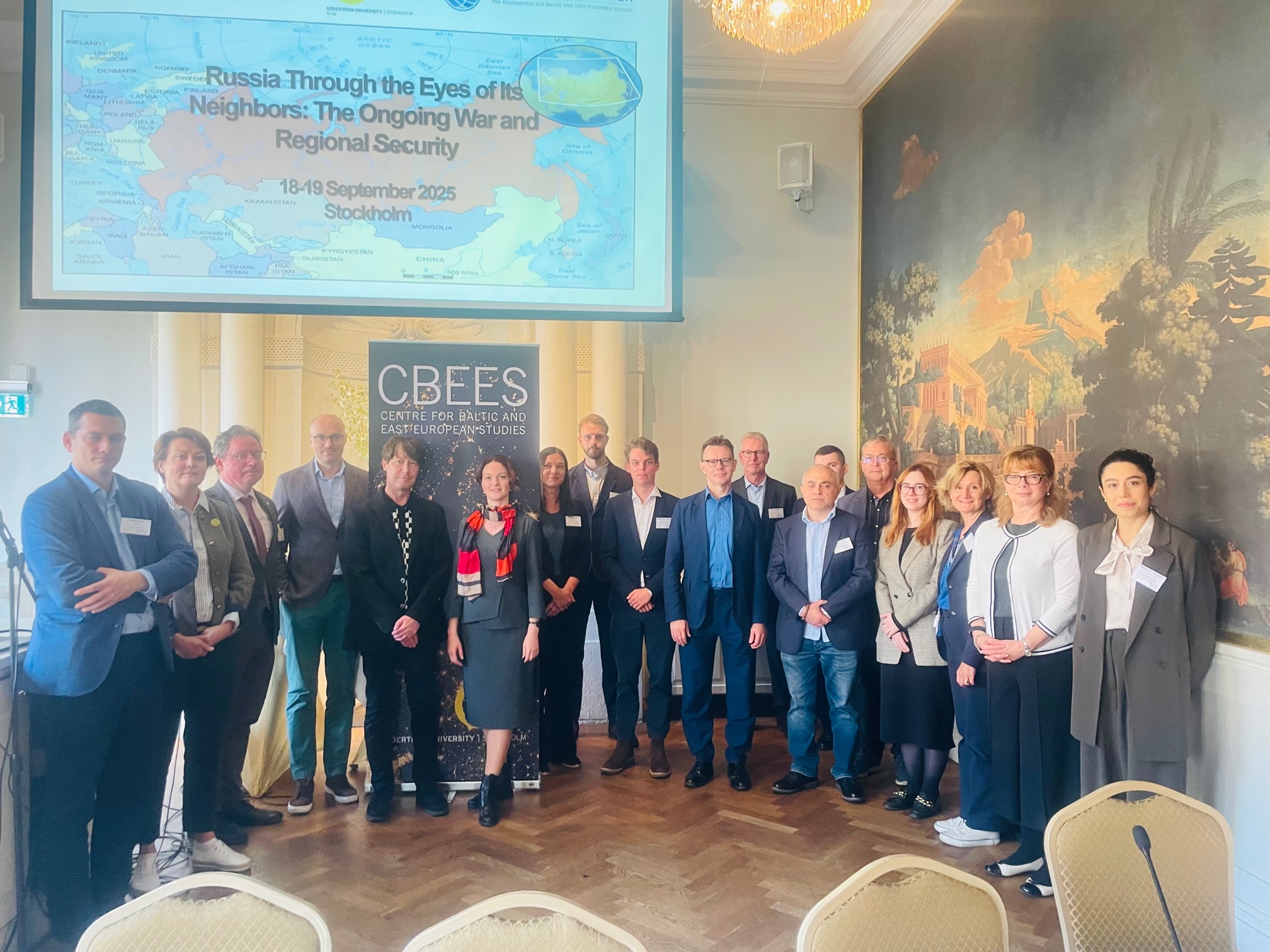
Conference reports Russia Through the Eyes of Its Neighbours: The Ongoing War and Regional Security
The international conference “Russia Through the Eyes of Its Neighbours: The Ongoing War and Regional Security” which was held in Stockholm on September 18–19, 2025, brought together leading scholars and policy experts from across Europe, providing a platform to assess how Russia’s ongoing war against Ukraine continues to reshape the geopolitical and security landscape of the region.
Published in the printed edition of Baltic Worlds BW 2025:4
Published on balticworlds.com on December 9, 2025


Post-Conference Report
The international conference “Russia Through the Eyes of Its Neighbours: The Ongoing War and Regional Security” which was held in Stockholm on September 18–19, 2025, brought together leading scholars and policy experts from across Europe, providing a platform to assess how Russia’s ongoing war against Ukraine continues to reshape the geopolitical and security landscape of the region. Traditionally, discussions on European security have been dominated by analyses of Russia’s intentions, capabilities, and strategic behaviour. This conference, however, highlighted a crucial shift in perspective: rather than viewing Russia solely as the driver of regional dynamics, the focus turned to how its neighbours are actively responding, adapting, and reshaping the strategic environment.
This neighbour-centred lens underscores that the states bordering Russia are not passive recipients of security shocks. Finland and Sweden’s NATO accession as well as Ukraine’s and Moldova’s accelerated integration with European institutions illustrate a spectrum of strategic agency of these states.
Overall, the sixteen countries bordering Russia can be analytically grouped into three broad clusters. The first cluster consists of states closely aligned with Russia, maintaining political, economic, or military ties that reflect friendship or dependency. The second cluster includes adversarial states, which actively counterbalance Russian influence through integration with Western security structures, reform-driven partnerships, or strong political opposition. The third cluster comprises states that adopt a cautious, hedging strategy, seeking to preserve autonomy and avoid direct confrontation while managing the risks of proximity to Russia. This typology highlights both the differentiated strategies neighbouring states adopt and the varying degrees of agency they exercise in response to Russian pressure.
These responses reveal both the vulnerabilities imposed by Russia’s aggression and the adaptive capacities that neighbouring states are cultivating. In essence, the war has served as a catalyst for changes in Russia’s neighbours, as it forces these countries to reassess alliances, diversify partnerships, and build their societal, economic, and military resilience.
Thus, the conference demonstrated that understanding the war’s impact requires moving beyond a Russia-centred paradigm to a relational analysis of the region. The agency of neighbouring states is evident across multiple dimensions: defence strategies and regional security architectures, economic adaptation under sanctions and energy pressures, the shaping of public narratives and societal cohesion, and long-term strategic planning for post-war futures. By shifting the analytical lens to neighbours’ perspectives, the discussions offered a more nuanced understanding of regional security, one in which democratic resilience is the primary determinant of future stability.
A Watershed in European Security
The conference opened with a keynote address by Dr. Nigel Gould-Davies, Senior Fellow for Russia and Eurasia at the International Institute for Strategic Studies and former UK Ambassador to Belarus, who set the tone for the discussions by emphasizing that Russia’s full-scale invasion of Ukraine marks not only a watershed in European security but also a deeper crisis within Russia’s own political order. He described the war as both a continuation of Moscow’s imperial legacy and a manifestation of its systemic decline. Dr. Gould-Davies highlighted that the trajectory of the war and the nature of any eventual settlement will shape Europe’s security architecture for decades to come. The war, he noted, has paradoxically united the West while isolating Russia from many of its neighbours, revealing that authoritarian resilience often masks systemic weakness. Dr. Gould-Davies underlined the importance of upholding European unity and investing in effective deterrence to foster sustainable peace.
Foreign and security policies
The four thematic panels that followed developed these insights along complementary directions, examining how Russia’s aggression against Ukraine has reshaped the foreign and security policies, economic trajectories, and societal resilience of its neighbours.
The first panel, chaired by Professor Mark Bassin (Södertörn University and Uppsala University), explored Security Dynamics and Foreign Policy Responses to the War in Ukraine. It highlighted how the invasion has triggered an unprecedented reconfiguration of defence policies and alliances across Europe’s northern and eastern peripheries. Dr. Anna Wieslander (the Atlantic Council) demonstrated how the Nordic and Baltic countries have moved from being a “security frontier” to becoming an integrated part of NATO’s strategic backbone. The accession of Finland and Sweden, she noted, has closed the Baltic Sea gap, transforming the region into a cohesive security zone characterized by shared deterrence planning, civil preparedness, and digital defence.
From a different angle, Dr. Ryhor Nizhnikau (the Finnish Institute of International Affairs) examined how Moldova, Ukraine, and Belarus have experienced Russia’s neighbourhood policy as a continuum of coercion rather than cooperation. He argued that Belarus now stands as the most extreme case of external political capture in the post-Soviet space – nominally sovereign but functionally absorbed into Russia’s security and military structure.
Dr. Nurlan Aliyev from the College of Europe added a broader Eurasian perspective, showing that in the South Caucasus and Central Asia, Russia’s weakening power projection has encouraged strategic diversification. Countries such as Kazakhstan and Armenia, while not severing ties with Moscow, are pursuing cautious multi-vector diplomacy and expanding relations with the EU, China, and regional neighbours. Finally, Dr. Edward Howell of the University of Oxford and Chatham House illuminated how Russia’s partnerships with China and North Korea, often portrayed as an anti-Western bloc, are in fact rooted in pragmatic transactionalism rather than genuine strategic alignment.
Dr. Edward Howell (University of Oxford and Chatham House):
Current dynamics among North Korea, Russia, and China evoke the triangular patterns of the Cold War, yet the configuration that has emerged by 2025 differs fundamentally in structure and intent. Relations among the three states evolved unevenly after the Cold War, particularly following the establishment of diplomatic ties between Moscow and Seoul in 1990 and Beijing and Seoul in 1992. These shifts introduced long-lasting asymmetries that continue to shape contemporary strategic interactions.
A significant turning point occurred with the 2012 announcement of a decision to cancel 90 percent of North Korea’s Soviet-era debt, a process completed in 2014. This development contributed to a notable increase in Russia–DPRK engagement. Subsequent years saw Russia and China play key roles in enabling North Korea to circumvent UN sanctions—including those under UNSC Resolution 2397—through practices such as maintaining overseas North Korean labour and facilitating ship-to-ship and port-to-port transfers of oil, petroleum products, and coal.
Russia’s invasion of Ukraine on 24 February 2022 accelerated these trends markedly. What began as a transactional exchange of munitions for financial resources expanded rapidly, especially after the signing of the comprehensive strategic partnership treaty on 19 June 2024. The relationship has become multi-sectoral, with security cooperation now representing a central component. Particular concern surrounds the opaque transfer of missile and military technologies to the DPRK—assistance that is highly sought by Pyongyang and remains poorly understood.
Rhetorical shifts further illustrate the deepening relationship, with Russian officials increasingly framing the bilateral connection as an “alliance” rather than a partnership.
Within this context, China’s role appears cautious yet pivotal. Public statements from Beijing present Russia–DPRK ties as a bilateral matter, while China simultaneously supports Russia’s war effort through the supply of dual-use technologies and significant purchases of Russian energy. China also remains central to North Korea’s sanctions-evasion mechanisms, including covert transfers of crude oil, petroleum products, and coal, as well as the docking of sanctioned Russian cargo vessels involved in munitions transfers.
These patterns collectively suggest the emergence of a loose configuration—sometimes referred to as “CRINK”—that exploits fractures within the post-1945 international order, undermining aspects of it without attempting an outright replacement. This behaviour contributes to broader discussions about a developing “alternative global order.”
Over the long term, China retains a dominant position in North Korea’s external relations due to its economic capacity and its longstanding role as Pyongyang’s principal trading partner. Nevertheless, Russia’s financial, technological, and ideological support is expected to continue in the short to medium term, even following a conclusion to the war in Ukraine, though the form and intensity of that support may evolve.
The key takeaway from this panel discussion was that Russia’s neighbours are no longer passive recipients of security shocks but active agents reshaping the regional order. NATO’s northern enlargement and the rise of regional defence cooperation reflect not only a response to Russian aggression but also a broader transformation of European strategic culture; from complacency to resilience. The notion of “resilience” itself emerged as a guiding concept: security is increasingly understood as the ability of states and societies to adapt, absorb, and recover, not merely deter.
Strategic realignments
The second panel, chaired by Professor Claes Levinsson (Uppsala University), examined the Domestic Repercussions and Strategic Realignments that have followed the war. The focus here shifted from military security to the economic and political dimensions of adaptation. Dr. Henrik Wachtmeister from Uppsala University and the Swedish Institute of International Affairs described the “energy war” between Europe and Russia as both a rupture and a redefinition of interdependence. While the EU’s decoupling from Russian hydrocarbons was remarkably rapid, he warned that Europe remains exposed to market volatility and partial dependency through LNG and indirect imports. The energy transition, in his assessment, is as much a geopolitical project as an environmental one.
Dr. Henrik Wachtmeister (Uppsala University and the Swedish Institute of International Affairs):
The ongoing energy confrontation between Europe and Russia continues to unfold across two main arenas: the European natural gas market and the global oil market. Each theatre has developed with distinct dynamics, producing a complex set of outcomes that make it difficult to identify a definitive winner at this stage.
In the gas sector, Russia moved first and took the offensive by sharply reducing pipeline exports to Europe. European responses remained defensive, as no outright EU import ban was introduced, and certain member states—most notably Hungary and Slovakia—continued receiving Russian pipeline gas while the EU as a whole sustained imports of Russian LNG.
European decision-makers approached the gas crisis through a clear cost–benefit lens. Cutting off Russian gas was assessed as inflicting more economic and political harm on Europe than on Russia. A similar calculation appears to have guided Moscow when it opted to curtail exports. Yet the impact of Russian cuts proved smaller than initially feared. Europe avoided recession, and political unity held more firmly than expected—an outcome that may have weakened Russia’s leverage.
In contrast, the oil sector saw Europe take the offensive. Despite earlier threats, Russia never unilaterally cut oil exports, whereas the EU and G7 introduced two major sanctions in December 2022: an embargo on seaborne imports of Russian oil and a global price cap on Russian crude.
Russia responded with several countermeasures, including the use of a “shadow fleet” of tankers to evade restrictions, falsified documentation to circumvent the price cap, and the cultivation of alternative buyers, chiefly China and India but also Turkey and others. Europe and the G7 countered these efforts through targeted sanctions on individual tankers and companies, stricter verification of shipping paperwork, and—most consequentially—U.S. secondary sanctions on buyers, including pressure on India and signals directed toward China.
As in the gas sector, the EU and G7 aimed to minimise self-harm. A full transport embargo was judged too risky, as it would have reduced Russia’s export volumes and driven up global oil prices. The price cap created a middle path: it maintained global supply while lowering Russia’s revenue. Current estimates indicate that Russian crude continues to sell at a discount—around 15–20 percent for Urals and 5–10 percent for ESPO—while export volumes remain largely constant. Income, though reduced, therefore remains substantial.
Sanctions enforcement has become a continual “whack-a-mole” exercise as authorities attempt to keep pace with evolving Russian circumvention tactics. Additional tanker sanctions could increase pressure. The price cap also retains the potential to evolve into a full transport embargo—an approach that could have even greater impact if combined with the ongoing Ukrainian drone campaign against Russian infrastructure.
The outcome of the energy war remains inconclusive. Europe has performed better than expected in its defensive posture, helped in part by favourable weather conditions, and has chosen an offensive strategy designed to limit costs to itself. Russia’s initial offensive in gas proved weaker than anticipated, but its overall defence and economic resilience—especially in the oil sector—have been stronger than many forecasts suggested.
Europe plans to fully eliminate the remaining Russian energy imports—LNG, some pipeline gas, and oil—by 2027. Further strengthening of sanctions remains on the table, including the possibility of a full transport embargo. Additional measures may involve promoting domestic energy production, increasing supply from partner countries, accelerating non-fossil energy deployment, and reducing overall consumption.
However, several risks and strategic dilemmas lie ahead. A more aggressive U.S. stance through secondary sanctions could trigger trade tensions with China and India. Europe’s shift away from Russian supply may lead to new dependencies—notably increased reliance on the United States for LNG and oil, and deeper reliance on China for green technologies essential to the energy transition. Meanwhile, environmental risks associated with the shadow fleet—poorly regulated, ageing vessels operating outside standard oversight—pose a growing concern.
In sum, while both sides have experienced setbacks and gains, the energy confrontation is far from resolved. Outcomes will hinge on future sanctions, geopolitical alignments, market responses, and Europe’s ability to transform its energy systems in the years ahead.
Dr. Karina Shyrokykh of Stockholm University offered an insightful analysis of Ukraine’s wartime European integration. She emphasized that the war has paradoxically strengthened the EU’s transformative power by turning accession into a security imperative. Ukraine’s reforms in transparency, digitalization, and governance, she argued, demonstrate how existential threat can catalyse institutional innovation. Dr. Dzmitry Kruk of BEROC presented a contrasting case: Belarus’s economic adaptation under sanctions. His analysis showed how Minsk’s survival strategy anchored in Russian subsidies and re-export schemes has deepened structural dependency and eroded long-term competitiveness. What appears as short-term stabilization, he concluded, is in fact a process of strategic subordination of Belarus to Russia.
This panel illuminated the asymmetric trajectories of adaptation among various post-Soviet states. Ukraine’s transformation and Belarus’s stagnation are two sides of the same coin: one driven by integration and reform, the other by coercion and isolation. For the EU, the implications are clear – economic policy, sanctions, and democracy promotion must be aligned within a single strategic framework rather than treated as separate instruments.
Narratives and identities
The third panel, chaired by Dr. Ekaterina Kalinina of Stockholm University, addressed Narratives, Media, and Identity in Times of War. Here the discussion turned to the contest over meaning and legitimacy that accompanies the military confrontation. Professor Bo Petersson, Director of RUCARR at Malmö University, presented a paper “The End of the Collective West? The Russian Master Myth and the US Reorientation on the Russo-Ukraine War”. Petersson explored the enduring role of political myth as an “important story” that shapes perception and mobilizes societies. Drawing on theoretical frameworks by Boer, Bouchard, Chloup, and Barthes, he argued that Russia’s master narrative – a portrayal of the country as a historically ordained great power, perpetually under threat from a hostile West – functions less as ideology and more as emotive, culturally taken-for-granted knowledge. Its efficacy lies not in truth but in its ability to legitimize Kremlin actions and mobilize popular support. The narrative’s power comes from its drama and emotional resonance, framing Russia’s foreign policy and justifying the war against Ukraine as part of a larger civilizational struggle, irrespective of factual accuracy.
Petersson emphasized the specific concept developed and used by Russia of the “Collective West”, to refer to the United States, the European Union, and NATO. In Kremlin discourse, the Collective West is led by the US and subordinated to its interests, carrying connotations of aspirations for world hegemony and conspiratorial designs against Russia. He highlighted how the “master myth” functions as a tool for legitimacy, mobilization, and meaning-making, demonstrating that in contemporary Russian statecraft, emotive narratives can have as much impact as conventional power instruments.
Dr. Yuliya Yurchuk (Södertörn University) analysed how Ukraine has mobilized memory politics as a tool of resistance. By redefining historical narratives, particularly those related to the Soviet period, Ukraine has transformed remembrance into a form of security, strengthening social cohesion in the face of aggression. Dr. Margarita Zavadskaya from the Finnish Institute of International Affairs examined how disinformation and censorship in Russia have produced not only polarization but also fatigue and disengagement, highlighting the limits of authoritarian control. Wicke van den Broek(Maastricht University) discussed the EU’s democracy promotion toward Belarus and identified a pattern of “bad learning”, where short-term normalization overshadowed long-term support for democratic transformation. He argued for a more strategic approach that prioritizes the resilience of civil society and exiled democratic actors.
Wicke van den Broek (Maastricht University):
In 2020, Belarus experienced the largest public mobilisation in its history, with hundreds of thousands of citizens protesting nationwide against another rigged election and demanding the release of political prisoners and free and fair elections. These demonstrations were brutally suppressed by the regime’s security forces, while support from Russia has since propped up the regime with loans, propaganda and secret services. Although some political prisoners have recently been released, repression and human rights abuses persist. People continue to face prosecution, job loss, and detention for their online activity, while many are tried in absentia in politically motivated trials reminiscent of the Soviet era.
This, combined with the hijacking of a Ryanair plane in 2021 and the regime’s participation in Russia’s full-scale invasion of Ukraine in 2022, forced the EU to rethink its policy of engagement and rapprochement with Belarus. The EU has redirected funds that were once allocated to Belarusian local and regional authorities toward urgent humanitarian needs and medium-term support for citizens, civil society, and democratic movements. In doing so, it strengthens its ties with the Belarusian “alternative.” A key example of this is the establishment of a Consultative Group, which serves as a high-level platform for dialogue between EU representatives and Belarusian democratic forces and civil society. It has managed to incorporate a diverse range of Belarusian democratic actors in its democracy support, and channelled this support not only through technical means, but also through political and vocal support.
Based on the conducted interviews and desk research, it can be seen that the EU has moved from a depoliticised, technical democracy promotion policy (2015-2019) to a more, but not fully, politicised democracy promotion policy, with explicit political goals. This shift does not necessarily come from the initiative of the EU itself. Rather, external events, such as the 2020 protests, subsequent repression, and the 2022 full-scale invasion of Ukraine, forced the EU to change its approach. Furthermore, the ‘where’ of EU democracy promotion has changed significantly.
First and foremost, the internal dimension inside Belarus, prevents technical or developmental assistance, as it is no longer possible to transfer money to schools, local governments, or to openly support NGOs that have been declared ‘extremist’ or have been outright banned. Further, the external dimension, in which the Belarusian democratic actors are active from the EU and its member states, combined with increased agency from the Belarusian themselves, facilitates a more political approach. Finally, external factors make previously technical or development models into de facto politics: as speaking Belarusian, reading certain literature, advocating for basic human rights, or simply being active in local initiatives becomes a political act of resistance, any support by the EU – also following this developmental model – becomes a more political democracy promotion policy.
Combined with the geopolitical aspects of the region, in which Belarus is an often overlooked player between Russia, Ukraine and the EU, support that makes democratic changes possible, either in the short or medium-long term, becomes part of the Common Foreign and Security Policy, as these measures go directly against the interests of the regime in Minsk, and thus work to oppose an expansionist Russia both vis-à-vis Ukraine but also Belarus and the Baltic states. However, within the external dimension, there is a continuous hesitation on the part of the EU and member states: cooperation with and support for the pro-democracy forces of Belarus is possible, but so far remains confined to the narrower, and more a-political space of NGOs. Rather than outright political backing of certain political forces or movements, support is channelled through formats as the EaP CSF, Belarusian diaspora organisations, cultural initiatives and functional cooperation on certain policy fields such as human rights, media freedom or political prisoners. While these are vital for the continued momentum towards a democratic Belarus and in fact to the survival of Belarusian culture, sovereignty and language, there remains a certain discrepancy between the realities on the ground – the internal dimension – and the way democracy promotion policies are organised within the territory of the EU. In conclusion, Belarus remains a compelling case for democracy promotion by the EU in the Eastern neighbourhood, and pressure on the regime both helps counter Russia’s full-scale war against Ukraine and raises the prospects of democratic change within Belarus.
Overall, the discussions during the third panel underscored that narratives and identities are not peripheral to security – they are constitutive of it. Control over information, historical memory, and public discourse directly shapes the capacity of societies to mobilize and endure.
Post-war futures?
The fourth panel, chaired by Professor Johan Eriksson (Södertörn University), looked to the future under the theme Regional Stability, Risk, and Post-War Futures. Dr. Carolina Vendil Pallin, Deputy Research Director at the Swedish Defence Research Agency, analysed Russia’s internal trajectory and concluded that the regime’s stability rests on increasingly brittle foundations. She warned that even if the war ends, the militarization of politics and the erosion of institutions are likely to persist, potentially leading to renewed aggression or domestic implosion.
Dr. Carolina Vendil Pallin (Swedish Defence Research Agency):
Understanding Russia’s future trajectory is essential for assessing regional stability in Europe and Eurasia. Since 2022, the Russian state has undergone rapid and profound transformations that will shape its behaviour long after the war in Ukraine ends. These changes have reinforced long-standing imperial ambitions while creating new political, economic, and security “lock-ins” that limit Russia’s ability—or willingness—to reform.
Russia’s strategic orientation continues to be informed by a neo-imperial worldview in which control over neighbouring states is framed as a historical right and a security necessity. The war in Ukraine has intensified these ambitions, normalising expansionist rhetoric and embedding it into official doctrine and public discourse. The result is a trajectory in which even a post-war Russia is likely to remain revisionist, centralised, and aggressive unless major internal change occurs.
A series of interconnected domestic shifts have consolidated the regime’s power and reduced societal pluralism:
Repression, surveillance, and control: since the invasion, legal and institutional tools for suppressing dissent have expanded dramatically. The state has criminalised criticism of the war, broadened definitions of “extremism,” and strengthened security services’ authority. Everyday life is increasingly monitored, creating an atmosphere of pervasive fear.
Propaganda and the “internet gulag”: the information space has been re-engineered to block independent sources and amplify state narratives. Restrictions on Western platforms, growing use of digital censorship technologies, and the threat of prosecution for online activity have turned the Russian internet into a curated, punitive environment.
Militarisation of society and education: Military-patriotic education, revised school curricula, and youth organisations tied to the state promote loyalty and prepare the population—especially young people—for a society permanently oriented toward conflict. War veterans and paramilitary groups also play a growing political and social role.
Isolation from the West: Diplomatic, economic, and cultural isolation has become both a necessity and a political tool. The regime frames separation from Europe as a civilisational choice, encouraging a pivot toward Asia while demonising Western influence.
A militarised economy: Wartime production has reshaped industrial policy and budget priorities. Defence spending dominates national planning and will remain difficult to reverse, creating structural dependence on military demand and state subsidies.
Russia’s policy direction is codified in a range of strategic documents and constitutional changes, which collectively outline a long-term commitment to confrontation with the West and centralised control at home. Russian law requires periodic updates of national strategies, but these documents increasingly serve ideological purposes, reinforcing the president’s worldview rather than offering pragmatic policy guidance.
National Security Strategy (2021) and Foreign Policy Concept (2023): These texts frame Russia as a besieged civilisation threatened by Western interference. They justify aggressive foreign policy, strategic autonomy, and tighter internal control.
Presidential Annual Addresses to Parliament (2023, 2024): The addresses emphasise sovereignty, military strength, and the need to sustain wartime mobilisation. They also frame the war in Ukraine as existential, preparing the population for a long-term confrontation.Constitutional changes (2020, 2022): Revisions have strengthened presidential power, entrenched conservative values, and asserted territorial claims. They also make retreat from certain political positions—such as claims over Ukrainian territory—more politically costly.
Possible Post-War Trajectories
The nature of the war’s end will shape Russia’s internal and external behaviour, though certain dynamics will persist regardless of the outcome. Potential trajectories include:
- Ceasefire without political transformation: Russia retains some gains, freezes the conflict, and continues rearmament and repression. Stability remains fragile.
2. Russian control of all Ukraine: A scenario likely to embolden further aggression, normalise militarised governance, and deepen authoritarian consolidation.
3. Russia left with only Donbas while Ukraine remains militarily strong: Russia would claim victory domestically but face long-term insecurity, sustaining hostility and militarisation.- Russian implosion or major internal crisis: State breakdown could lead to fragmentation or violent power struggles, posing severe regional security risks.Hard-to-Change Structural Realities
Regardless of how the war ends, several deep lock-ins make meaningful reform unlikely in the near term:
Neo-imperial hangover and national identity: Historical narratives portraying Russia as a great power with a mission to dominate its neighbourhood remain central to state ideology and collective identity.
Economic lock-in: The war economy, sanctions, and structural inefficiencies reinforce dependency on the state and limit diversification. Reversing militarisation would come at high political and economic cost.
Repression: Once expanded, repressive institutions—security services, surveillance systems, and political control mechanisms—are difficult to dismantle.
Technological backwardness and dependence on China: Isolation from Western technologies pushes Russia into an asymmetric partnership with China, limiting autonomy and future development.
Bloated armed forces and entrenched militarisation: Enlarged military structures, paramilitary organisations, and internal security forces now play central roles in the political order. Demobilising or reforming them would be destabilising.
Professor Elena Korosteleva from the University of Warwick expanded the scope to Eurasia, describing the region as “Putin-led but misled”. She observed that Russia’s declining influence is enabling new forms of agency among Central Asian states, particularly Kazakhstan, which are pursuing diversification strategies and asserting diplomatic independence. Professor Kataryna Wolczuk of the University of Birmingham and Chatham House discussed how EU enlargement has re-emerged as a strategic tool of security policy. She argued that Ukraine’s and Moldova’s candidacies mark a turning point, but that the EU must reform internally to sustain credibility. Professor Matthew Kott (Uppsala University) concluded the discussion by emphasizing the growing importance of the Baltic and Nordic regions as laboratories for European resilience; spaces where security, democracy, and sustainability intersect.
Taken together, the final discussions revealed a Europe that is redefining itself not only in opposition to Russia but through new patterns of integration and regionalism. The notion of a “post-war Europe” is increasingly understood as one where democratic reconstruction, defence cooperation, and sustainable development are inseparable.
Concluding Remarks: Towards a New Perspective
Across all panels, several themes stood out. First, Russia’s regional dominance has eroded irreversibly, giving rise to a multipolar neighbourhood in which small and medium-sized states exert growing agency. Second, resilience (whether military, economic, or informational) has become the central organizing principle of the new European order. Third, the battle for narratives has become as consequential as the battle for territory: the legitimacy of political systems now depends on their ability to generate credible and inclusive identities. Finally, the discussions repeatedly returned to the question of how the EU can translate these transformations into coherent strategy. Enlargement, sanctions, and democracy support must be treated as elements of a single geopolitical agenda, not parallel policies.
The Stockholm conference thus highlighted not only the depth of the transformations set in motion by Russia’s war but also the emergence of a new strategic consensus among its neighbours: that Europe’s security is inseparable from democracy’s survival. The challenge ahead lies in operationalizing this understanding, translating scholarly insight into policy that strengthens both deterrence and democratic resilience.
In this sense, “seeing Russia through the eyes of its neighbours” proved more than a metaphor; it was a reorientation of perspective. It showed that the future of regional stability will depend not only on Russia’s choices but more on how its neighbours, and Europe as a whole, choose to reimagine and rebuild their shared security architecture.