Lectures are former public presentations that have been reworked for publishing in print.
Why is it so easy to remember war and so hard to remember peace? In order to bring forth memories of peace we need to reconceptualize what we mean by peace. I propose the term wild peace as a conceptual and potentially radical move that engage our imagination and capture the lived, embodied and agential dimensions of peace. Memories of wild peace are unruly as they hold the power to unsettle hegemonic narratives and point to alternative futures. I argue that unruly memories of wild peace are important at the present time, when the very idea of peace is contested and undermined.
By
Johanna Mannergren
March 7, 2026
Since the country’s civil war, which began with rival protests in the center of the capital city Dushanbe turning violent in May 1992, protests have been relatively rare in Tajikistan as the government of Emomali Rahmon has consolidated its control. Yet protests erupted across Tajikistan in late September 2016.
By
Edward Lemon
August 23, 2023
This paper is based on two arguments: First, “grim storytelling” only gives access to part of the story and therefore needs to be supplemented with “better stories” — stories that generate an understanding of human potentiality, creativity, resilience, interconnectedness and shared “vulnerability”. Second, the tendency towards “grim storytelling” in critical social sciences constitutes a major limitation for the possibilities of imagining and enacting the very transformations that Europe most urgently needs in order to enhance the European project.
By
Andrea Petö
June 20, 2023
When looking at transitions from imperial to post-imperial rule, scholars have tended to look either at ruptures or at direct continuities of structures, laws, relationships, etc. I want to suggest a different approach. I believe we need to study more closely how political projects of a hugely different nature interact with one another across the divide of state collapse — and how this dynamic interaction raises expectations across long stretches of time. With a focus on East Central Europe, I would therefore like to present a specific, hopefully original narrative, but I also want to propose a research agenda.
By
Klaus Richter
January 23, 2022
Conversation with Slavenka Drakulić, Croatia; Samirah Kenawi, Germany; Tamara Hundorova, Ukraine; Ewa Kulik-Bielińska, Poland; and Olga Lipovskaia, Russia.
By
Witness Seminar
February 27, 2020
More than anything else, the avant-garde is the area of the production of the past: the colossal amounts of memoirs, artefacts, and photographs that are accumulated in archives — in different kinds of archives, including personal ones, but also state archives, and many others of different kinds.
By
Mikhail Iampolski
December 30, 2019
Policy-making is an applied process. We can ask: towards what end or goal are policy-makers striving? At present, as far as domestic and increasingly foreign policy-making in Russia are concerned, an important policy direction can be described with reference to development.
By
Marina Khmelnitskaya
October 25, 2016
The escalation around Ukraine calls for a larger historical re-assessment of social change in Eastern Europe – and indeed of the European project at large. The current moment of historical re-assessment requires a full-fledged competitor to liberal theory.
By
Don Kalb
November 19, 2015
Whatever might be said of pop art techniques and art-historical discourses used in Hungary, and later in Estonia, (and less frequently in other countries), one would be hard-pressed to say that the 1960s was an era of pop in the region, especially one with North American influences. Why then?
By
Piotr Piotrowski
November 19, 2015
Communism has failed, not only on political and economic, but especially on moral grounds, the author claims; "Every communist state was a far cry from the paradise the doctrine proposed.".
By
Edward Kanterian
January 21, 2015

 Issue 2026, 1:
 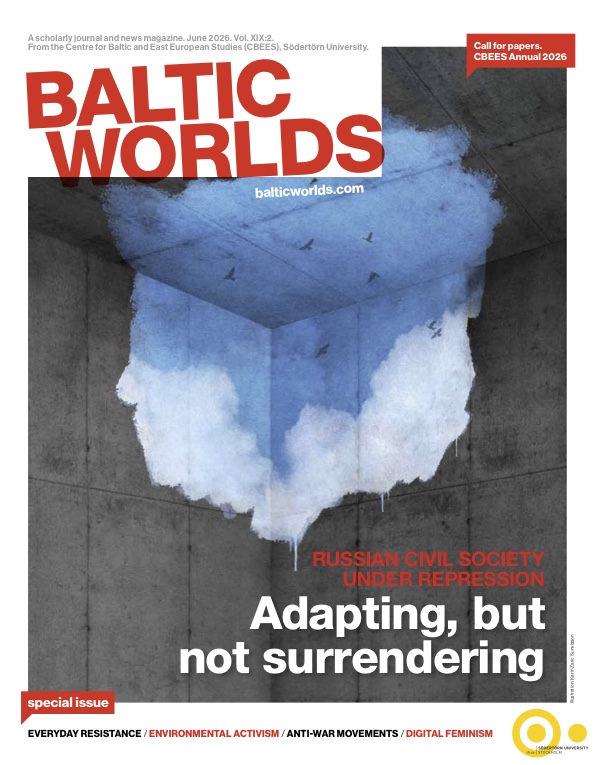 Issue 2026, 2:
  Baltic Worlds covers; the Baltic Sea Region, Eastern Europe, Russia, CentralAsia, Caucasus and the Balkan area.