
Download back issue of Baltic Worlds
 Issue 2026, 3-4: Download.
Reviews A big little book on Donbas. A memory book for the multicultural Ukraine
Life in Spite of Everything: Tales from the Ukrainian East, Victoria Donovan (London: Daunt Books, 2025), 273 pages.
Published in the printed edition of Baltic Worlds BW 2026 vol. 19 no. 3-4, pages 100-101
Published on balticworlds.com on November 6, 2026


Life in Spite of Everything: Tales from the Ukrainian East, Victoria Donovan (London: Daunt Books, 2025), 273 pages.
ictoria Donovan (University of St Andrews) started traveling to Donbas and collecting material for her research in the Ukrainian east in 2019, drawn largely by the parallels she found there with her original home region of Wales. Since the Russian full-scale attack on Ukraine in February 2022, this research work has been on hold. As the writer says in the preface of her new book, “the anger and sadness has poured over onto the pages of my writing […], the only story that I am able to write”. The result is probably the best book anyone could read right now on the often misunderstood and purposefully misinterpreted Ukrainian east.
Unlike in the common understanding, Donbas actually has a long industrial and mining history. It was salt that first attracted both people and governments to the Ukrainian east, where besides chalk materials such as flint, gypsum, limestone, and coal have all also been utilized for centuries. They are still there, as Donovan describes in a separate chapter on minerals, geology, and nature in Donbas. The region was originally called “Dike pole” [wild fields], but it was multiethnic rather than empty, populated among others by Tatars and Cossacks — once headquarters of the Zaporozhian Cossacks, is not far away. Following Catherine II’s reign, it belonged to the border zone that defended the expansive Russian Empire against Turkic peoples.
THE MINING INDUSTRY was launched in Donbas in the mid-19th century, utilizing Belgian capital and British-Welsh know-how. Donovan links this with colonialism — the British empire covered almost half the world at that time, Belgium had its Congo, and Russian Empire was expanding into Central Asia. Mining experts and workers were exported from Wales to Donbas, and in Belgium the region was occasionally called the tenth Belgian province. This international link persisted until the Russian revolution, and some Welsh influence can still be found with a discerning eye. Donovan also points out the parallels between the British colonization of Wales and the Russification of Donbas. The center of the mining industry was dubbed Hughesovka by a Welsh ironmaster named John Hughes, who founded the New Russia Company in 1869 — today, the city is called Donetsk. By 1910, Ekaterinoslav province, including Hughesovka, produced over half of the coal and iron ore output in all of Russia. Donovan defines early mining activity in the region as both colonialist and extractivist, based on the exploitation of workers and resources alike. She sees a parallel here with practices in British and French plantations, and with British mines in India.
Donbas has suffered massively in the civil war, although the local population has, according to the writer, largely attempted to stay out of conflicts. For instance, Konstiantiynivka changed hands 27 times within a period of months in 1919, and the region was by described as a cemetery of miners and steelworkers — today, Konstiantynivka is again on the frontline. In Soviet times, Donbas was packed with largely made-up mythology, including the national legend Aleksei Stakhanov’s well-known story. Donovan coolly describes it as “the literal smiling face of the Stalin-era terror” and reminds us that the “Shakhty affair”, in which 53 mining engineers and directors were murdered shortly before Stalin’s death, also took place in Donbas. Stakhanov survived the purges. In 1957, during the thaw, he moved back to Donbas, where he spent the last period of his life drinking, like many of his disillusioned compatriots.
THERE ARE MANY local heroes who still enjoy high popularity today, such as Makar Mazai and Volodymyr Boiko in Mariupol. Donovan has a keen eye for local and regional specifics and shows respect to the industrial heritage of eastern Ukraine, with all its environmental and other problems — to life as it was lived and experienced locally up until February 2022. Those working for decommunization (a process very much in progress in Ukraine, where remnants of Soviet life are often considered “historical trash” and accordingly gotten rid of ) should keep in mind that culture is not only to be found in museums, concert halls, and architectural treasures but also in urban infrastructure, with the region’s hill-like slag heaps and factories forming “part of what it means to be from and to belong to this place”, as Donovan states. She describes the process of transition in independent Ukraine without mercy:
Those particles that descend to your lungs were part of the most recent chapter in this history that saw market transition turn to market theft and made billionaires of business-savvy swindlers.
In order to give a more complex view of Donbas’s industries, I want to mention here Artemivsk with its famous champagne factory, which is also recalled by Donovan. Unlike most factories, it used the traditional method (méthode champenoise) in its production; the grapes were from Crimea. The city was renamed Bakhmut in 2016, and the ongoing war made it world-famous. No champagne is produced there now, and in practice the city no longer exists.
The writer traveled extensively in Ukraine-governed Donbas, visiting the towns and localities now in the front zone, razed to the ground by the war and sometimes occupied by the
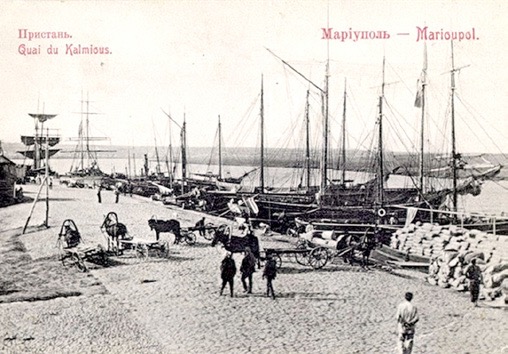
Russian army. As her Ukrainian friends said: “All the places that we saw, are gone now. Victoria had an exclusive tour.” Donovan describes an activist who meets others from Ukraine, often fled from the Russian-occupied part of the country, such as Luhansk or Donetsk. Mariupol was one of the hubs for this activism up until 2022, Sievierodonetsk — “Bright City”, as Donovan calls it — was another one. Although she does not long for the industries that once polluted the Azov sea to return to Mariupol, she mourns the annihilation of the city at the hands of the Russian invaders, with potentially tens of thousands of civilian victims. Similarly to Mariupol, Sievierodonetsk has also effectively been destroyed since 2022. Russia is presently rebuilding Mariupol as a kind of holiday resort, a macabre project of reconstruction in the light of what happened there. This “renewal” may well succeed in this phantasmagoric world — new apartments are already up for sale in Russia, while the old Mariupol is gone.
VICTORIA DONOVAN’S Life in Spite of Everything is a memory book for the multicultural eastern Ukraine and Donbas, now perished due to external aggression and local bandits. Photos and maps included in the book are most informative in this context. Its nostalgic, aggressive tone and feeling of overwhelming sadness is compelling; despite all the losses, it honors human strength and perseverance, showing that a tragedy does not block memories or the spirit of activism. Donovan wants to write “for, not about the people”, as she says — to avoid writing as a “parasitic act” that exploits the suffering of others. She succeeds, informed and enriched by both her Welsh roots and her academic background.
There were already 1.5 million internally displaced persons (IDPs) when Donovan was writing her book; by the end of 2022 the number was 5.9 million, while 5.7 million had left the country for Central and Western Europe. Some of the writer’s friends end up in hip Lviv, where air alerts do happen but rather seldomly, and where people live quite a normal life — although the city is crowded with people from the east, the war is not there on the doorstep. Donovan finds that there are now two Ukraines, one where the war happens and another one where it does not. This may be some challenge to the present Ukraine.
Donovan also points out the discrimination people from the east sometimes face in western Ukraine for not being “Ukrainian enough”. She does not bring up the language issue here, obvious to any reader: her friends and contacts, albeit probably bilingual, were most likely originally Russian-speakers but may now be moving to Ukrainian due to the stigma around speaking Russian. For Ukrainian locations, the writer uses correctly Ukrainian names. She also brings up the sad history of Lviv (Lemberg), where one third of inhabitants were Jewish before WWII. They perished in the hands of the Nazis and their collaborators. Forty-one synagogues were destroyed in Lviv during the Nazi occupation, with the first, very small new synagogue opened in 2016.
Life in Spite of Everything has as an important by-product in that it shows, once more, the hypocrisy and miscalculations of Putin’s Russia. While officially maintaining that the war was started in order to protect Russian-speakers in Ukraine, who were supposedly threatened by its government, the main burden of the war against Ukraine has fallen on Russian-speakers there. The criminal war has destroyed their domicile and killed Russian-speaking Ukrainian soldiers and civilians in masses, and keeps on doing so. The “logic” may lie in the fact that Putinist policy holds these people as traitors to be punished, since they do not welcome the aggression as a friendly gesture.
Donovan ironically describes how Ukrainians were expected — and not only by the Russian government, unfortunately — to be “empty-headed pawns without political will or vision of their own”, which turned out to be untrue. The result is the largest war in Europe, and one that has now continued for longer than WWI.
AS A RESULT, the Russian language has in practice disappeared from Ukraine, while the phrase “russkiy mir” has lost any real cultural meaning and is now generally seen as a perverse nightmare from which hundreds of thousands of decent and gifted Russians wanted to flee. The Putin government’s insistence that Russian be given the status of an official language in Ukraine has become absurd. Victoria Donovan’s big little book takes a long and critical perspective on colonialism. Sometimes I wonder whether it is still premature to speak about “postcolonial studies” — are we not back in colonial times? ≈