
Download back issue of Baltic Worlds
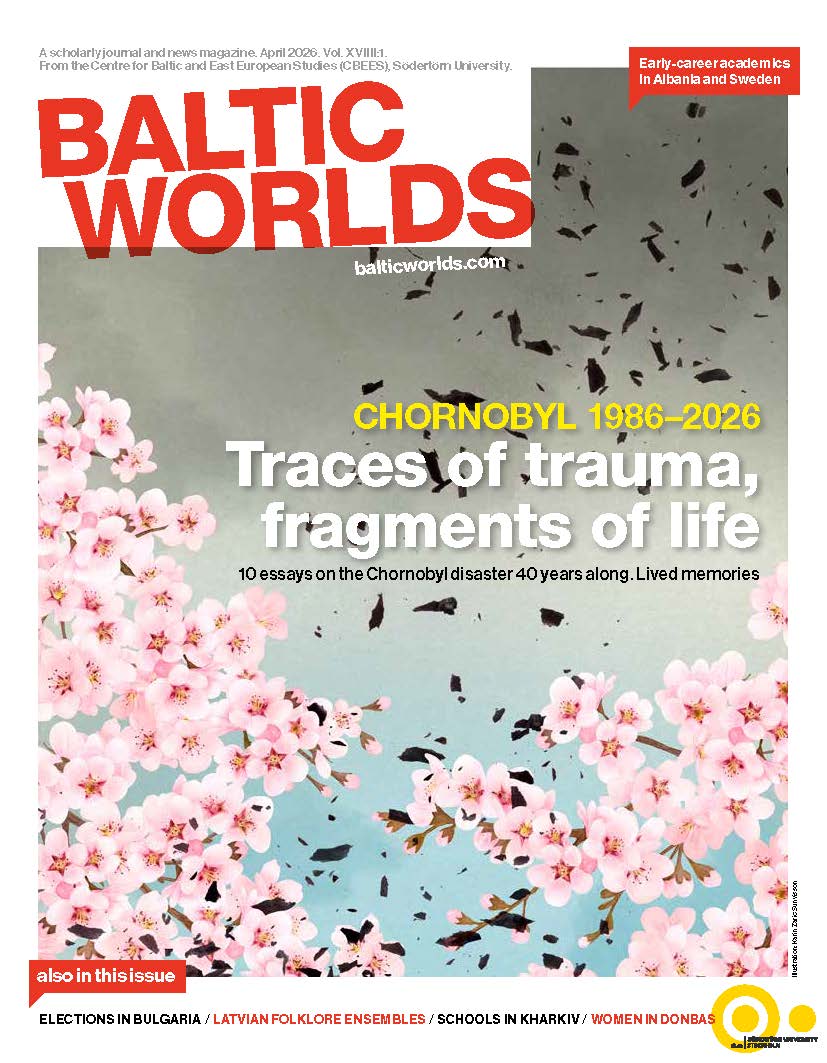 Issue 2026, 1: Download.

Peer-reviewed articles Caught between pasts and futures: Negotiating the meaning of the Left among female politicians in post-socialist Poland
This article examines how female politicians in Poland’s contemporary Left navigate the complex legacies of socialism and communism in shaping their political identities and practices. Drawing on ethnographic fieldwork conducted before the 2019 parliamentary elections and during the 2021 party unification convention, as well as 23 in-depth interviews with current and former female left-wing politicians, the article explores how the socialist past continues to structure the discursive field within which the Left defines itself and whether this process is gendered. The analysis reveals how associations with socialism and/or communism are simultaneously disavowed and re-appropriated, as female politicians negotiate their belonging to a “progressive Europe” while distancing themselves from the stigmatized post-socialist East. The article argues that this negotiation unfolds from a distinctly post-socialist “in-between position,” where temporal and spatial hierarchies intersect with gendered experiences of political engagement.
Published in the printed edition of Baltic Worlds BW 2025:4, pages 87-97
Published on balticworlds.com on December 18, 2025


abstract
This article examines how female politicians in Poland’s contemporary Left navigate the complex legacies of socialism and communism in shaping their political identities and practices. Drawing on ethnographic fieldwork conducted before the 2019 parliamentary elections and during the 2021 party unification convention, as well as 23 in-depth interviews with current and former female left-wing politicians, the article explores how the socialist past continues to structure the discursive field within which the Left defines itself and whether this process is gendered. The analysis reveals how associations with socialism and/or communism are simultaneously disavowed and re-appropriated, as female politicians negotiate their belonging to a “progressive Europe” while distancing themselves from the stigmatized post-socialist East. The article argues that this negotiation unfolds from a distinctly post-socialist “in-between position,” where temporal and spatial hierarchies intersect with gendered experiences of political engagement.
KEYWORDS: Polish Left, post-socialism, political discourse, ethnography, center–periphery, post-Cold War Europe.
DOWNLOAD THE FULL PAPER OA (see upper right corner)