Alexander Abramov, Maria Chernova and Alexander Radygin
Alexander Radygin, Director at the Institute of Applied Economic Research, the Russian Presidential Academy of National Economy and Public Administration (RANEPA), Moscow. He is also head of the Research Department and a board member at the Gaidar Institute for Economic Policy, Moscow.
Alexander Abramov, Professor at the Institute of Applied Economic Research, RANEPA. His main research interests span over the development of financial markets in Russia, with a special focus on institutional investors including pension and mutual funds.
Maria Chernova, Researcher at the Laboratory of Institutions and Financial Markets Analysis at the Institute of Applied Economic Research, RANEPA. Financial markets and financial risk management are her main research filed.
view all contributors
Articles by Alexander Abramov, Maria Chernova and Alexander Radygin
-
The 2015 election will be held very close to the end of the parliamentary term and it will be the first time since 1903 that Denmark holds a general election in June. As is usual in Denmark, the election campaign will be very short and intensive. Three issues so far have dominated the campaign: Job creation, healthcare and immigration.
-
The panel debate “Mendicancy, poverty and Swedish society” was organized the 20th of May at Södertörn University, with the intention to flesh out an emotionally loaded political topic with professional background knowledge.
-
At a symposium in March 2015, Erasmus University Rotterdam, Andrej Kotljarchuk presented the results of an ongoing research project “The Roma Genocide in Ukraine 1941-1944: History, memories and representations”.
-
In Ukraine today, “solidarity” means self-dedication and sacrifice — and is more tangible than ever before.
-
To speak of a solidarity beyond sense or meaning does not imply that the solidarity in question lies beyond the world, or beyond existence. What Patočka is trying to come to terms with is rather a solidarity at the limits of existence and at the limits of experience: the experiences of the limits of existence.
-
The term “fraternity” has been clearly linked to a register that could be called romantic. This explains the desire to distinguish the word from others like “solidarity” and “justice” and in particular “equality”.
-
In 1980, women’s participation in the Solidarność movement was far from invisible. Women were present from the start and they “took over” several highly important activities in Solidarność after its de-legalization in December 1981. The invisibility of these tasks was compounded by the fact that all of this work was illegal.
-
The author analyzes the content of the word “solidarity”, not for the sake of linguistics, but in the belief that words contain memories as well as many other experiences, often conflicting ones. He also talks about Solidarity, the trade union in Poland, which was created in August 1980 and crushed in December 1981.
-
Ludger Hagedorn has gathered together different voices, all adding insights into the meaning of solidarity. Here he presents the different contributions and place them in a wider context. He concludes, "Perhaps the outcome of solidarity counts less than the atmosphere that it creates and in which it unfolds its explosive message.".
-
Christer Lokind: DC-3:an. Kalla krigets hemlighet [The DC-3: the secret of the Cold War]. Stockholm: Medströms bokförlag, 2014.
-

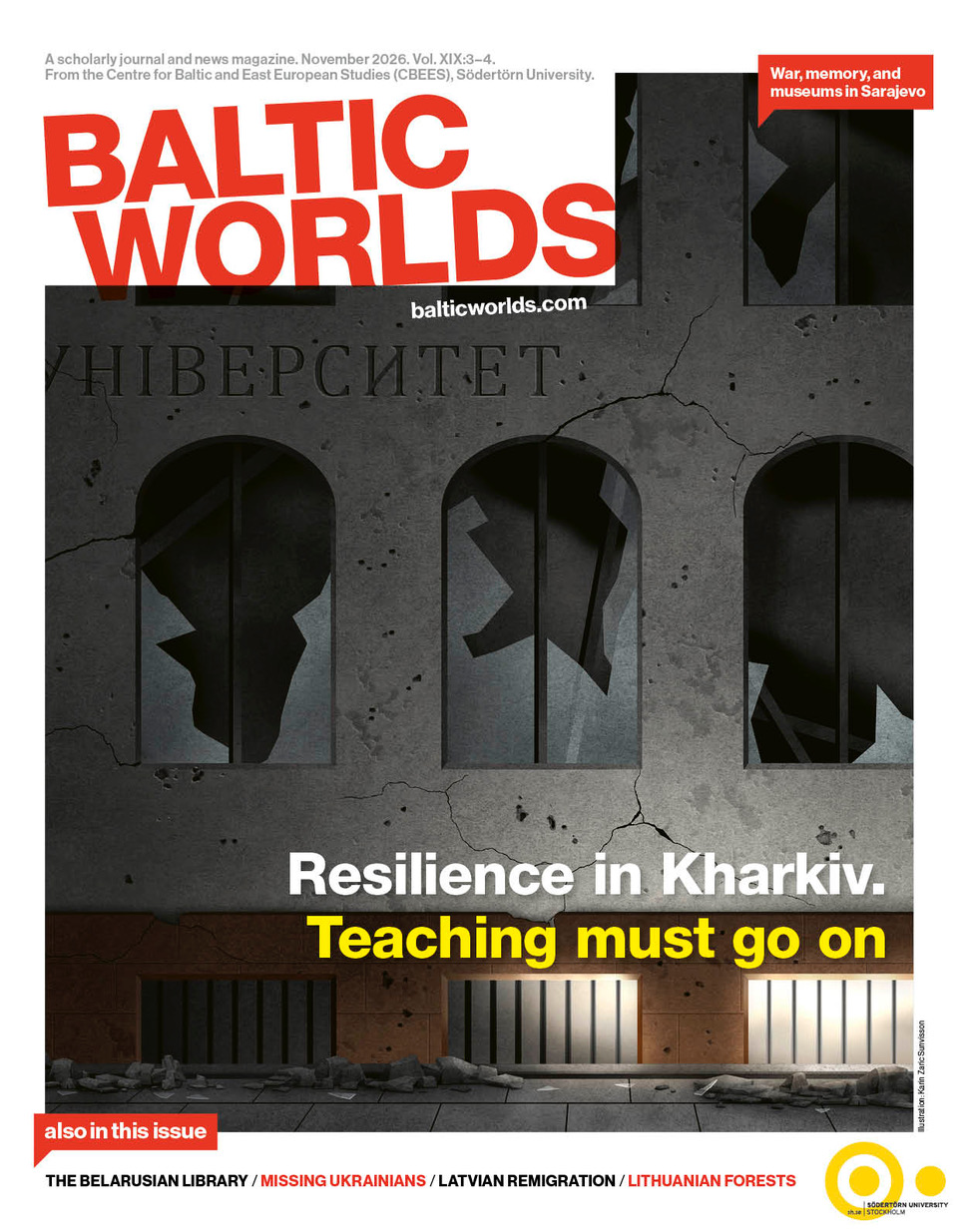 Issue 2026, 3-4: