Alexandra Biktimirova and Victoria Kravtsova
Alexandra Biktimirova is a student at the HSE University in Moscow and a feminist activist. Research interests center on the intersections of feminism and Islam in the Volga-Ural region in Russia, as well as globally. Coordinated the exhibition Feminist Translocalities in Kazan in 2020. Research interests are gender, muslim women, and relationships between discourses of power and marginality.
Victoria Kravtsova is a Feminist researcher, NGO-worker and activist. Born in Smolensk, Russia. Initiated Feminist Translocalities – a queer feminist network between the former USSR, Germany, and sometimes other locales, as wel l as a platform for supporting projects – publications, exhibitions, seminars, podcasts etc. Research interests include the intersections of feminist, antiracist and decolonial struggles in the countries of the former USSR.
view all contributors
Articles by Alexandra Biktimirova and Victoria Kravtsova
-
According to the databases of Ukrainian Cultural Foundation and of Ministry of Culture and Information Politics in Ukraine, there were 389 crimes against cultural heritage on June 10, 2022. In the conditions of an ongoing war, it is impossible to be certain of any further damage; this general insecurity and vulnerability adds to general losses. In many towns in Ukraine people made efforts to secure their monuments, covering them physically and digitalizing them in databases.
-
In most post-communist countries after the breakdown of the USSR, memory legislation often aimed at constructing an identity of suffering under Nazism and the totalitarian Soviet regime, which relativized itself according to a cosmopolitan understanding of victimhood centered on the Holocaust memory. Regulations of memory, in this sense, were considered an indicator of democratic transition and an entry ticket to the European Union.
-
I would like to offer this remnant of a futuristic halo of the Soviet space program as a possible way to comprehend why April 12 never managed to become a full-fledged fantasy world of what Boym terms “restorative nostalgia” like May 9th, and to see which alternative ways to understand nostalgia it may open up.
-
Before the war, Ukraine was the main trade partner of Belarus, after Russia. Imports of Belarusian goods to Ukraine in 2021 are estimated at 5.4 billion US dollars. Therefore, Belarus has a great economic interest in stopping the war.
-
The outbreak of the war on February 24, 2022, was a real shock for the Russian science and higher education, and completely turned the situation upside down, even in comparison with the negative trends of the previous years.
-
Like Stefan Zweig writing about the sophisticated idyll of Central Europe in the 1930s, I clutch at these memories like straws, at the same time that the Russian army is continuing to attack Ukraine, pulverizing its cities and killing its people. Although I have spent very little time in Ukraine, I have spent a lot of time with Ukraine.
-
A military endgame is taking place in Mariupol that could be an omen for Europe’s future to come.
-
On March 24, I visited the military hospital in Kyiv together with my colleagues from one Kyiv publishing house. That was very important for me as I saw the “inner” world of the war of young soldiers injured. Many of them suffer in terrible pain after surgery as there is a shortage of painkiller medication.
-
During the first month of the war, more than half of the children in Ukraine left their homes. Many of those who came out of hell arrived in the relatively calmer west of Ukraine as well as to neighboring European countries. Some were displaced after weeks of hiding in basements, dilapidated houses, in cars or even lines of vehicles under the enemy fire.
-
The Russian invasion of Ukraine on February 24 violated the territorial integrity of the independent Ukrainian state and is causing extreme suffering to the Ukrainian people. Baltic Worlds deplores and condemns this violation of international law and the cruelty of the war against the people of Ukraine.
For many years, the political, economic, social and cultural development of Eastern Europe has been the principal focus of the scholarly research published in the journal. Baltic Worlds has extensive networks of readers, contributors and colleagues at educational and cultural institutions in the larger region of Easter Europe, including Ukraine and Russia. The current war threatens and concerns us all.
With this statement Baltic Worlds declares its solidarity with the Ukrainian people, who are the innocent victims of Russian aggression, and demand that all Russian troops be withdrawn from Ukrainian territory with immediate effect and an immediate end to the Russian army’s attack on the civilians.
Baltic Worlds condemns in the strongest terms the violent destruction of Ukraine’s cultural heritage, cities, and educational facilities as a result of Russia's full-scale invasion.
Stop the war immediately!
-

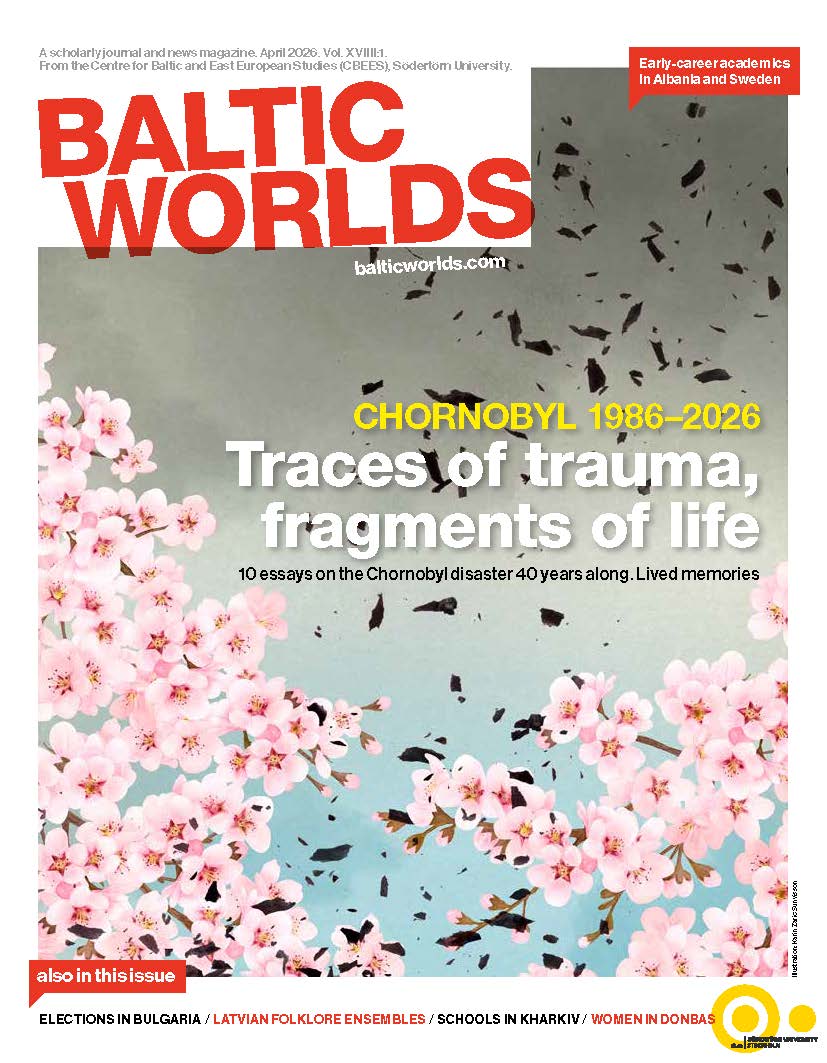 Issue 2026, 1: