Path dependency and gender norms. Governance and “doing gender”
Gendering postsocialism: old legacies and new hierarchies, Yulia Gradskova and Ildikó Asztalos Morell, Eds.. 2018. London ; New York: Routledge, Taylor & Francis Group.

A scholarly journal from the Centre for Baltic and East European Studies (CBEES) Södertörn University, Stockholm.
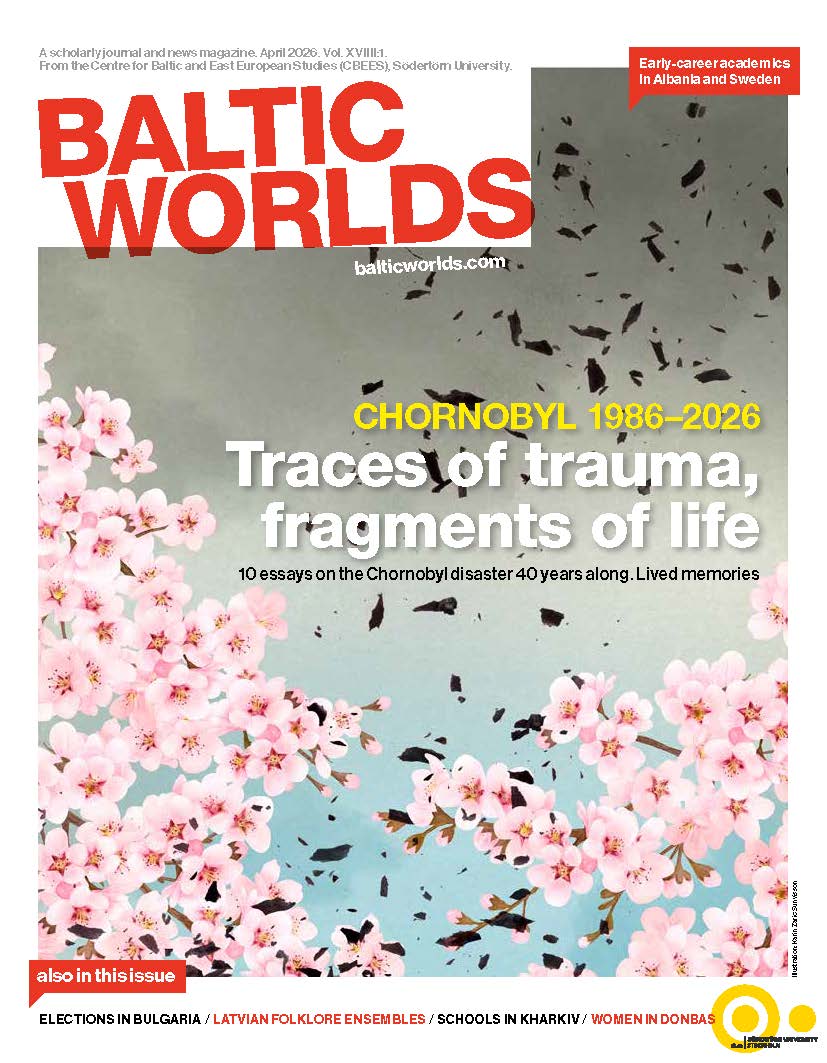 Issue 2026, 1: Download.
Alexandra Biktimirova is a student at the HSE University in Moscow and a feminist activist. Research interests center on the intersections of feminism and Islam in the Volga-Ural region in Russia, as well as globally. Coordinated the exhibition Feminist Translocalities in Kazan in 2020. Research interests are gender, muslim women, and relationships between discourses of power and marginality.
Victoria Kravtsova is a Feminist researcher, NGO-worker and activist. Born in Smolensk, Russia. Initiated Feminist Translocalities – a queer feminist network between the former USSR, Germany, and sometimes other locales, as wel l as a platform for supporting projects – publications, exhibitions, seminars, podcasts etc. Research interests include the intersections of feminist, antiracist and decolonial struggles in the countries of the former USSR.
Gendering postsocialism: old legacies and new hierarchies, Yulia Gradskova and Ildikó Asztalos Morell, Eds.. 2018. London ; New York: Routledge, Taylor & Francis Group.
Die Ostsee. Berichte und Geschichten aus 2000 Jahren. Klaus-Jürgen Liedtke (ed.) Berlin: Galiani Verlag 2018, 650 pages.
Ukraina och informationskriget – journalistik mellan ideal och självcensur [Ukraine and the information war – journalism between ideal and self-censorship] Gunnar Nygren and Jöran Hök (ed.), Myndigheten för samhällsskydd och beredskap. (2016), 279 pages.
Belarus in Maps, Edited by Dávid Karácsonyi, Károly Kocsis, and Zsolt Bottlik. Budapest: Geographical Institute, 2017, 194 pages.
The distinguishing feature of the Kaliningrad region is the fact that it is an exclave, part of but separated from Russia by two countries, Poland/Belarus or Lithuania/Latvia, though with access across the Baltic Sea (thus strictly speaking a semi-exclave). It is Russia’s only exclave and is the biggest in Europe. Seen from inside it is an enclave (or a semi-enclave).
Immediate reactions to the election results focused largely on the triumph of EKRE which nearly tripled its number of mandates. EKRE holding nearly a fifth of the Riigikogu seats ushers in a new era in Estonian politics where the populist far-right is a force to be reckoned with.
Regardless of what shape the future government will take, there is no doubt that it will remain under the control of Vlad Plahotniuc and Igor Dodon. This in turn means further deterioration of Moldova's relations with its Western partners, lack of structural reforms and deepening social collapse.
There is a significant discrepancy between the political potential of the EU and its actual position and role in the future development of Europe. In practice, the member states have maintained their power monopoly in the most essential policy areas.
Over 40 researchers representing countries spanning from Ukraine to the United States and from Sweden to Serbia gathered in Prague to explore the changing roles of rural and urban cultural heritages in post-socialist countries.
Usually, this triennial takes place in Lithuania, as it has since its foundation in the year 1979. But now, due to the celebration of the centennial of the restored three Baltic states, Kestutis Kuizinas, the leader of the Contemporary Art Centre, decided to suggest that they work collaboratively. Thematically, the 13th Baltic Triennial’s three-part format also shaped the way it was realized.