Phantom borders in Europe. A fluid phenomenon
“Phantom Borders in the Political Geography of East Central Europe”, Erdkunde 69, no. 2 (2015), ed. Sabine von Löwis

A scholarly journal from the Centre for Baltic and East European Studies (CBEES) Södertörn University, Stockholm.
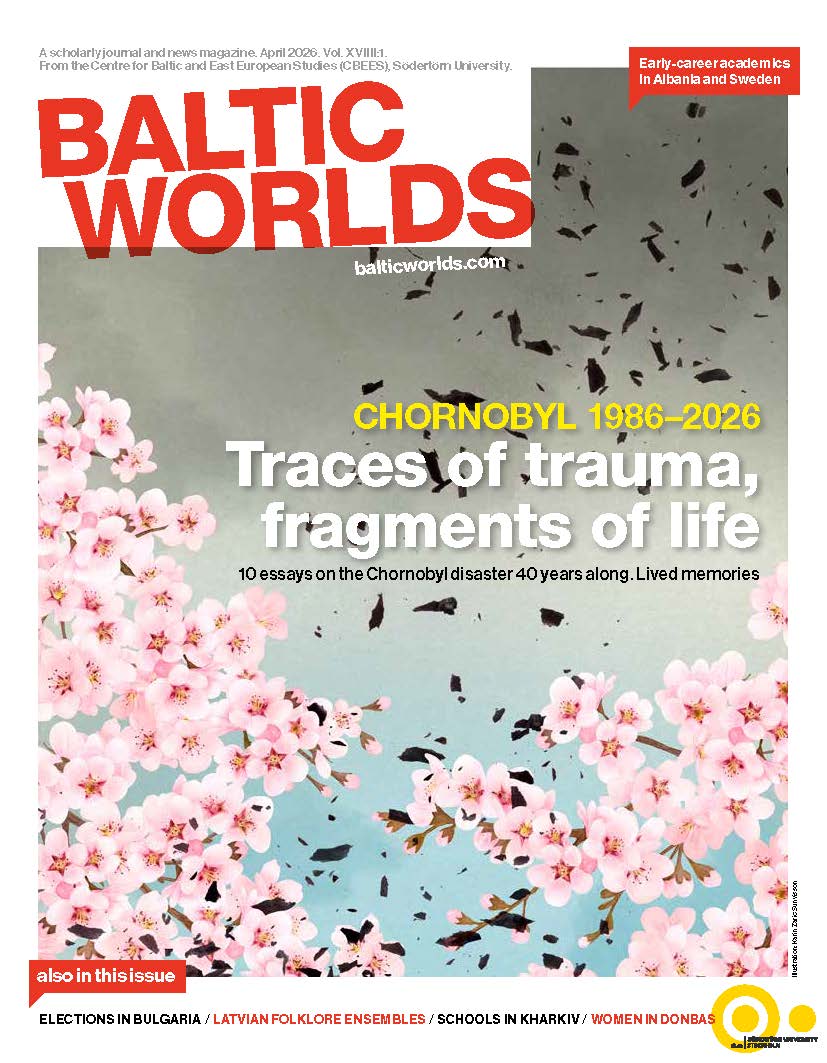 Issue 2026, 1: Download.
Alexandra Biktimirova is a student at the HSE University in Moscow and a feminist activist. Research interests center on the intersections of feminism and Islam in the Volga-Ural region in Russia, as well as globally. Coordinated the exhibition Feminist Translocalities in Kazan in 2020. Research interests are gender, muslim women, and relationships between discourses of power and marginality.
Victoria Kravtsova is a Feminist researcher, NGO-worker and activist. Born in Smolensk, Russia. Initiated Feminist Translocalities – a queer feminist network between the former USSR, Germany, and sometimes other locales, as wel l as a platform for supporting projects – publications, exhibitions, seminars, podcasts etc. Research interests include the intersections of feminist, antiracist and decolonial struggles in the countries of the former USSR.
“Phantom Borders in the Political Geography of East Central Europe”, Erdkunde 69, no. 2 (2015), ed. Sabine von Löwis
Lena Jonson, Art and Protest in Putin’s Russia. London and New York: Routledge 2015, 399 pages.
Helmut Müssener, Wolfgang Wilhelmus: Stettin Lublin Stockholm. Elsa Meyring: Aus dem Leben einer deutschen Nichtarierin im zwanzig-sten Jahr-hundert., 2nd edition. Rostock: Ingo Koch Verlag, 2014.
Richard Sakwa, Frontlinje Ukraina: Krisen i gränslandet mellan Ryssland och Europeiska unionen; Frontline Ukraine: Crisis in the Borderlands, Karneval förlag; London: I. B. Tauris, 2015, 349 pages
This paper presents the constitution of the “political” in two cases of political squatting in Hungary after 1989: the Centrum squatter group’s occupations in 2004–2006, and the homeless advocacy group The City is for All’s occupations in 2013–2014.
This paper explores the scope, causes, flourishing, and decline of squatting in Lithuanian society during the period of 1990-2002. Drawing on 16 in-depth interviews conducted with squatters in Vilnius, newspaper articles and legal documents, this paper shows that squatters made contributions to the city with their cultural capital, creating local subcultures and making the urban space more attractive.
The case of late Soviet and early post-Soviet squatting helps to elucidate how squatting is structured in regard to public-private relations and what the political component of squatting can be in a society not based on private property. The self-help occupying of vacant flats was not restricted to subcultures.
Two Polish cities, Warsaw and Poznań, are studied in the article to examine how external structures are handled and used by squatters in these two settings. The aim is to analyze opportunity structures that condition the emergence and development of squatting and how squatters respond to and utilize these opportunities.
The predominantly unfavorable and restrictive socio-spatial conditions of squatting in Prague, have been shaped by the socialist past and post-socialist transformation. Temporarily facilitated by the fluid and liberalized nature of the early post-1989 era, the emergence of the first squats in Prague was inspired by the international squatters’ movement, and alienated from the enthusiastic acceptance of capitalism by Czech society.
Social dumping is a concept with negative connotations that appeared in public debate shortly after the 2004 accession.