Archiv
2016. Backlash in the East Baltic Worlds publishes comments and opinions on the recent situation in Poland concerning the abortion […]

A scholarly journal from the Centre for Baltic and East European Studies (CBEES) Södertörn University, Stockholm.
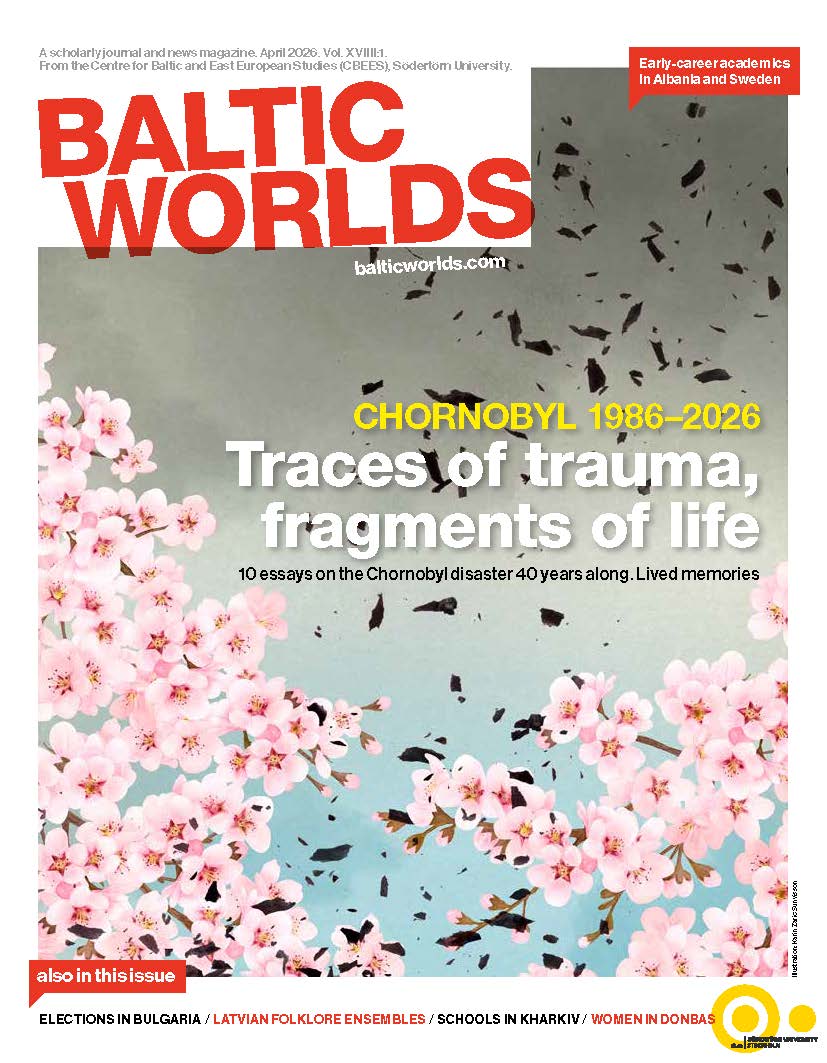 Issue 2026, 1: Download.
Dominika v. Polanska, Institute for Housing and Urban Research (IBF) at Uppsala University and Södertörn University. Leader of a project started in 2015 at Södertörn University, financed by the Foundation for Baltic and East European Studies, called “Challenging the Myths of Weak Civil Society in Post-socialist Settings: ‘Unexpected’ Alliances and Mobilizations in the Field of Housing Activism in Poland”.
Grzegorz Piotrowski is currently a CBEES Fellow; previously involved in three research projects at Södertörn University. PhD in social and political sciences at the European University Institute in 2011. Research interests: issues of anarchism, alterglobalism, squatting, social movements, postsocialism, and urban movements.
2016. Backlash in the East Baltic Worlds publishes comments and opinions on the recent situation in Poland concerning the abortion […]
Novoe literaturnoe obozrenie (NLO) [New Literary Observer] (2016) no. 5–6.
Russian Literature since 1991, Eds. Evgeny Dobrenko and Mark Lipovetsky, Cambridge University Press, 2015, 320 pages.
Vasil Navumau, The Belarusian Maidan in 2006: A New Social Movement Approach to the Tent Camp Protest in Minsk, Polish Studies in Culture, Nations and Politics, vol. 5, edited by Joanna Kurczewska and Yasuko Shibata, Frankfurt am Main: Peter Lang, 2016, 260 pages.
Deborah Paci, L’archipelago della pace: Le isole Åland e il Baltico (XIX-XXI secolo) [The Archipelago of Peace: The Åland Islands and the Baltic Sea (19th-21st centuries)], Milan: Unicopli, 2016; 236 pages.
Renat Bekkin and Almira Tagirdz-hanova, Musulmanskii St. Peterburg.Istoricheskii putevoditel. [Muslim St. Petersburg: Historical Guidebook; The Life of Muslims in St. Petersburg and Its Suburbs] Renat Bekkin and Almira Tagirdzhanova. Moscow and St. Petersburg, 2016, 639 pages.
The paper is a study of the Ukrainian popular culture based on the material of the Ukrainian TV comedy shows which emerged after 1991. They are: Maski Show, Gentlemen Show, Verka Serduchka, Fajna Ukrajna, Vital’ka, and Evening Kvartal. These TV shows have not been investigated by Western, nor Ukrainian scholars. The Ukrainian TV comedy shows are examined in the context of Bakhtin’s theory of carnival and of the ideas of the Australian Slavic scholar M. Pavlyshyn who has elaborated the concepts anticolonialsim and postcolonialism in relation to contemporary Ukrainian culture.
Paromita Chakrabarti and Yulia Gradskova discuss the Bakhtin Circle with five experts in the field: Caryl Emerson, university professor emeritus of Slavic languages and literatures, Princeton University; Lakshmi Bandlamudi, professor of psychology at LaGuardia Community College, City University of New York; Ken Hirschkop, professor of English at the University of Waterloo, Ontario; Craig Brandist, professor of cultural theory and intellectual history and director of the Bakhtin Centre, at the University of Sheffield; and Galin Tihanov, the George Steiner professor of comparative literature at Queen Mary University of London.
This paper traces the emergence of various digital technology-driven policy ideas in Estonia during the last two decades. The article is specifically concerned with the idea of e-Estonia, a signifier that is widely used as shorthand to denote Estonia’s success in developing digital solutions in government, public management, business, education, etc. The paper analyzes the idea of e-Estonia to disclose, contextualize, and critically explain the particular discursive practices that constitute the e-Estonia discourse. It offers a discourse-theoretical reading of e-Estonia in terms of different types of discursive ‘logics’. Finally, the paper argues for the importance of recognizing what is at stake in the act of naming e-Estonia.
Juxtaposing the postcolonial in-betweenness of critical discourse with Bakhtin’s idea of hybridized, collusive and hidden dialogicality, the postcolonial memoir can be read as the self’s mapping of a paradigm shift in contemporary times. The postcolonial memoirs become a site of contested, unsettling and endless renegotiations. I shall read South Asian-American diasporic writer Meena Alexander’s 1993 Fault Lines: A Memoir and the revised 2003 version as dialogic texts. Alexander’s memoirs engage, contest and alter each other to disrupt the possibility of singular meanings and absolute truth. Instead, the texts offer a conflicting and incommensurate idea of the past and a fractured yet intensely interconnected vision of the present.