Elena Marushiakova and Vesselin Popov
Elena Marushiakova is a holder of ERC Advanced Grant 2015, “Roma Civic Emancipation Between the Two World Wars”, and President of the Gypsy Lore Society. She is affiliated to the School of History at the University of St. Andrews. She has published widely on Roma in Bulgaria, Balkans and Central and Eastern Europe.
Vesselin Popov works at the School of History at the University of St. Andrews. Conducts research in frames of ERC Advanced Grant 2015, “Roma Civic Emancipation Between the Two World Wars”. Has published widely on Roma in Bulgaria, Balkans and Central and Eastern Europe.
view all contributors
Articles by Elena Marushiakova and Vesselin Popov
-
In this special section, the histories of dietary reform have been approached and explored from different perspectives. The essays weave together threads of the history of dietary advice and nutritional standards with social history, women’s history and food history, covering the elements of life reform and women’s movements, the establishment of communist food ideology, etc.
-
This article investigates the ideas of correct and modern nutrition during the early communist period in Bulgaria and outlines their relationship to previously existing ideas and practices. The research reveals the multiple influences of pre-communist food ideologies, particularly those of the vegetarian movement that flourished in the country in the 1920s and 1930s. It questions the propaganda claim that the communist regime introduced a radically new understanding of and approach to nutrition. It also suggests that there were significant differences between the attitudes towards meatless diets in Eastern European communist countries. The hostility towards vegetarianism was not equally strong and consistent across the bloc, and despite the evident influence of Soviet teachings focused on meat-based, protein-rich diets, nutritionists introducedmeatless diet “through the back door”.
-
This article considers the spread of ideas on vegetarianism in Estonia from the turn of the 19th century until 1940. The study builds on analyzing archival sources, media texts and educational work conducted by nutrition experts, schools and organizations. Propaganda about the consumption of vegetarian food was associated with the general modernization of domestic culture and the discourse on healthy food as the basis for the nation’s vitality. The article highlights the leading role of women’s movement in home economics, including attempts to implement food culture informed by nutritional science, especially teaching the people to eat more fruits and vegetables. The spread of vegetarian ideas in Estonia also illustrates how the previously dominating German cultural influences were gradually replaced by an orientation towards the Nordic countries, and demonstrates how these ideas were adapted to an Estonian context.
-
In this article, I tackle and reflect on the vegetarian movement of the Russian empire in its making, branding, and imagining by examining the All-Russian Vegetarian Congress in Moscow in 1913. By scrutinizing its organization, agenda and resolutions, the study brings to the surface and explores the ideological imaginaries and the dynamics of vegetarian collective action. I discuss the organization and convening of the congress, analyze the discursive activity around it, as well as hint at its implications for the fledgling vegetarian activism. I also contextualize the event within a broad reform-oriented social movement space, as well as spotlight the diversity of understandings of vegetarianism. The case study hints at the manifestations of movement making and branding, as well as unfolds the ideological foundations that were given preferences and why this was so. The congress apparently favored the ethical strand of vegetarianism and aimed at life reform in a broader sense. However, it did not really succeed in bringing about the long-awaited consolidation and unification of the vegetarians in the country.
-
This text gives a glimpse of a hitherto unknown design discourse during the Cold War – from both sides of the Iron Curtain – by exploring the 1975 Congress of the International Council of Societies of Industrial Design (ICSID), held in Moscow. Sweden sent a big delegation to Russia. More than forty of the small country’s top designers and influencers participated, which was more than twice as many as usual to these international design congresses. Thanks to reactions published about the events in journals on design in Sweden and in the Soviet Union, archival material, and the author’s own interviews with the delegates from Sweden who participated in Moscow, as well as one-off exclusive backstage witnesses from the local staff of the host organization during the ongoing congress, Moscow 1975 is experienced through the eyes of contemporary witnesses. The essay gives new insights into the world congress in design and illustrates the international atmosphere during the Cold War.
-
This article describes the current developments of feminist discourses and activism in Russia, as well as in the former USSR in general, towards inclusion of more intersectional perspectives: antiracist, disabled and trans*/non-binary. It reviews the contemporary feminist movement in Russia, provides some examples of intersectional projects and focuses on Feminist Translocalities – a project based jointly in the former USSR and Germany, as part of which an exhibition about intersectionality in the histories of these countries travelled across Russia. Describing this and other activities within the Feminist Translocalities project and focusing on anti-racism as a vector of the development of the feminist movement in Russia, the article shows that it is shifting towards more attention to other discriminations, thus also encouraging a similar trend in the broader society.
-
Diary from Kharkiv on impressions of the first two months of a full-scale war unleashed by Moscow.
-
During the last eight years we have become used to living near the line of fire and the feeling of danger has been lowered: but everything changed the early morning on February 24, 2022. That day the first Russian rockets destroyed Mariupol’s anti-aircraft weapons and next day we observed civilian casualties in the eastern part of the city.
-
I decided to go to Sumy to support my parents and bought a train ticket. But the train was cancelled due to a Russian attack. So this was my destiny — to stay in Kyiv!
-
Professor Andrzej Leder, psychoanalyst and professor of philosophy, in a conversation with Aleksandra Reczuch about the history and social transformations in the region, the threat of Russia, and the historical memory embodied in buildings, symbols, commemorations, and family albums.
-

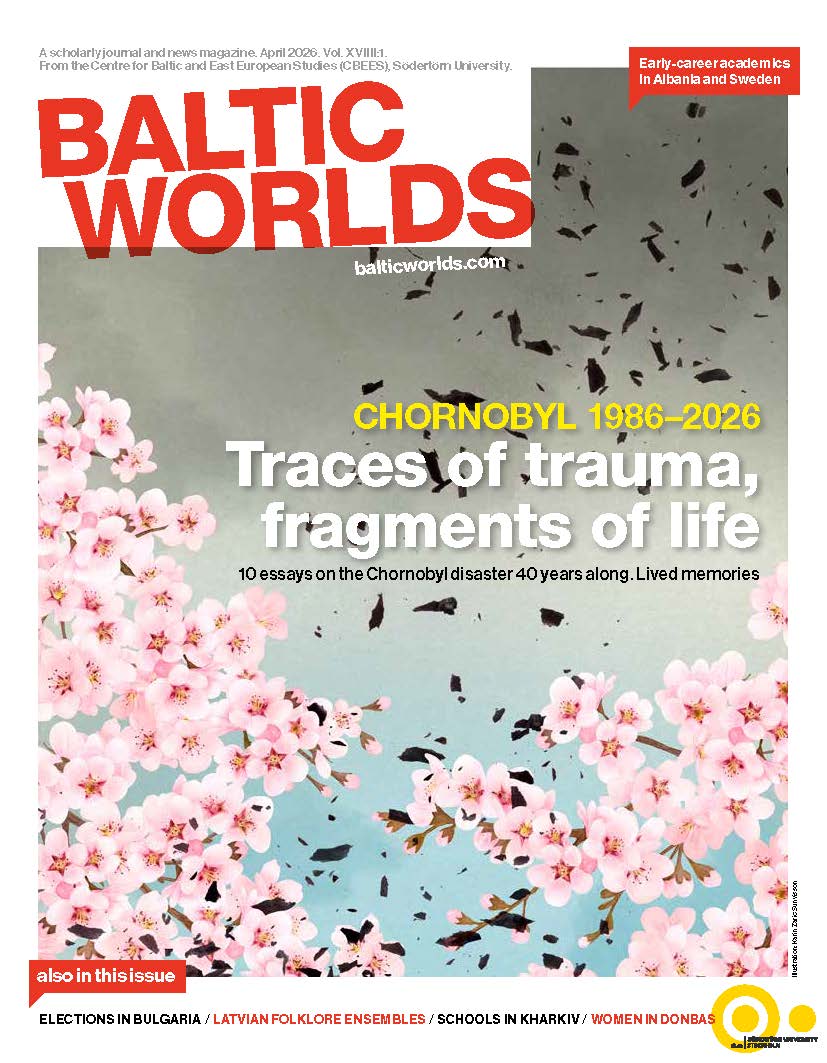 Issue 2026, 1: