Exodus from Galicia. Inferno of the swindlers and the swindled
Martin Pollack, Kaiser von Amerika: Die grosse Flucht aus Galizien, Vienna: Paul Zsolnay Verlag 2010, 285 pages

A scholarly journal from the Centre for Baltic and East European Studies (CBEES) Södertörn University, Stockholm.
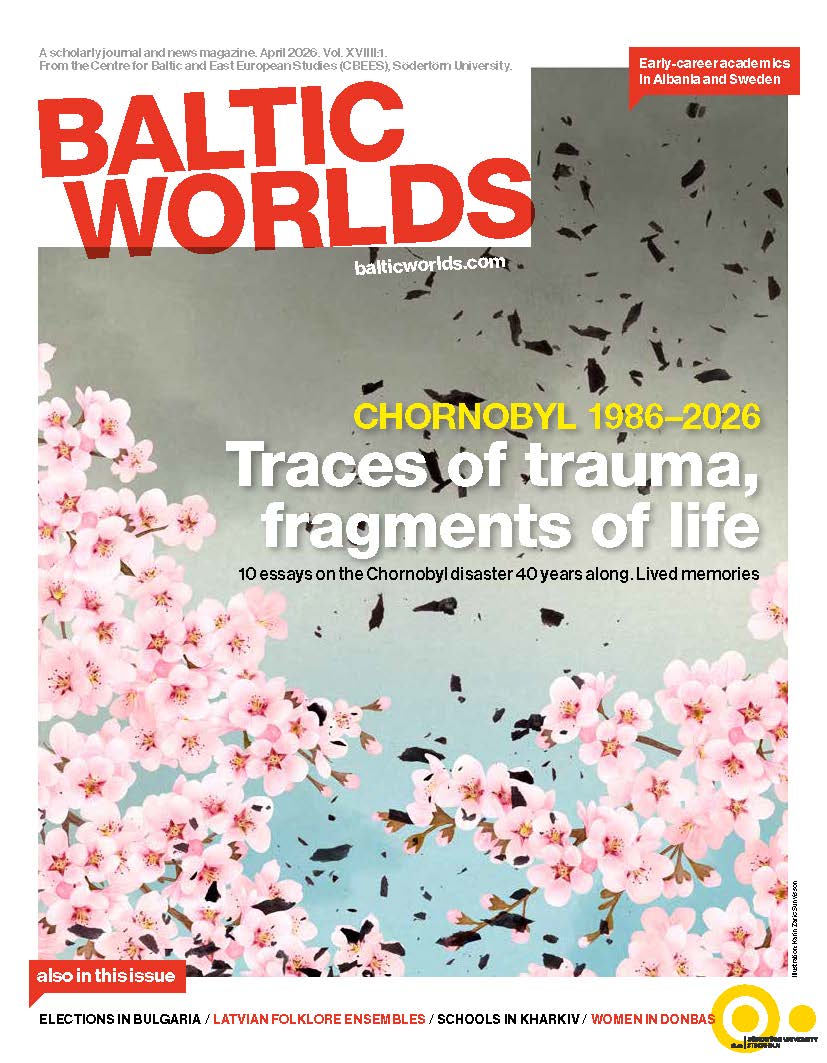 Issue 2026, 1: Download.
PhD student in philosophy at Södertörn University. He is writing a dissertation on the political thought of Jan Patočka with the provisional title “Abyssal Politics – the political thought of Jan Patočka”. His main areas of study are phenomenology and political philosophy.
Martin Pollack, Kaiser von Amerika: Die grosse Flucht aus Galizien, Vienna: Paul Zsolnay Verlag 2010, 285 pages
András Vari, Herren und Landwirte: Ungarische Aristokraten und Agrarier auf dem Weg in die Moderne (1821—1910) Studien zur Sozial- und Wirtschaftsgeschichte Ostmitteleuropas 17, Wiesbaden: Harrowitz Verlag 2008, 273 pages
Pavel Konovalchuk & Einar Lyth, Vägen till Poltava, Slaget vid Lesnaja 1708 [The road to Poltava: The battle of Lesnaya, 1708] Svenskt militärhistoriskt bibliotek Stockholm 2009, 249 pages + Vladimir A. Artamonov Poltavskoye srazhenie K 300 letiyu Poltavskoy pobedy [The engagement at Poltava: In commemoration of the tercentenary of the victory at Poltava] MPPA BIMPBA , Moscow 2009, 640 pages + Valery A. Moltusov Poltava 1709 — vändpunkten [Poltava, 1709: the turning point] Svenskt militärhistoriskt bibliotek, Stockholm 2010, 213 pages + Pavel A. Krotov, Bitva pri Poltave K 300-letnej godovsjtjinje [The Battle of Poltava: On the occasion of the 300th anniversary] Istoricheskaya Illyustratsiya, Saint Petersburg 2009, 397 pages
Trying to understand where post-Soviet Russia is going seems to be a matter of understanding how the society is redefining itself: contradictory pictures are circulating of what precisely Russia and “Russianness” are. The official picture of a united and multicultural Russia is being challenged from several directions.
On June 15–17, 2011, the Advanced Cultural Studies Institute of Sweden (ACSIS) organized its biennial conference, this year dedicated to “Current Issues in European Cultural Studies”. This report highlights some of the issues that were discussed at the panel session “East European Cultural Studies: The ‘New’ Europe”, chaired by Professor Irina Sandomirskaya of CBEES.
Adopting and Remembering Soviet Reality: Life Stories of Lithuanian Women 1945—1970, Edited and adapted by Dalia Leinarte, Amsterdam & New York: Rodopi 2010, 234 pages
Privatizations in states with no actual market economy obviously become legislative matters. For instance, matters related to property rights may need to be re-regulated. The role of EU law in privatization was brought up at the conference. The law does not regulate privatizations, but contains a great deal on liberalization, which in turn affects privatization. Matters related to the alignment of legislation have made law more interesting for all of us who usually categorize legislation among the restrictions.
During two scorching hot days in the middle of June, a diverse assembly of scholars from Russia and beyond converged in Moscow in search of answers to two questions: What is Varlam Shalamov? And why do we need him?
Scientists have not always agreed on either the causes or the possibility of restoring the cloudy, fish-poor, partially oxygen-deficient, algae-blooming, oil-slicked Baltic Sea. Wherein lies the disagreement? There seem to be two main controversies: 1. The Baltic Sea is eutrophic. Or is the Baltic Sea not eutrophic? 2. Algae blooms are controlled by the nutrient phosphorus. Or is the bloom controlled by both phosphorus and nitrogen?
Even though, with the dissolution of Austria-Hungary, Galicia ceased to exist, the idea of Galicia has a kind of ghostly presence in contemporary politics. The area was incorporated in 1919—1923 in the resurrected Polish state, only to be divided twenty years later between Germany and the Soviet Union as a result of the Molotov-Ribbentrop pact. This cleaving in two endured through the “shift” of Poland westwards after the Second World War. East Galicia became part of Soviet Ukraine and thereafter of independent Ukraine.