Maidan 2.0
Maidan 2.0. Letter from Kyiv the 10th of December 2013.

A scholarly journal from the Centre for Baltic and East European Studies (CBEES) Södertörn University, Stockholm.
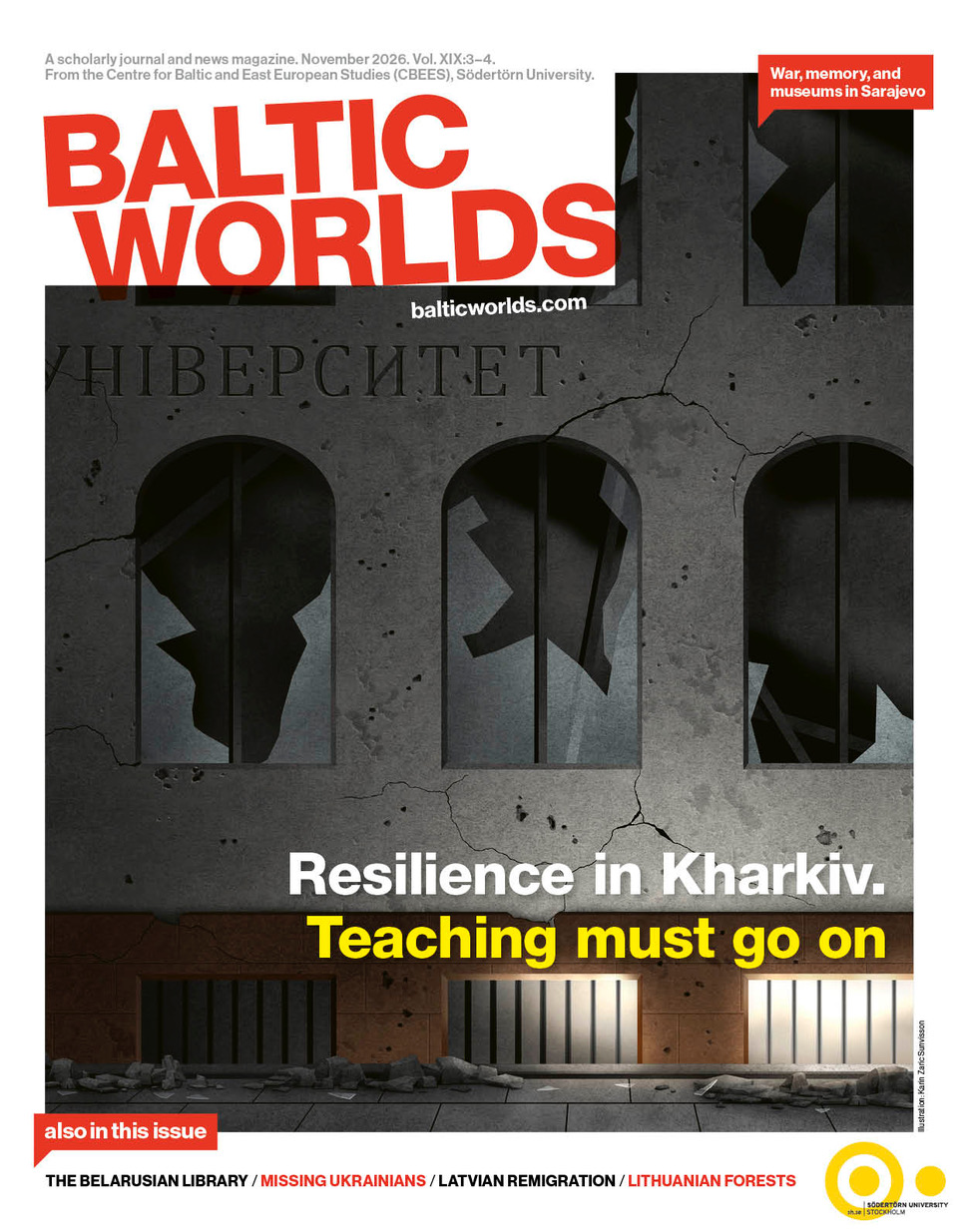 Issue 2026, 3-4: Download.
PhD in international relations; researcher at the Finnish Institute of Foreign Affairs, Helsinki. One of her ongoing research projects is “Russia’s Foreign Policy and the Quest for Leadership in the Eurasian Economic Space (2011–2013)”.
Maidan 2.0. Letter from Kyiv the 10th of December 2013.
Fatherhood in Russia today is a vague institution. The role of the father is developing in several directions at the same time, both in state policies and in the private sphere. The lack of coherence is somewhat surprising since active, engaged fatherhood has proven to be an important factor to reverse declining birth rates, which is a key factor behind Russia's current demographic crisis.
Many who migrate are forced to leave their children in their home country. Children being left behind in this way has become a problem in the EU, as Påhl Ruin relates in a report from Lithuania. The children don’t thrive, and there is a risk that they will become social outsiders.
The Channel Island of Guernsey was among the first places for Latvians to look for work abroad after the mid-1990s. Over time, an emerging culture of migration has developed on Guernsey among the Latvians.
Literary scholar David Williams analyzes Ulrich Seidl’s film Import/Export and criticizes Seidl for using and humiliating amateur actors with the aim of telling a story that ultimately only underscores a stereotypical image of the East: as precisely an object of pleasure for the West.
The 13th Annual Aleksanteri Conference “Russia and the World”, which took place in the main building of the University of Helsinki, October 23–25, was dedicated first and foremost to Russian foreign policy.
From the discussions at the “Frameworks for University Cooperation in the Baltic Sea Region” conference, the new EU-level interest in the region as well as increased Russian attention to the Baltic Sea sent a strong signal regarding the contemporary relevance and future importance of Baltic Sea cooperation.
VNIITE, once the world’s largest institute of design research, ceased to exist on June 14, 2013. It was once conceived as a marriage of engineering and aesthetics. Intellectual abilities and sensitivity were to be respected rather than viewed as problems.
+ Mary Hilson, Pirjo Markkola and Ann-Catrin Östman (eds.) Co-operatives and the Social Question: The Co-operative Movement in Northern and Eastern Europe (1880—1950), Cardiff 2012: Welsh Academic Press, 226 pages
+ Henrik Stenius, Mirja Österberg, and Johan Östling (eds.), Nordic Narratives of the Second World War: National Historiographies Revisited, Lund 2011: Nordic Academic Press, 173 pages