Minsk. Kurapaty. Khatyn.
Kurapaty and Khatyn: two places along the same road, the number three highway from Minsk to Vitebsk. Two places that are about history. But also about how history is used.

A scholarly journal from the Centre for Baltic and East European Studies (CBEES) Södertörn University, Stockholm.
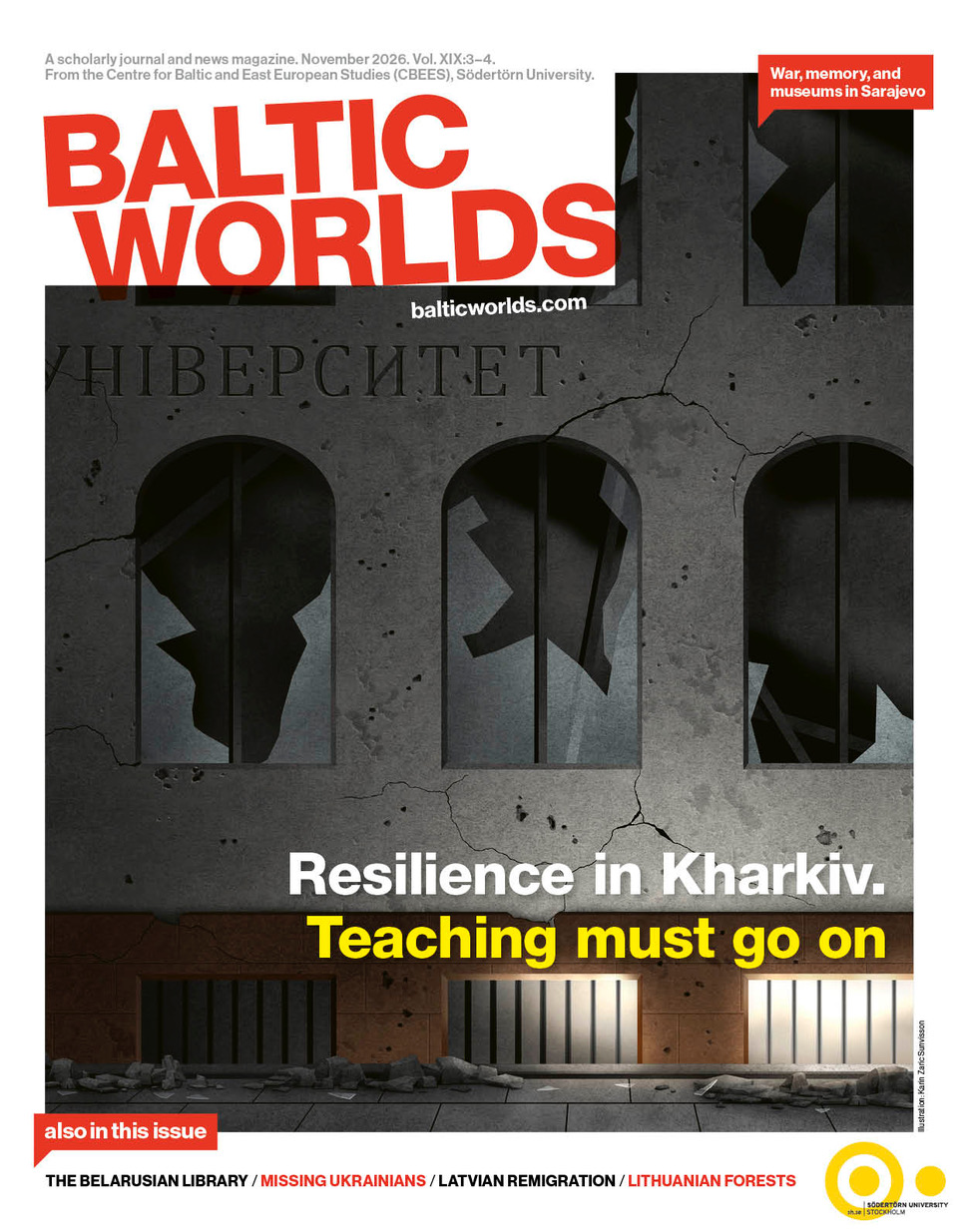 Issue 2026, 3-4: Download.
PhD in international relations; researcher at the Finnish Institute of Foreign Affairs, Helsinki. One of her ongoing research projects is “Russia’s Foreign Policy and the Quest for Leadership in the Eurasian Economic Space (2011–2013)”.
Kurapaty and Khatyn: two places along the same road, the number three highway from Minsk to Vitebsk. Two places that are about history. But also about how history is used.
Russian financial markets have been a completely new element in the Russian post-Soviet economy. The level of development and the character of the financial market institutions in this country can tell us much about whether Russia will succeed or fail in evolving towards a well-functioning market economy. Professor Alexandr Abramov from the Higher School of Economics in Moscow is one of Russia’s leading experts on Russian financial markets. Ilja Viktorov from CBEES met him in Moscow to pose some questions concerning developments in the field.
Professor of mathematics, Ulf Persson, visits the legandary Steklov Institute, the flagship of pure mathematics in the Soviet Union. Russian mathematicians have long inspired awe among their Western colleagues. A second-rate Soviet mathematician was usually considered first-rate by Western standards.
Peter Weiss' descriptions of the agony and torture associated with the genocide against the Jews, of the survivors’ experiences of violence, death and war, contribute substantially to breaching the taboo of the Shoah, and hence to coming to terms with the past. By invoking the dead through memory, making them speak and thus overcome death in his works, the author confronts his guilt complex and mortal fear.
The author suggests that Platonov’s Chevengur is an attempt to describe the relationships between utopia and ideology, as seen through the eyes of a participant observer.
Region-building around the Baltic Rim is not simply proceeding along a continuous path: it has entered a new phase. The region’s agenda has become increasingly outwardly oriented, argues the author.
The Finnish version of populism is known in the vernacular as “Vennamoism,” after the colorful founder and long-time leader of the Finnish Rural Party, Veikko Vennamo. Although Finnish populism has been pronounced dead over and over again, it has always managed to rise again and reinvent itself. The high polling numbers of the True Finns in the lead-up to the forthcoming Finnish general election in April indicate that populism in Finland is once again making a comeback as a political force to reckon with.
The current situation in Ukraine and the country’s economic and political development during President Viktor Ianukovych’s first year in office were discussed at the fifth Europe–Ukraine Forum, held in Kyiv February 23rd to 25th.
2011 elections in Estonia is a distinct indication of a political development in very much the right direction. The government coalition did ´deliver´ to the voters, and in a relation of reciprocity, the voters delivered back.
Ukraine clearly became a democratic country after the Orange Revolution because all subsequent elections, the parliamentary elections in 2007 and even the presidential elections of 2010, raised no doubts or concerns from the international community, representing a new reality for Ukraine. However, in a mere matter of months, the perception of Ukraine by the international democratic took a turn for the worse after the last presidential election.