RUSSIA AND GERMANY IN TUG-OF-WAR OVER IMMANUEL KANT
This year, 300 years have elapsed since the great German philosopher Immanuel Kant was born in 1724 in Königsberg, in what was then East Prussia.

A scholarly journal from the Centre for Baltic and East European Studies (CBEES) Södertörn University, Stockholm.
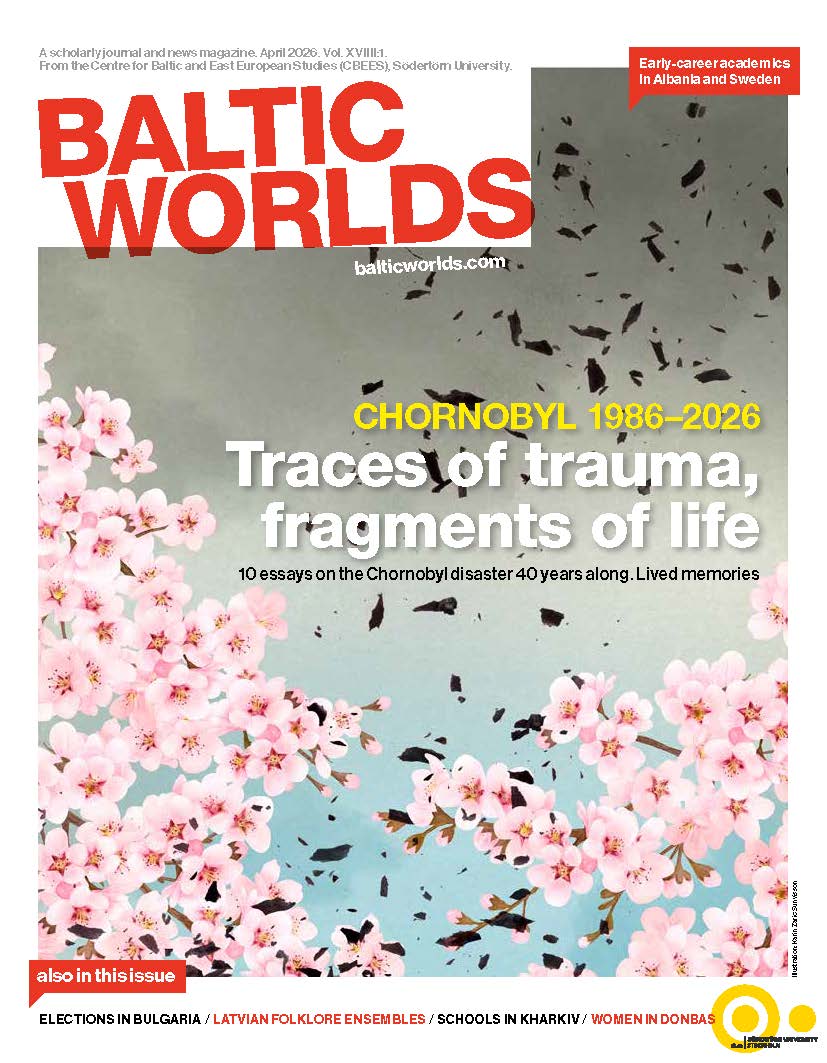 Issue 2026, 1: Download.
Kevin Deegan-Krause is Associate Professor of Political Science at Wayne State University. He is the author of Elected Affinities: Democracy and Party Competition in Slovakia and the Czech Republic (2006) and co-editor of The Structure of Political Competition in Western Europe (2010) and the Handbook of Political Change in Eastern Europe (forthcoming), and the co-editor of the European Journal of Political Research’s Political Data Yearbook
Tim Haughton is Senior Lecturer in the Politics of Central and Eastern Europe at the University of Birmingham and the 2011-12 Austrian Marshall Plan Foundation Fellow at Johns Hopkins University’s School of Advanced International Studies. He is the author of Constraints and Opportunities of Leadership in Post-Communist Europe (2005), the editor of Party Politics in Central and Eastern Europe: Does EU Membership Matter? (2011) and the co-editor of the Journal of Common Market Studies’ Annual Review of the European Union.
This year, 300 years have elapsed since the great German philosopher Immanuel Kant was born in 1724 in Königsberg, in what was then East Prussia.
Review article of Kassandra Larysa Luciuk, Making Ukrainian Canadians: Identity, Politics, and Power in Cold War Canada, (Ph.D. Dissertation, University of Toronto, 2021) xv+338 pages.
The article discusses the portrayal of hippies in The Pink Elephant (Rozā zilonis, 1976), a story by the Latvian SSR writer and physician, Miervaldis Birze (1921–2000). The author’s attitude towards this counterculture is mostly critical, even patronizing; however, it is through the portrayal of the hippies, Broņislavs and Baiba, that the author indulges in a conversation about young adulthood, revives the story, and even trifles with the questionable or inadmissible aspects of life. The Pink Elephant, when read through the lens of renewed interest about Soviet hippies, reveals their living conditions, attitude towards power, their parents, and themselves. As opposed to their Western counterparts, the impoverished Soviet hippies (who had experienced the system of blats and the shadow economy) did not condemn consumerism; in fact, they sought out material goods, especially those originating from the other side of the ocean.
If the grand narrative of German reunification in the autumn of 1989 in media discourse used to be a more or less coherent story of successful reconciliation, recent political developments have made it necessary to question some of the nuances of this seemingly flawless narrative. One way of doing this is to present personal memories in narrative form for consideration as more or less autobiographical accounts from the inside, so to speak. A growing number of writers who were children and young people 35 years ago, at the time of reunification, are now starting to write about their childhood and memories of the reunification process. These stories display more or less biographical features, albeit composite and contrived. In this paper, two novels, both dealing with the past, are compared: Grit Lemke’s affirmative oral history Kinder von Hoy (2021) and David Blum’s more critical Dantesque underworld narrative Kollektorgang (2023). Lemke’s depiction of a happy childhood is rather nostalgic, if not downright ostalgic (“East-nostalgic”), while Blum’s is much more discerning. Generational considerations may explain this difference in approach. What they have in common is that they ascribe significance to the big city with its high-rise buildings as a symbol of a collapsed system, based on their own memories of reunification.
On April 22, 2024, professor Steven Seegel, University of Texas at Austin, was awarded the Vega medal from the hands of the King of Sweden in the Royal Palace in Stockholm, “for his scientific contributions to Human Geography.”
At this year’s CBEES Annual Conference (November 28–29, 2024, at S.dertörn University), Ninna Mörner (Baltic Worlds) and Joakim Ekman (CBEES) organized a roundtable discussion on academic journals with a focus on the Baltic Sea region and Eastern Europe.
The 10th CBEES Annual Conference offers a time of retrospection and a time of new imaginings – a time to […]
In this essay, the author is engaging with the transforming presence of Stepan Bandera (1909-1959) in the Ukrainian social media space between 2014 and 2024. Building along and against the mainstream discussions on collective memory, The author argues that with the presence of war, the Ukrainian social media users memefied Bandera, making him a useful tool for politically-driven activities and an emptied signifier to be used in ironic contexts. The author also shows that in war-torn Ukraine, the meme and the myth of Bandera are intertwined with the commemorations of those who died on the frontline, which requires a nuanced understanding of the country’s changing memory landscape.
This essay is an attempt to describe my thoughts from the CBEES summer school in Sigtuna. The author attempts to articulate the complexities of working with memory and heritage through his topic related to the heritage of the Soviet Gulag, as well as the more general problems of the industry of preserving and reinterpreting the past.
This essay reflects on the issues of the past, memory practices, decolonisation, and reconciliation, as discussed during the 2024 CBEES Summer School. The author applies these reflections to think of her own research on LGBTQ+ Ukrainians’ wartime embodied relationalities, and how the discussed issues might manifest for her studied group. She further reflects on importance of positionality in discussions on postwar memory.