After Entry into the EU. Homophobia was Let Loose
Conor O'Dwyer, professor of political science, talks about a backlash at the political level also. Sexual minorities in Poland and Latvia have had their rights restricted following EU accession.

A scholarly journal from the Centre for Baltic and East European Studies (CBEES) Södertörn University, Stockholm.
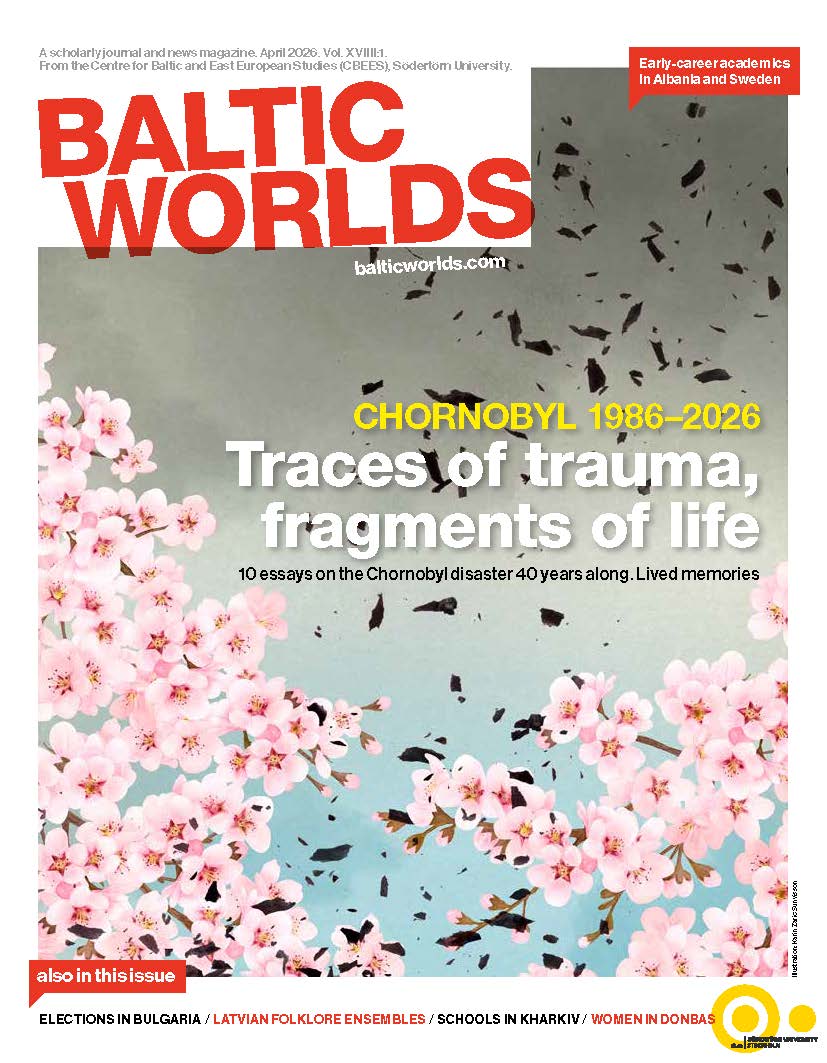 Issue 2026, 1: Download.
León Poblete, PhD candidate at the Department of Business Studies at Uppsala University, Sweden. Currently working on his doctoral dissertation in which he studies the dynamics of business-to-business relationships and complex business networks in industrial markets. The Swedish defense and security industry is the main empirical context in his research.
H. Richard Nakamura, assistant professor at the Centre for International Business Studies at the School of Business, Economics and Law at the University of Gothenburg, Sweden, holds a PhD in International Business Studies from Stockholm School of Economics, Sweden. His research concerns international business, management and entrepreneurship, especially regarding cross-border mergers and acquisitions and foreign direct investments in the Baltic Sea and East Asia regions.
Conor O'Dwyer, professor of political science, talks about a backlash at the political level also. Sexual minorities in Poland and Latvia have had their rights restricted following EU accession.
The passing of a homophobic law 2009 threw the spotlight on the difficult situation faced by the homosexual community in Lithuania.
Cultural historian Karl Schlögel reflects on what sort of components create a geographic space. Interpretations of what took place and what is taking place always occur in a spatial context.
Historian Mats Fridlund says that the technological and scientific development of weapons has influenced the choice of method and the type of people who have become perpetrators. When the revolver became smaller and lighter, female terrorists became more common.
Annual meeting in Narva of translators and writers from countries around the Baltic Sea. Meetings, exchanges of experience – which are the cultural common denominators and where are the barriers?
Latvia’s deep economic down-turn has brought about a historical political change. A left-wing party has won an election and come to power in Riga. The local party is dominated by ethnic Russian politicians.
Many migrate from poor regions of Europe to the richer regions. In the richer regions, there is a need for workers to fill low-paid jobs on the black market.
Narva is the EU’s port to Russia. Here, Swedes, Germans, Russians, and Estonians have had their interests. Today, the official language is Estonian and it is difficult for the Russian minority to obtain citizenship.
The Baltic Sea is difficult to navigate, through the ages many vessels have been wrecked. Marine archaeologists tell us about discoveries of ships and the difficulties involved in preserving the wrecks on land.
The historian Marta Reuter conducts research on how concepts are created and filled with meaning. NGOs are thought to stand for democratic values, but the Hell’s Angels are also elements of civil society.