Upcoming Election. Russia
This Sunday, on December 4, parliamentary elections are held in Russia as the first step in the country’s electoral cycle that will end with the presidential elections in early March 2012.

A scholarly journal from the Centre for Baltic and East European Studies (CBEES) Södertörn University, Stockholm.
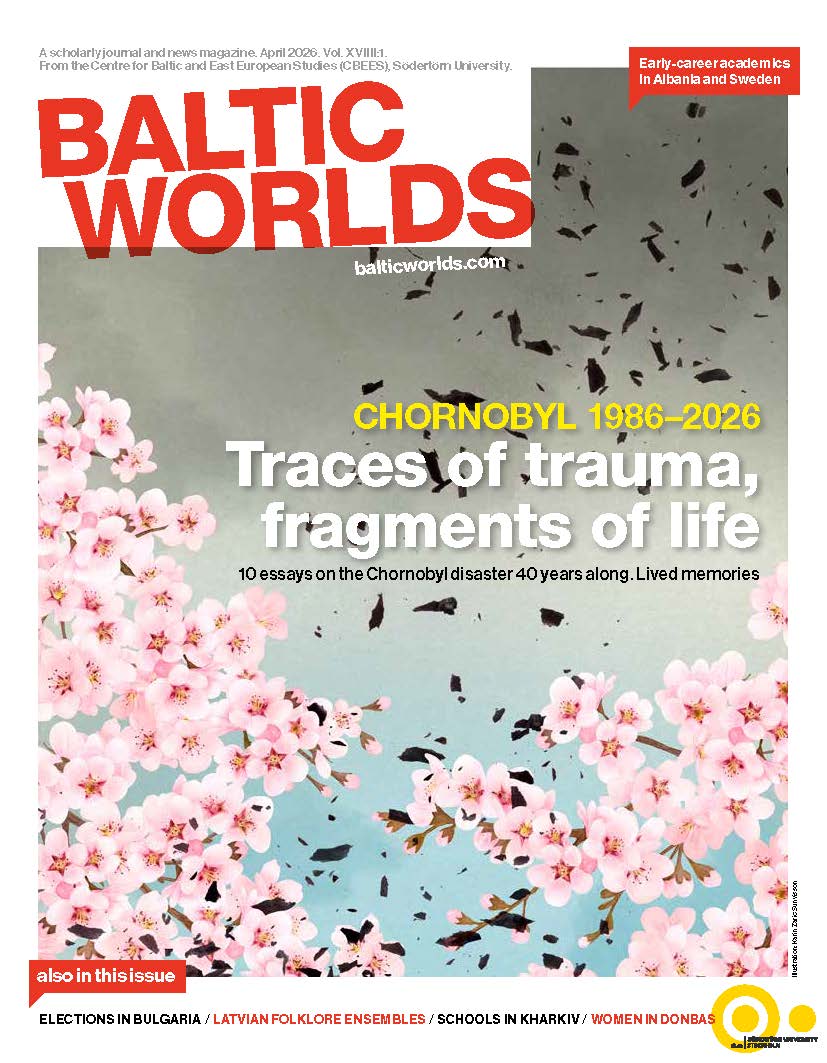 Issue 2026, 1: Download.
León Poblete, PhD candidate at the Department of Business Studies at Uppsala University, Sweden. Currently working on his doctoral dissertation in which he studies the dynamics of business-to-business relationships and complex business networks in industrial markets. The Swedish defense and security industry is the main empirical context in his research.
H. Richard Nakamura, assistant professor at the Centre for International Business Studies at the School of Business, Economics and Law at the University of Gothenburg, Sweden, holds a PhD in International Business Studies from Stockholm School of Economics, Sweden. His research concerns international business, management and entrepreneurship, especially regarding cross-border mergers and acquisitions and foreign direct investments in the Baltic Sea and East Asia regions.
This Sunday, on December 4, parliamentary elections are held in Russia as the first step in the country’s electoral cycle that will end with the presidential elections in early March 2012.
On 23 October 2011 a presidential election was held in Bulgaria, together with the country’s municipal elections, with a run-off on 30 October 2011. This comment explore the way that these elections were conducted, the political platforms of the three main contestants, and finally assess their outcome for the future politics of Bulgaria.
From a party-political perspective, the election has seen at least a partial consolidation of the pattern of competition. Although the spectacular arrival of a new party, the pro-market and libertarian Palikot Movement (Ruch Palikota, RP) represents a new locus of ideological identification in this structure, the surprise of its emergence should not lead to the rash drawing of conclusions as to its present relevance or future prospects. When the novelty of Palikot's triumph has worn off, the governing liberal-conservative Civic Platform (Platforma Obywatelska, PO) - and Tusk in particular - will remain the real winners of this election.
This fall, it was Helsinki’s turn to host this year's Yuri Lotman Symposium, whose theme was “The Writer and Power.” About forty Slavists from seven countries – Finland, Estonia, Russia, Sweden, Germany, the United States, and Israel – met over the space of three days to discuss this utterly inexhaustible topic. A number of fascinating cross-pollinations were among the most interesting outcomes.
Next Sunday's Polish parliamentary election is, on current evidence, too close to call. This is somewhat unexpected – in contrast with the majority of its predecessors in the post-communist era, the coalition government of the liberal-conservative Civic Platform (Platforma Obywatelska, PO) and the Polish Peasant Party (Polskie Stronnictwo Ludowe, PSL) has enjoyed higher levels of public approval than disapproval, and for much of its tenure looked set to become the first government in post-communist Poland to win a second term.
Sofi Gerber, Öst är Väst men Väst är bäst: Östtysk identitetsformering i det förenade Tyskland, East is West but West is best: East German identity formation in unified Germany, Stockholm University (Stockholm Studies in Ethnology 5) 2011, 248 pages
While the centre-left as expected won the Danish election on 15 September 2011, the victory turned out to be much narrower than predicted and the two main parties of the Left, the Social Democrats (S) and SF both lost votes compared with the 2007 election.
Martin Pollack, Kaiser von Amerika: Die grosse Flucht aus Galizien, Vienna: Paul Zsolnay Verlag 2010, 285 pages
András Vari, Herren und Landwirte: Ungarische Aristokraten und Agrarier auf dem Weg in die Moderne (1821—1910) Studien zur Sozial- und Wirtschaftsgeschichte Ostmitteleuropas 17, Wiesbaden: Harrowitz Verlag 2008, 273 pages
Pavel Konovalchuk & Einar Lyth, Vägen till Poltava, Slaget vid Lesnaja 1708 [The road to Poltava: The battle of Lesnaya, 1708] Svenskt militärhistoriskt bibliotek Stockholm 2009, 249 pages + Vladimir A. Artamonov Poltavskoye srazhenie K 300 letiyu Poltavskoy pobedy [The engagement at Poltava: In commemoration of the tercentenary of the victory at Poltava] MPPA BIMPBA , Moscow 2009, 640 pages + Valery A. Moltusov Poltava 1709 — vändpunkten [Poltava, 1709: the turning point] Svenskt militärhistoriskt bibliotek, Stockholm 2010, 213 pages + Pavel A. Krotov, Bitva pri Poltave K 300-letnej godovsjtjinje [The Battle of Poltava: On the occasion of the 300th anniversary] Istoricheskaya Illyustratsiya, Saint Petersburg 2009, 397 pages