Quo Vadis, Ukraine?
The current situation in Ukraine and the country’s economic and political development during President Viktor Ianukovych’s first year in office were discussed at the fifth Europe–Ukraine Forum, held in Kyiv February 23rd to 25th.

A scholarly journal from the Centre for Baltic and East European Studies (CBEES) Södertörn University, Stockholm.
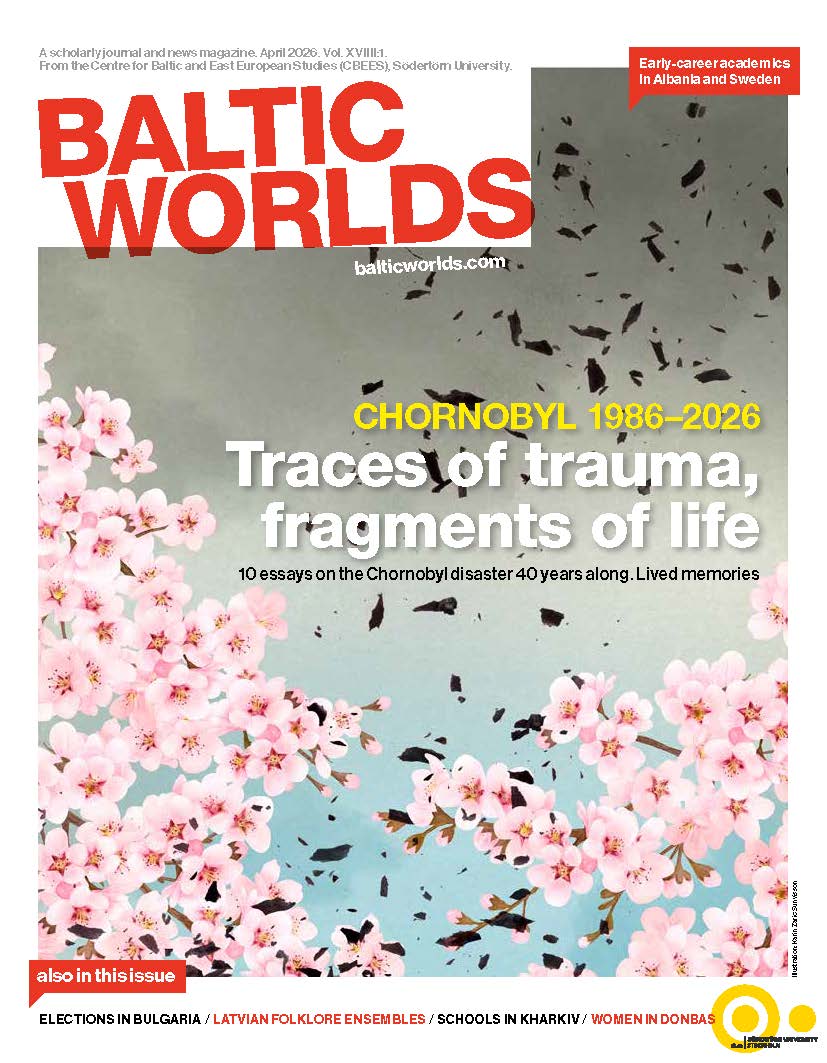 Issue 2026, 1: Download.
León Poblete, PhD candidate at the Department of Business Studies at Uppsala University, Sweden. Currently working on his doctoral dissertation in which he studies the dynamics of business-to-business relationships and complex business networks in industrial markets. The Swedish defense and security industry is the main empirical context in his research.
H. Richard Nakamura, assistant professor at the Centre for International Business Studies at the School of Business, Economics and Law at the University of Gothenburg, Sweden, holds a PhD in International Business Studies from Stockholm School of Economics, Sweden. His research concerns international business, management and entrepreneurship, especially regarding cross-border mergers and acquisitions and foreign direct investments in the Baltic Sea and East Asia regions.
The current situation in Ukraine and the country’s economic and political development during President Viktor Ianukovych’s first year in office were discussed at the fifth Europe–Ukraine Forum, held in Kyiv February 23rd to 25th.
2011 elections in Estonia is a distinct indication of a political development in very much the right direction. The government coalition did ´deliver´ to the voters, and in a relation of reciprocity, the voters delivered back.
Ukraine clearly became a democratic country after the Orange Revolution because all subsequent elections, the parliamentary elections in 2007 and even the presidential elections of 2010, raised no doubts or concerns from the international community, representing a new reality for Ukraine. However, in a mere matter of months, the perception of Ukraine by the international democratic took a turn for the worse after the last presidential election.
Is it possible to imagine a disused nuclear power plant as a monument or memory site, a trace in the landscape that tells of days gone by? Have our notions of what constitutes history and cultural heritage expanded to the degree that we can also include a physical setting whose meaning is so controversial, especially considering the current political relevance of nuclear power technology?
Archie Brown, The Rise and Fall of Communism, London: Vintage Books 2010, (First edition 2009), 752 pages
Max Engman, Gränsfall: Utväxlingar och gränstrafik på Karelska näset 1918–1920 [Borderline case: Exchanges and border traffic on the Karelian isthmus 1918—1920] Helsinki/Stockholm, Svenska litteratursällskapet i Finland [Swedish Literature Society in Finland] & Bokförlaget Atlantis 2008, 538 pages
Vesa Oittinen (ed.) Max Weber and Russia, Helsinki 2010, Aleksanteri Series 2/2010, 197 pages
Johan Svanberg Arbetets relationer och etniska dimensioner: Verkstadsföreningen, Metall och esterna vid Svenska Stålpress-nings AB i Olofström 1945–1952 [Labour Relations and Ethnic Dimensions of Work. The Swedish Engineering Employers’ Association, the Swedish Metalworkers’ Union, and the Estonians at Svenska Stålpressnings AB in Olofström 1945—1952] Linnaeus University Press: Växjö 2010 380 pages
Mats Deland, Purgatorium: Sverige och andra världskrigets förbrytare[Purgatory: Sweden and the criminals of World War II] Stockholm: Atlas 2010 568 pages
Rikskanslern Axel Oxenstiernas skrifter och brevväxling Avd. 2. Bd 13 Brev från Jacob Spens och Jan Rutgers Utgivna av Arne Jönsson [Lord High Chancellor Axel Oxenstierna’s writings and correspondence II:13 Letters from Jacob Spens and Jan Rutgers Published by Arne Jönsson] Royal Swedish Academy of Letters, History and Antiquities (2007) 643 pages Rikskanslern Axel Oxenstiernas skrifter och brevväxling Avd. 1. Bd 16 Brev 1636–1654 Del 1–2 Utgivna av Helmut Backhaus [Lord High Chancellor Axel Oxenstierna’s writings and correspondence I:16 Letters 1636–1654 Parts 1–2. Published by Helmut Backhaus] Royal Swedish Academy of Letters, History and Antiquities/Swedish National Archives (2009) 883 pages.