Lia Dostlieva and Andrii Dostliev
Lia Dostlieva is an Ukrainian artist, essayist, cultural anthropologist and researcher at Adam Mickiewicz University in Poznań, Poland. Focusing on trauma, postmemory, commemorative practices, and agency and visibility of vulnerable groups and how to process “difficult knowledge” and “difficult past”.
Andrii Dostliev is an independent Ukrainian artist, curator, and photography researcher currently based in Poland. His primary areas of interest are memory, trauma, identity – both personal and collective, and various aspects of queerness. Works in various media.
view all contributors
Articles by Lia Dostlieva and Andrii Dostliev
-
Agnieszka Mrozik analyzes the portrayals of women communists in the Stalinist period in Poland, produced in the framework of nationalist history during the illiberal turn. She argues that biographies of women dignitaries served the broader political function of delivering a cautionary tale against “excessive” liberation of women, so that female communists were often presented as beasts and demons rather than political agents.
-
This paper discusses the current “herstorical turn” in professional and popular historiography and memory of WWII in Poland: a growing interest in women and the distinctiveness of their wartime experiences. Focusing on one dominant strand of this “herstorical turn” – nationalist herstory – the article reflects on the ways in which women’s history has become one of the platforms a broader illiberal political shift that is currently ongoing in Central Europe.
-
In 2016, commemorations of the 60th anniversary of the 1956 Hungarian Revolution brought new conflicts in memory politics. This article analyzes the reasons for women’s absence from the historiography of the 1956 Revolution and discusses how the polypore state is using the populist turn to introduce hegemonic narratives and to include women in the narrative of “national feminism”.
-
This paper is devoted to the semantics of the visual images of the Chinese-Eastern Railroad (KVGD)1 and the “Oriental Other” in the Russian public consciousness of the late 19th and early 20th centuries. Here it is that the construction of the KVGD was intended to be a symbol of the technological progress and spiritual strength of the Russian Empire in the Russian mass consciousness.
-
The article describes Ukrainian views on the war in the eastern region of the country and other worries of the people as well as Ukrainian-Russian relations and the views on the EU. The empirical material is from opinion polls carried out by the Kyiv International Institute for Sociology in 2014–2017. The conflict in the east is the main concern of the population.
-
As the articles in this issue demonstrate, the revisionist strand of nationalist herstory has certainly made some women visible in narratives about historical events, but it is also highly problematic as it often reproduces traditionalist notions of femininity, masculinity and ideas about women’s “proper” place in history and society.
-
Agnieszka Graff and Elżbieta Korolczuk in an interview about the phenomenon of anti-genderism: a topic they written together on and both try to understand as it is spreading in Poland but also widely elsewhere
-
More than twenty-five years after gaining independence, Armenia is yet to undergo a democratically instigated change of power. It can no longer be said that Armenia is still a state in transition. On the contrary, in many respects, the lately held Presidential elections illustrate that the country is currently moving away from democracy in order to strengthen the authoritarian regime ruled by the ‘party of power’, the Republican Party.
-
-
We believed that a conference on arts and aesthetics is hardly imaginable without a cultural program and therefore included one, comprising a dance performance, Breakin’ Revolution, on the opening night at Färgfabriken on October 19, and a public screening of the art film To The New Horizons at the closing session at Moderna Museet on October 21, conceptually marking the beginning and the end of the Russian Revolution.
-

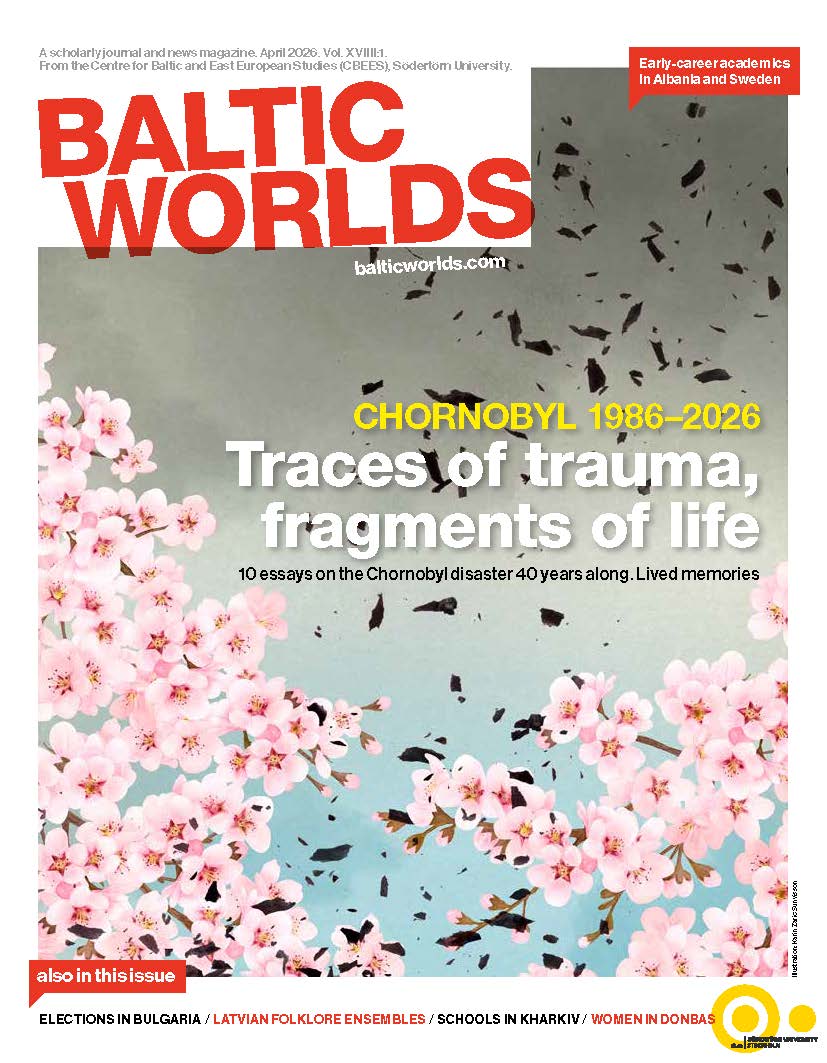 Issue 2026, 1: