Brücke nach Europa. Schwedisch-Pommern 1630-1815
Pomerania flew the Swedish flag during the years 1630–1815. The province became a coveted badge in the great political power game of Northern Europe.

A scholarly journal from the Centre for Baltic and East European Studies (CBEES) Södertörn University, Stockholm.
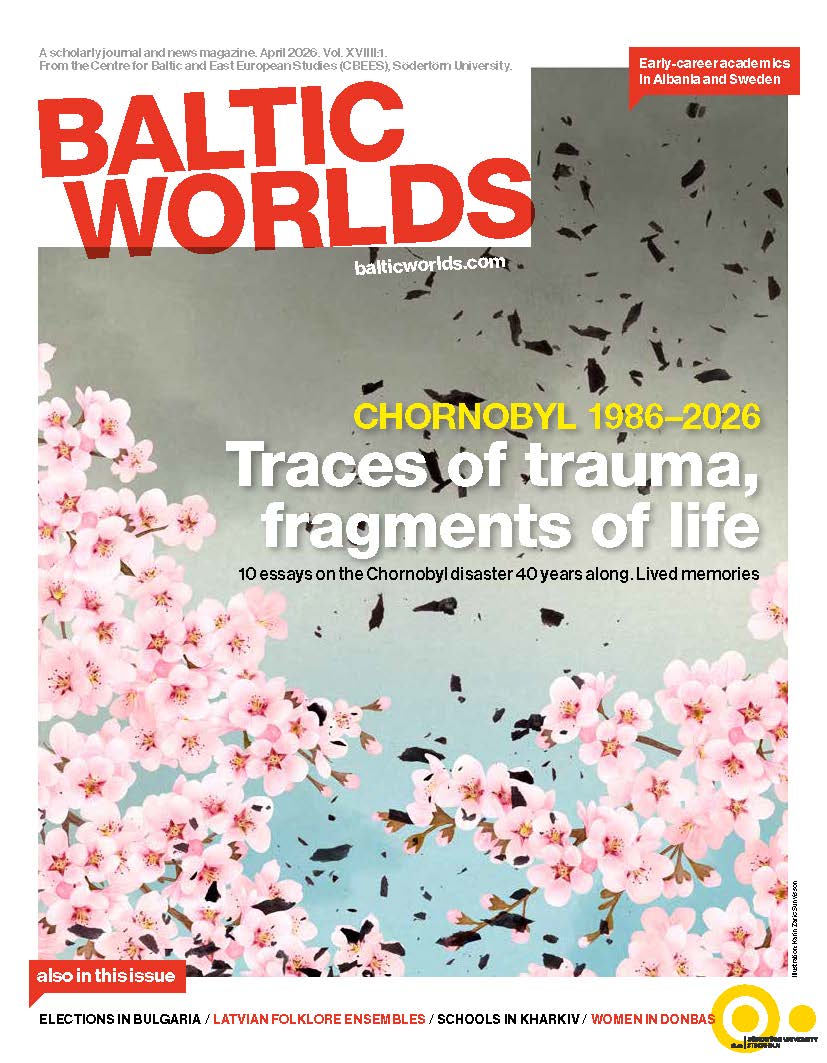 Issue 2026, 1: Download.
Professor of Postcolonial Feminisms at the Department of Thematic Studies/Gender Studies division at at Linköping University, Sweden.
The author of eight scholarly books, over 250 articles and two postcolonial novels, Tlostanova focuses on non-Western gender theory, decolonial and postcolonial theory, and postsocialist studies.
Pomerania flew the Swedish flag during the years 1630–1815. The province became a coveted badge in the great political power game of Northern Europe.
The altruistic act of donating organs is increasingly a financial transaction with the body as a commodity. Poor people are persuaded, tricked, into selling one of their kidneys without receiving adequate care afterwards.
Baltic Sea cooperation is a good example of how nations can find forms of collaboration. There is a solidarity between countries and a desire to work on things such as environmental problems.
The struggle for control among the Great Powers in the Nordic region during the 19th century focused on the dissolutions of unions and on nation-building. Russia and Napoleon were strong players. Sweden and Finland had a close relationship.
Ragni Svensson contribute in each issue of Baltic Worlds with illustrations.
Translator Brian Manning Delaney has developed a Style Guide for the magazine based on a modified version of the Chicago […]