Advertise in printed Baltic Worlds
Your advertisement in Baltic Worlds reaches a specialised, academic target group. Baltic Worlds contributes to the dissemination of knowledge about […]

A scholarly journal from the Centre for Baltic and East European Studies (CBEES) Södertörn University, Stockholm.
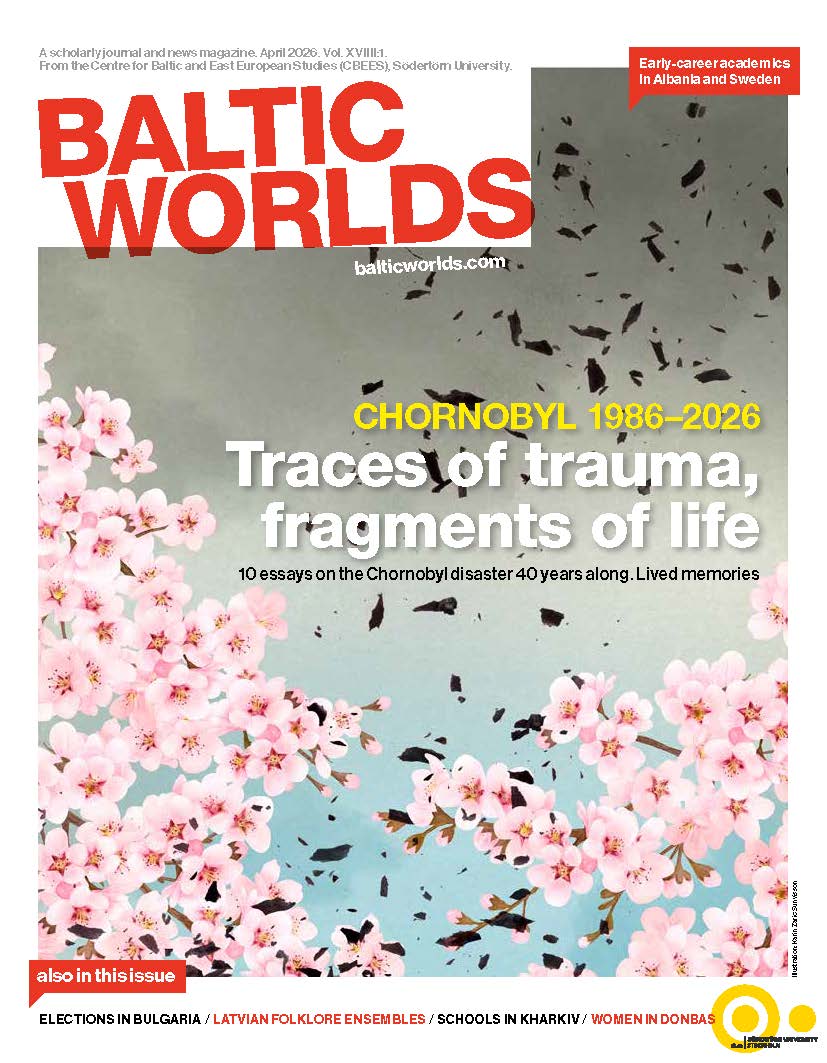 Issue 2026, 1: Download.
Oksana Shmulyar Gréen is PhD in sociology and senior lecturer at the Department of Sociology and Work Science, University of Gothenburg. Her research interests include issues of global migration, gender, and care at a distance, with a special focus on child well-being and migrants’ rights.
Andrea Spehar is PhD in political science and senior lecturer at the University of Gothenburg; researcher at the Centre for European Research (CERGU). Her focus is on political and gender equality developments in Central and Eastern Europe and migration policy development in the EU.
Your advertisement in Baltic Worlds reaches a specialised, academic target group. Baltic Worlds contributes to the dissemination of knowledge about […]
The electoral campaign was marked by the emergence of several rather peculiar issues in a contemporary electoral context: appeals to religion and ethnic belonging, and to family status.
An interview with Russian human rights activist Elena Vasilyeva, founder of the group “Load 200 from Ukraine to Russia.” that gathers information about soldiers killed in military operation zones abroad and then transported home. The article contains statements that reflect the views of the author and the interviewed, not necessary the view of Baltic Worlds'.
Today there is a new reign of terror against the Crimean Tatars, as well as against the Ukrainian population in Crimea. Mustafa Jemiloglu has once again been forced out from Crimea. He was after a meeting in Ankara in March refused to enter Crimea and come back to his home in Bakhchisaray.
Iryna Dovgan is one of several women that helped Ukrainian soldiers. But she was caught and imprisoned for several days. She was beaten, injured and humiliated. Today she stands up for her rights and is running in the election campaign.
“Translation in Russian Contexts: Transcultural, Translingual and Transdisciplinary Points of Departure”, hosted June 3–7 by the Uppsala Centre for Russian and Eurasian Studies (UCRS), brought together scholars and practitioners of translation from Europe, Russia, and North America to Sweden, a central point between Western Europe and Russia.
When it comes to art museums in post-Soviet Eastern Europe, ownership is an especially loaded issue that continues to bring out new skeletons from its closeted past. Ludwig’s gigantic art collection, consisting of some 50,000 artworks, came into being because of his goal of inscribing himself into the future of art history.
By analyzing the usage of the word “market” (rynok) in the Russian press since 1990, the author shows how the keyword takes on new meanings, reflecting and relates to the different social and political roles of the press outlets in an evolving, modernizing environment.
The author argues that the equation of culture and natural resources has become a fundamental metaphor of the official patriotic discourse of identity in contemporary Russia. This conceptualization of the past frames nation building and state construction, the “nostalgic modernization”.
In an attempt to bring Russian articulations of Russian religiosity into a dialogue with the American sociologist Robert N. Bellah’s theory on secularization the author argues for a Russian model of civil religion.