Message from Ukraine
A message on situation in Ukraine from Ukrainian writer Yuri Andrukhovych. (translated by Vitaly Chernetsky, via Andrij Bondar)

A scholarly journal from the Centre for Baltic and East European Studies (CBEES) Södertörn University, Stockholm.
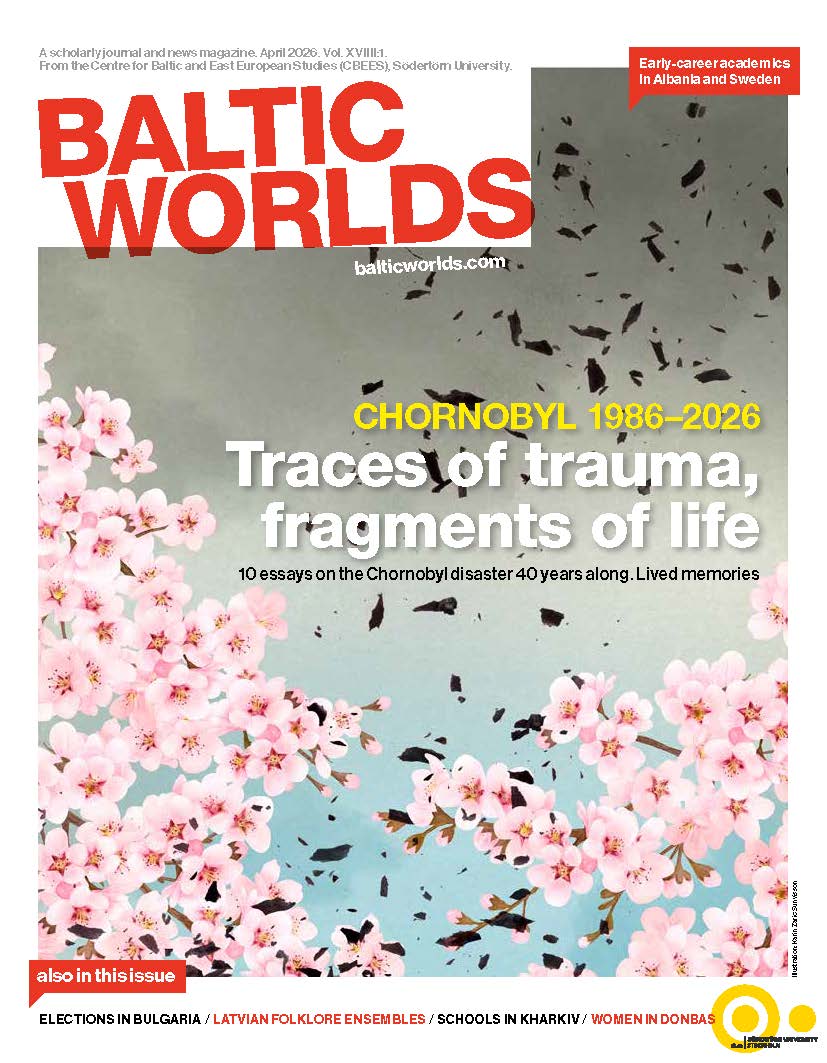 Issue 2026, 1: Download.
Pēteris F Timofejevs
Senior Lecturer at the Department of Political Science, Umeå University. He has written on Europeanization of foreign aid policy in Central and Eastern Europe and European NGOs working with development cooperation.
Currently, his research is focused on radical right parties in the Baltic Sea area, their positions in foreign and environmental policies and their youth organizations.
Louis John Wierenga
Lecturer in International Relations at the Baltic Defence College, PhD fellow at the Johan Skytte Institute of Political Studies, University of Tartu and Research fellow at the Latvian Institute of International Affairs (LIIA). His research interests include populist radical right parties – specifically leadership and party structure, social media and discursive opportunity structures, youth organizations and transnational networks. Currently, Wirenga is part of a project entitled, “Making Tomorrow’s Leaders” which is a Swedish Research Council project analyzing youth organizations of far-right parties.
A message on situation in Ukraine from Ukrainian writer Yuri Andrukhovych. (translated by Vitaly Chernetsky, via Andrij Bondar)
Maidan 2.0. Letter from the Ukrainian PEN Club, Kyiv January 22 2014.
Maidan 2.0. Letter from Kyiv the 10th of December 2013.
Fatherhood in Russia today is a vague institution. The role of the father is developing in several directions at the same time, both in state policies and in the private sphere. The lack of coherence is somewhat surprising since active, engaged fatherhood has proven to be an important factor to reverse declining birth rates, which is a key factor behind Russia's current demographic crisis.
Many who migrate are forced to leave their children in their home country. Children being left behind in this way has become a problem in the EU, as Påhl Ruin relates in a report from Lithuania. The children don’t thrive, and there is a risk that they will become social outsiders.
The Channel Island of Guernsey was among the first places for Latvians to look for work abroad after the mid-1990s. Over time, an emerging culture of migration has developed on Guernsey among the Latvians.
Literary scholar David Williams analyzes Ulrich Seidl’s film Import/Export and criticizes Seidl for using and humiliating amateur actors with the aim of telling a story that ultimately only underscores a stereotypical image of the East: as precisely an object of pleasure for the West.
The 13th Annual Aleksanteri Conference “Russia and the World”, which took place in the main building of the University of Helsinki, October 23–25, was dedicated first and foremost to Russian foreign policy.
From the discussions at the “Frameworks for University Cooperation in the Baltic Sea Region” conference, the new EU-level interest in the region as well as increased Russian attention to the Baltic Sea sent a strong signal regarding the contemporary relevance and future importance of Baltic Sea cooperation.
VNIITE, once the world’s largest institute of design research, ceased to exist on June 14, 2013. It was once conceived as a marriage of engineering and aesthetics. Intellectual abilities and sensitivity were to be respected rather than viewed as problems.