From clients to agents. Roma feminist activism in the special issue of Analize
Analize – Journal of Gender and Feminist Studies, New Series, Issue no. 7, 2016, The Romanian Society for Feminist Analyses AnA, 2016, 101 pages.

A scholarly journal from the Centre for Baltic and East European Studies (CBEES) Södertörn University, Stockholm.
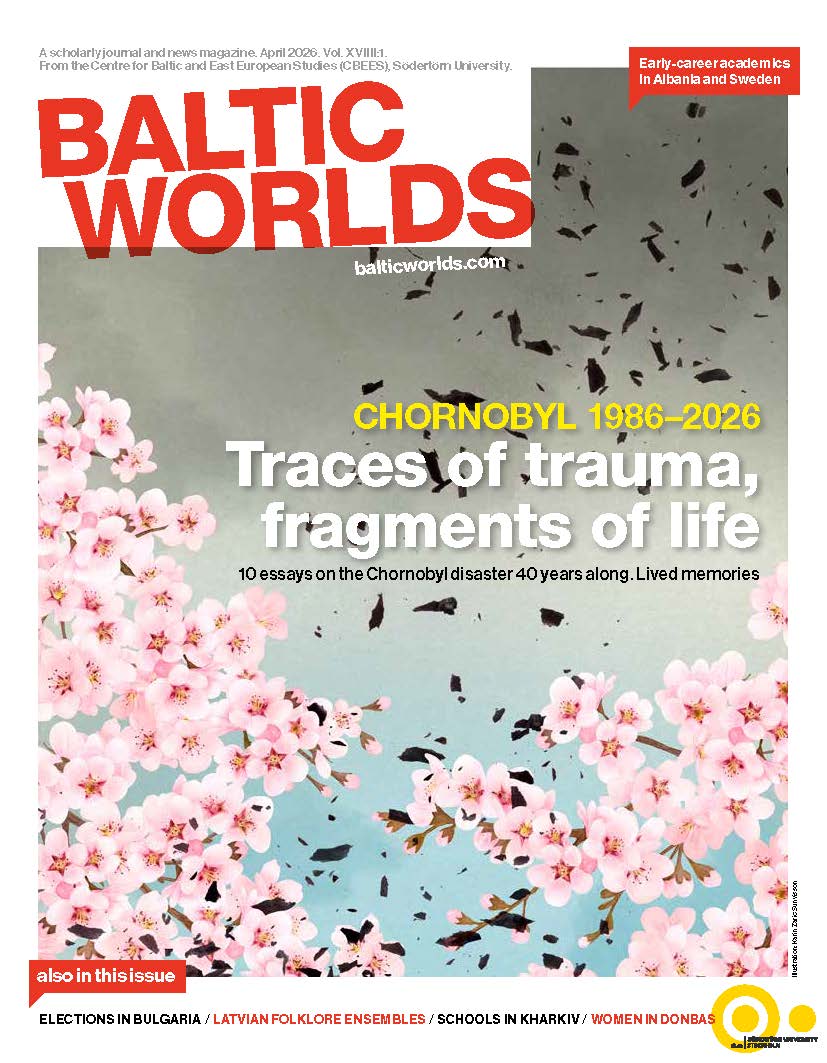 Issue 2026, 1: Download.
The Polish art historian, critic, and curator Piotr Piotrowski passed away May 2015. He was the chair of the Modern Art History Department at Adam Mickiewicz University, in Poznań, where he was also the director of the Institute of Art History from 1999 to 2008.
Read Charlotte Bydler’s In Memoriam here>>
Analize – Journal of Gender and Feminist Studies, New Series, Issue no. 7, 2016, The Romanian Society for Feminist Analyses AnA, 2016, 101 pages.
Europe faces Europe: Narratives from its Eastern Half, Johan Fornäs (toim.). Bristol, UK/ Chicago, USA: Intellect, 2017, 252 pages.
The elections in Albania were overshadowed by three issues: further EU integration through key judicial reform, and property rights. All three are closely interconnected, and illustrate the difficult changes Albania still need to face in order to become a politically, economically and judicially stable country.
The 400th anniversary of the peace treaty between Sweden and Russia has for obvious reasons been in the shadow of […]
In the much visited and favorably reviewed exhibition “Revolution. Russian Art 1917—1932” held at the Royal Academy of Arts in February through April 2017, a large number of works was displayed, borrowed from art museums all over Russia and other countries, as well as from private collections.
Lusine Djanian and Alexey Knedlyakovsky at the Bakhtin workshop shared their experiences from the art protest in 2013, in the Russian Republic of Mordovia, the historical place for those serving sentence or being exiled. And it was in this region where Bakhtin spent many years of his life when he was not allowed to live in Moscow. The protest was a direct action to support the demands of Pussy Riot-member Nadezda Toloknnikova, who was serving her sentence in prison for the action in the Moscow Cathedral of Christ the Savior.
The workshop “Bakhtinian Theory in Postcolonial and Postsocialist Perspective” was organized to link with the publication of the special section on “Bakhtinian theory in a postcolonial and postsocialist perspective” in Baltic Worlds (number 1, 2017).
Early this fall Irina Seits, Russian PhD candidate at CBEES, Södertörn University met with Gustaf Nobel, Ludvig’s great-grandson, in order to talk about the Russian period in the life of his prominent family.
That gender cannot be reduced to an ahistorical fact is a widely researched insight of multidisciplinary gender studies. In theory as well as in political practice gender is thus generally understood as a post-essentialist, reflexive, and contingent concept. Against this backdrop the essay asks for the German context in what way and with which intentions, neo-authoritarian discourses and movements explicitly not only reject, attack and defame gender as concept, but also reclaim it. I will argue that under the cipher ‘anti-genderism’, a discourse has been formed that can first be described as a neo-fundamentalist discourse and that is secondly explicitly used to construct racist, neo-authoritarian us/them-dichotomies. The so called anti-gender forces become thus identifiable as the element of a dispositif, which is at the core and subject to further clarification of anti-democratic nature.
The clear winner was – as had been predicted – the ANO movement (29,64%). The other two major winners of the elections were the Pirate Party and the extreme right-wing SPD, that both for the first time ever surpassed the ten percent election threshold and made their way to the parliament. The biggest winners of the elections were thus the Anti-Establishment Parties and their candidates.