Writing history politically. A safe haven for war criminals?
Mats Deland, Purgatorium: Sverige och andra världskrigets förbrytare[Purgatory: Sweden and the criminals of World War II] Stockholm: Atlas 2010 568 pages

A scholarly journal from the Centre for Baltic and East European Studies (CBEES) Södertörn University, Stockholm.
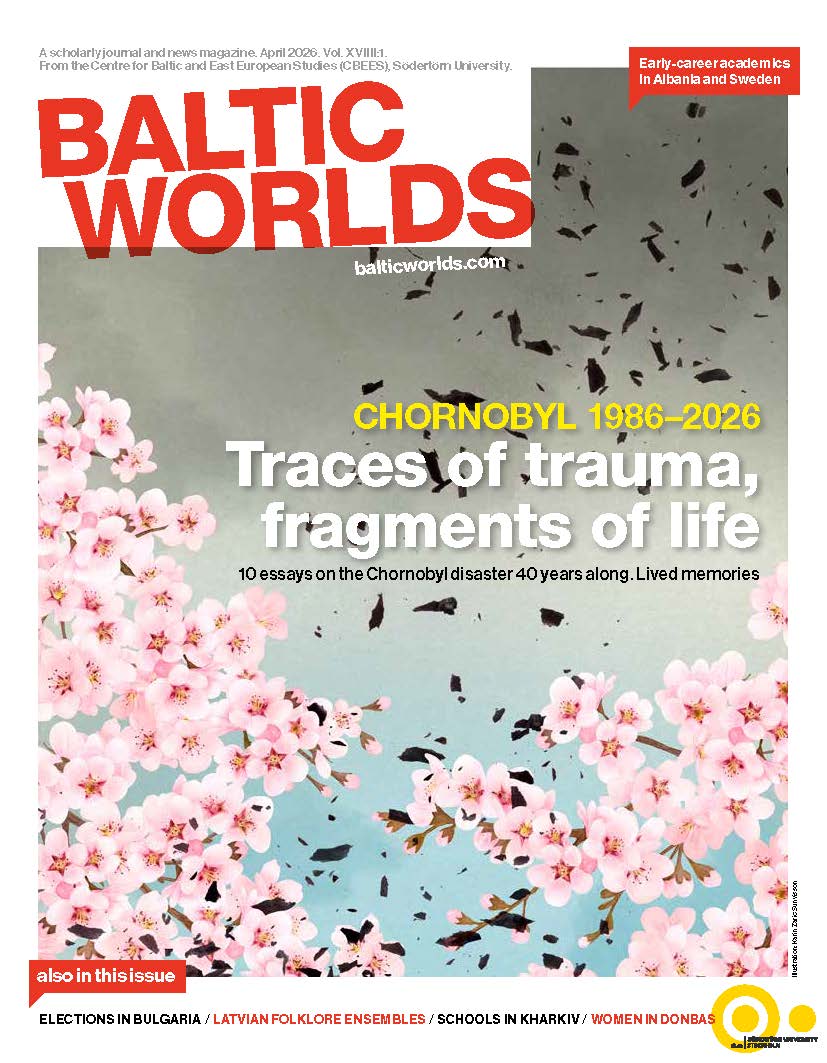 Issue 2026, 1: Download.
Author, selected as one of the British Council’s 20 best young British novelists in 2004. Has published the novels The Last Girl (2003), Amber (2014) and The Song of the Stork (2016)
Mats Deland, Purgatorium: Sverige och andra världskrigets förbrytare[Purgatory: Sweden and the criminals of World War II] Stockholm: Atlas 2010 568 pages
Rikskanslern Axel Oxenstiernas skrifter och brevväxling Avd. 2. Bd 13 Brev från Jacob Spens och Jan Rutgers Utgivna av Arne Jönsson [Lord High Chancellor Axel Oxenstierna’s writings and correspondence II:13 Letters from Jacob Spens and Jan Rutgers Published by Arne Jönsson] Royal Swedish Academy of Letters, History and Antiquities (2007) 643 pages Rikskanslern Axel Oxenstiernas skrifter och brevväxling Avd. 1. Bd 16 Brev 1636–1654 Del 1–2 Utgivna av Helmut Backhaus [Lord High Chancellor Axel Oxenstierna’s writings and correspondence I:16 Letters 1636–1654 Parts 1–2. Published by Helmut Backhaus] Royal Swedish Academy of Letters, History and Antiquities/Swedish National Archives (2009) 883 pages.
Norbert Götz, Jan Hecker-Stempehl & Stephan Michael Schröder (eds.) Vom alten Norden zum neuen Europa Politische Kultur im Ostseeraum Festschrift für Bernd Hennigsen, Berliner Wissenschafts-Verlag, Berlin 2010, 458 pages.
Professor Adam Przeworski often asks the questions most of us are a little embarrassed to ask. We see democracy as the natural state of affairs. To Adam Przeworski, who came from New York to Uppsala in late September 2010 to receive this year’s Johan Skytte Prize in political science, no such truths are taken for granted.
Here the author discuss questions of normality, deviation from norms, and power relations through a selection of Polish student essays that address both gender relationships and the relationship between East and West. The working assumption is that theories of gender and the East— West relation can enrich each other and thus help achieve greater understanding of how both power systems work, individually, and combined.
A specter is haunting the Baltic States. It appears in different forms and with different names: Air Baltic, Mažeikių Nafta, Lattelecom, Ventspils Nafta, Latvenergo, Estonian Air. With their independence in 1991, the Baltic nations inherited enormous state enterprises, built to serve large parts of the Soviet Union, and thus too big for small republics like Lithuania, Latvia, and Estonia.
The Hungarian János Kornai is one of Europe’s most respected economists. His name is often mentioned in speculation about the […]
There was a time, only a few decades ago, when Northern Europe was the object of intensified strategic attention. Today, by comparison, the Baltic area seems a fairly tranquil place. Is it in fact too tranquil? That is worrisome for the once-again independent three republics on the eastern shores of the Baltic Sea.
David Holloway, professor of international history at Stanford University, has been specializing as a Cold War scholar for a long time. He has recently delved into many archives in an attempt to find the answer to the question of the significance of the atom bomb during the Cold War. He presented part of his findings at a research seminar at CBEES in September.
The EU wants the Baltic region to have a common energy sector, something the region does not have today. Political governance is weak and the people making the investments have yet to prioritize regional cooperation. This is the view of Michael Bradshaw, professor of human geography at Leicester University, who opened the first Baltic Worlds Annual Round Table on November 24 at Södertörn University in Stockholm.