A sense of moral superiority. Russian intellectuals
+ Laurie Manchester Holy Fathers, Secular Sons. Clergy, Intelligentsia and the Modern Self in Revolutionary Russia. Northern Illinois University Press 2008. 288 pages.

A scholarly journal from the Centre for Baltic and East European Studies (CBEES) Södertörn University, Stockholm.
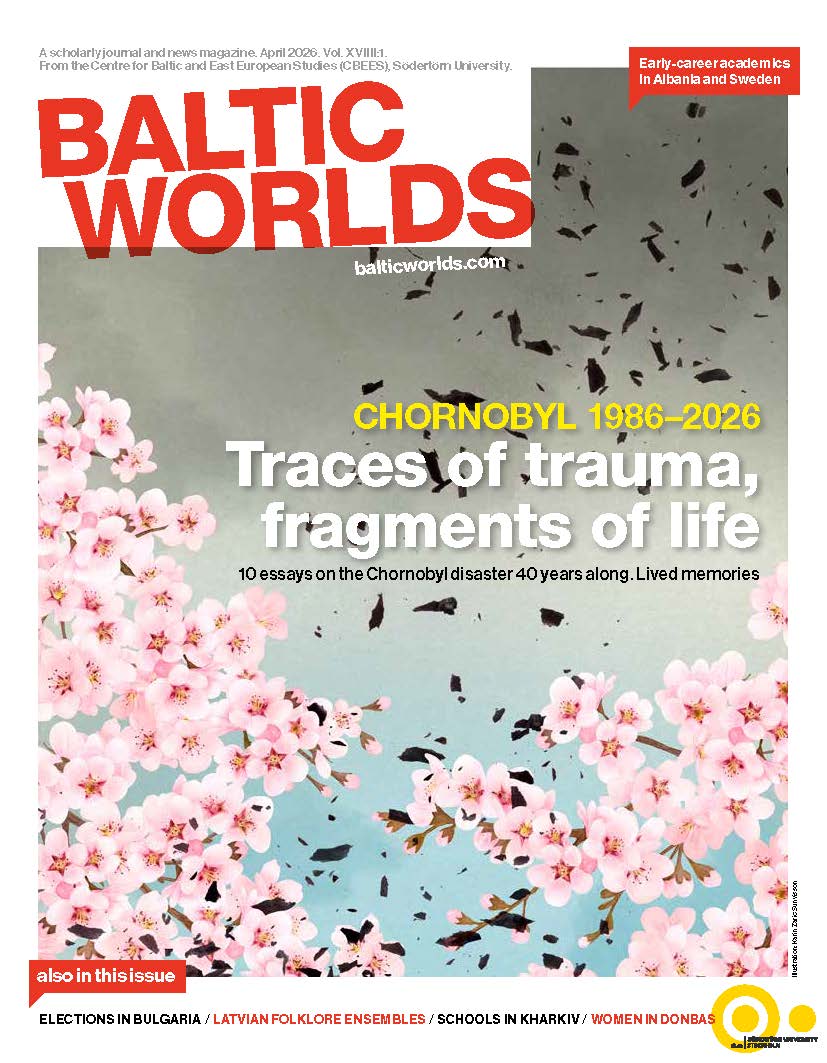 Issue 2026, 1: Download.
Professor of European history at the Department of Business and Politics, Copenhagen Business School, and former director of the Danish Center for Holocaust and Genocide Studies. Among his books are Europas ansigter [The faces of Europe] (1992) and Europa: Identitet og identitetspolitik [Europe: Identity and identity politics] (1998).
+ Laurie Manchester Holy Fathers, Secular Sons. Clergy, Intelligentsia and the Modern Self in Revolutionary Russia. Northern Illinois University Press 2008. 288 pages.
+ Paul Hollander (ed.) Political Violence: Belief, Behavior, and Legitimation. Basingstoke and New York: Palgrave MacMillan 2008. 272 pages.
+ Marjatta Hietala. De finländska forskarna och orienteringen mot Tyskland under andra världskriget. [The Finnish Researchers and the Orientation Towards Germany during World War II], in Historiska och litteraturhistoriska studier 83 [Historical and Literary-Historical Studies 83] (Malin Bredbacka-Grahn and Johan Strömberg, eds.). Svenska litteratursällskapet i Finland: Helsingfors/Helsinki 2008.
+ Dirk Hempel. Walter Kempowski – Eine bürgerliche Biographie. Verlagsgruppe Random House (2007).
+ Jane Dawson Eco-Nationalism: Anti-Nuclear Activism and National Identity in Russia, Lithuania and Ukraine. Duke University Press, 221 pages. Rurik Holmberg Survival of the Unfit: Path Dependence and the Estonian Oil Shale Industry. Linköping University, 345 pages.
+ Seppo Zetterberg Viron historia [The History of Estonia] Suomalaisen Kirjallisuuden Seuran toimituksia 1118 [Publication of Finnish Literary Society]. Hämeenlinna, 2007, 810 pages
+ Peter Bötker Leviatan i arkipelagen. Staten, förvaltningen och samhället. Fallet Estland [Leviathan in the Archipelago: State, Administration, and Society: The Case of Estonia]. Stockholm: University of Stockholm, 2007.
+ Elena Zubkova Pribaltika i Kreml, 1940–1953 [The Baltic States and the Kremlin, 1940–1953], Moscow: Rosspen 2008. 351 pages.
+ Lennart Samuelson Tankograd. Den ryska hemmafrontens dolda historia 1917–1953 [Tankograd: The Secret History of the Russian Home Front, 1917–1953]. Stockholm: SNS Publisher 2007. 368 pp., illustrated.
In Hungary, there were several active women fascists. In the People’s Tribunals after World War II, however, few of the women were convicted. There was an unwillingness to think of women as capable of such evil deeds.