Polish Presidential Elections: Three Times “No”
Poland went to presidential elections. The first round took place on May 10th and the second May 24th. The opposition candidate from the conservative Law and Justice (PiS) Andrzej Duda won both rounds.

A scholarly journal from the Centre for Baltic and East European Studies (CBEES) Södertörn University, Stockholm.
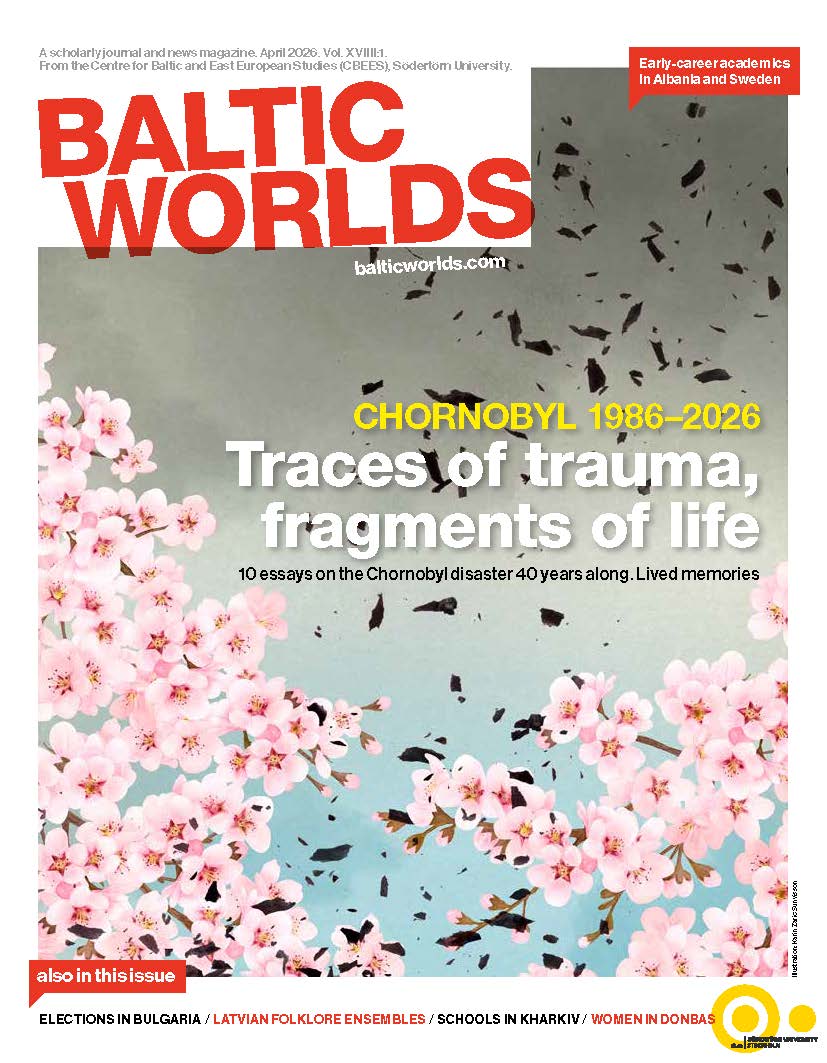 Issue 2026, 1: Download.
Valters Bolevis is PhD Oec. Can. in business administration, Riga International School of Economics and Business Administration. Project manager. MS with distinction cum laude in the field of transport and maritime management from Institute of Transport and Maritime Management (ITMMA), Belgium, 2007.
Jan Sjölin is associate professor at the Baltic International Academy (BIA in Riga) and emeritus at the Technical University of IASI (CETEX). Served within the inner circle of CEEMAN (the Central and Eastern European Management Development Association) dealing with transition and evaluation of academic institutions.
Tatjana Volkova is professor in strategic management and innovation management and former rector of BA School of Business and Finance, Latvia. Her special research interests are design-driven innovations and creative industries. She is among other things a former President of Rector’s Conference of Latvia (2004—2011) and a former member of the European University Association Council.
Poland went to presidential elections. The first round took place on May 10th and the second May 24th. The opposition candidate from the conservative Law and Justice (PiS) Andrzej Duda won both rounds.
The 2015 election will be held very close to the end of the parliamentary term and it will be the first time since 1903 that Denmark holds a general election in June. As is usual in Denmark, the election campaign will be very short and intensive. Three issues so far have dominated the campaign: Job creation, healthcare and immigration.
The panel debate “Mendicancy, poverty and Swedish society” was organized the 20th of May at Södertörn University, with the intention to flesh out an emotionally loaded political topic with professional background knowledge.
At a symposium in March 2015, Erasmus University Rotterdam, Andrej Kotljarchuk presented the results of an ongoing research project “The Roma Genocide in Ukraine 1941-1944: History, memories and representations”.
In Ukraine today, “solidarity” means self-dedication and sacrifice — and is more tangible than ever before.
To speak of a solidarity beyond sense or meaning does not imply that the solidarity in question lies beyond the world, or beyond existence. What Patočka is trying to come to terms with is rather a solidarity at the limits of existence and at the limits of experience: the experiences of the limits of existence.
The term “fraternity” has been clearly linked to a register that could be called romantic. This explains the desire to distinguish the word from others like “solidarity” and “justice” and in particular “equality”.
In 1980, women’s participation in the Solidarność movement was far from invisible. Women were present from the start and they “took over” several highly important activities in Solidarność after its de-legalization in December 1981. The invisibility of these tasks was compounded by the fact that all of this work was illegal.
The author analyzes the content of the word “solidarity”, not for the sake of linguistics, but in the belief that words contain memories as well as many other experiences, often conflicting ones. He also talks about Solidarity, the trade union in Poland, which was created in August 1980 and crushed in December 1981.
Ludger Hagedorn has gathered together different voices, all adding insights into the meaning of solidarity. Here he presents the different contributions and place them in a wider context. He concludes, "Perhaps the outcome of solidarity counts less than the atmosphere that it creates and in which it unfolds its explosive message.".