War, masculinity, and memory. Recruited into a foreign army
Ene Kõresaar (ed.)Soldiers of Memory World War II and its Aftermath in , Estonian Post-Soviet Life Stories, Amsterdam & New York Rodopi 2011, 441 pages

A scholarly journal from the Centre for Baltic and East European Studies (CBEES) Södertörn University, Stockholm.
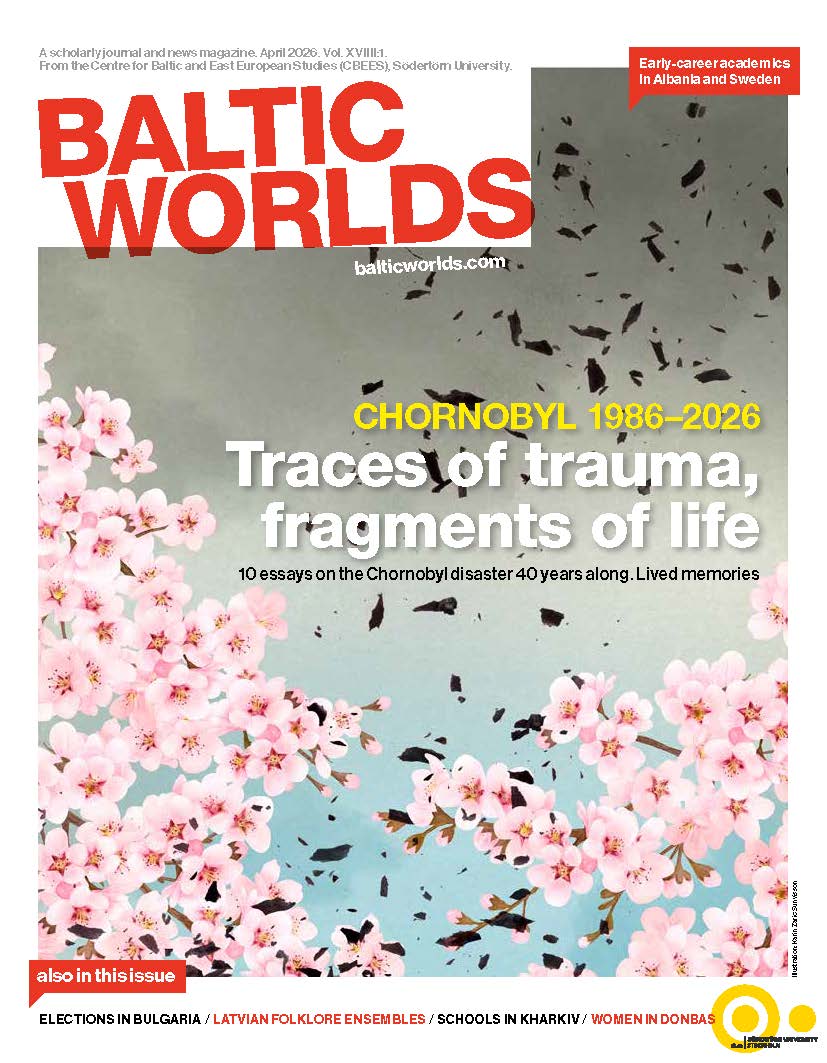 Issue 2026, 1: Download.
These three authors held a seminar on Pussy Riot in November 2012. Afterwards they jointly wrote down their contributions and thoughts – and also commented each other texts.
Ene Kõresaar (ed.)Soldiers of Memory World War II and its Aftermath in , Estonian Post-Soviet Life Stories, Amsterdam & New York Rodopi 2011, 441 pages
Mary-Kay Wilmers, The Eitingons, A Twentieth-Century Story, London: Faber & Faber, 2009, XI + 476 pages
Francis W. Wcislo, Tales of Imperial Russia, The Life and Times of Sergei Witte, 1849–1915, Oxford: Oxford University Press, 2011, 314 pages
Mark Bassin, Christopher Ely & Melissa K. Stockdale (eds.) Space, Place, and Power in Modern Russia, Essays in the New Spatial History, DeKalb, Northern Illinois University Press, 2010, 268 pages
Spomeniks are monuments commemorating the World War II dot the landscape: gigantic futuristic creations that in some cases have been spared destruction.
About Estonia’s endeavors to become part of the staid but stable Scandinavia – an effort based on the belief that the country actually has a special affinity with Scandinavia. One sign of this, Pärtel Piirimäe points out, is the use of the word jõul (cognate to English “Yule”). The Estonians, like the Swedes, Norwegians, Danes, and Finns, thus live in Yule Land.
When the shops in the center of Riga emptied out in the wake of the economic crisis, the artists were given free reign over the spaces – the result was an art festival.
The fact that Moscow and St. Petersburg house in total five fashion events every season makes one think that the fashion business is considered attractive and economically sound in Russia. However, despite the growth of the Russian fashion market since the 1990s, the fashion industry is losing ground to other promising fashion hubs.
Infrastructure forms a link between the open global economic space and the non-public Russian political space. The question of how to manage the most important trade flows and understand their social importance is not, of course, solely seen as a matter of Russian politics. The research on Russia is also connected to the recent debate on the importance of increasing globalization and the mutual dependence of societies.
“Market Reform and Socio-Economic Change in Russia” was the subject of an ambitious full-day seminar held October 6, focusing on the period since the fall of the Soviet Union.