
Download back issue of Baltic Worlds
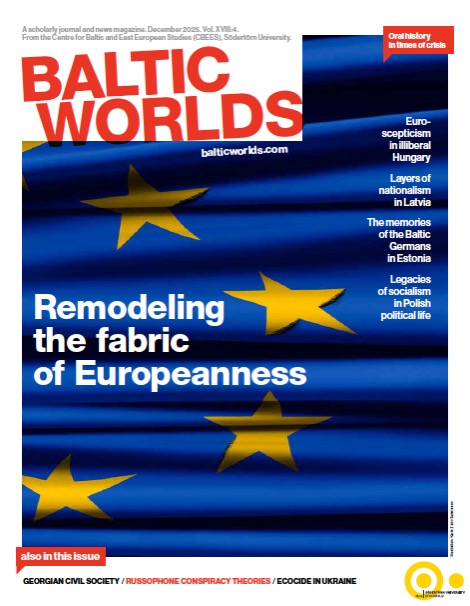 Issue 2025, 4: Download.

Peer-reviewed articles Cultural recolonization in the post- Soviet space
This article examines how culture functions as a strategic instrument of recolonial power in the post-Soviet space, where imperial legacies, Soviet infrastructures, and contemporary authoritarian practices converge. Integrating postcolonial, decolonial, and recolonial frameworks, the study analyzes three emblematic cases – Gergiev’s 2008 Tskhinvali concert, the 2014 opera Crimea, and Sandro Sulaberidze’s 2023 protest in Tbilisi – to show how artistic production legitimizes territorial conquest, naturalizes hierarchical authority, and disciplines cultural autonomy.1 The article argues that recolonization today operates not only through military force but through performative, affective, and institutional mechanisms that render domination intelligible, emotionally resonant, and politically durable.
Published in the printed edition of Baltic Worlds BW 2025:4, pages 32-45
Published on balticworlds.com on December 18, 2025


abstract
This article examines how culture functions as a strategic instrument of recolonial power in the post-Soviet space, where imperial legacies, Soviet infrastructures, and contemporary authoritarian practices converge. Integrating postcolonial, decolonial, and recolonial frameworks, the study analyzes three emblematic cases – Gergiev’s 2008 Tskhinvali concert, the 2014 opera Crimea, and Sandro Sulaberidze’s 2023 protest in Tbilisi – to show how artistic production legitimizes territorial conquest, naturalizes hierarchical authority, and disciplines cultural autonomy.1 The article argues that recolonization today operates not only through military force but through performative, affective, and institutional mechanisms that render domination intelligible, emotionally resonant, and politically durable.
KEYWORDS: Cultural recolonization, post-Soviet, Georgia, Ukraine, Russia.
DOWNLOAD THE FULL PAPER OA (see upper right corner)