
Download back issue of Baltic Worlds
 Issue 2026, 1: Download.
Conference reports The Baltic Sea Day: Preachings of Aquatic Autochthony and Marine Citizenship
The Baltic Sea Day (BSD) is an initiative launched by Finnish John Nurminen Foundation in 2019. On the last Thursday of every August since, the foundation has celebrated Baltic Sea Day to safeguard the sea environment and to foster an understanding of the sea’s history.
Published on balticworlds.com on November 2, 2026


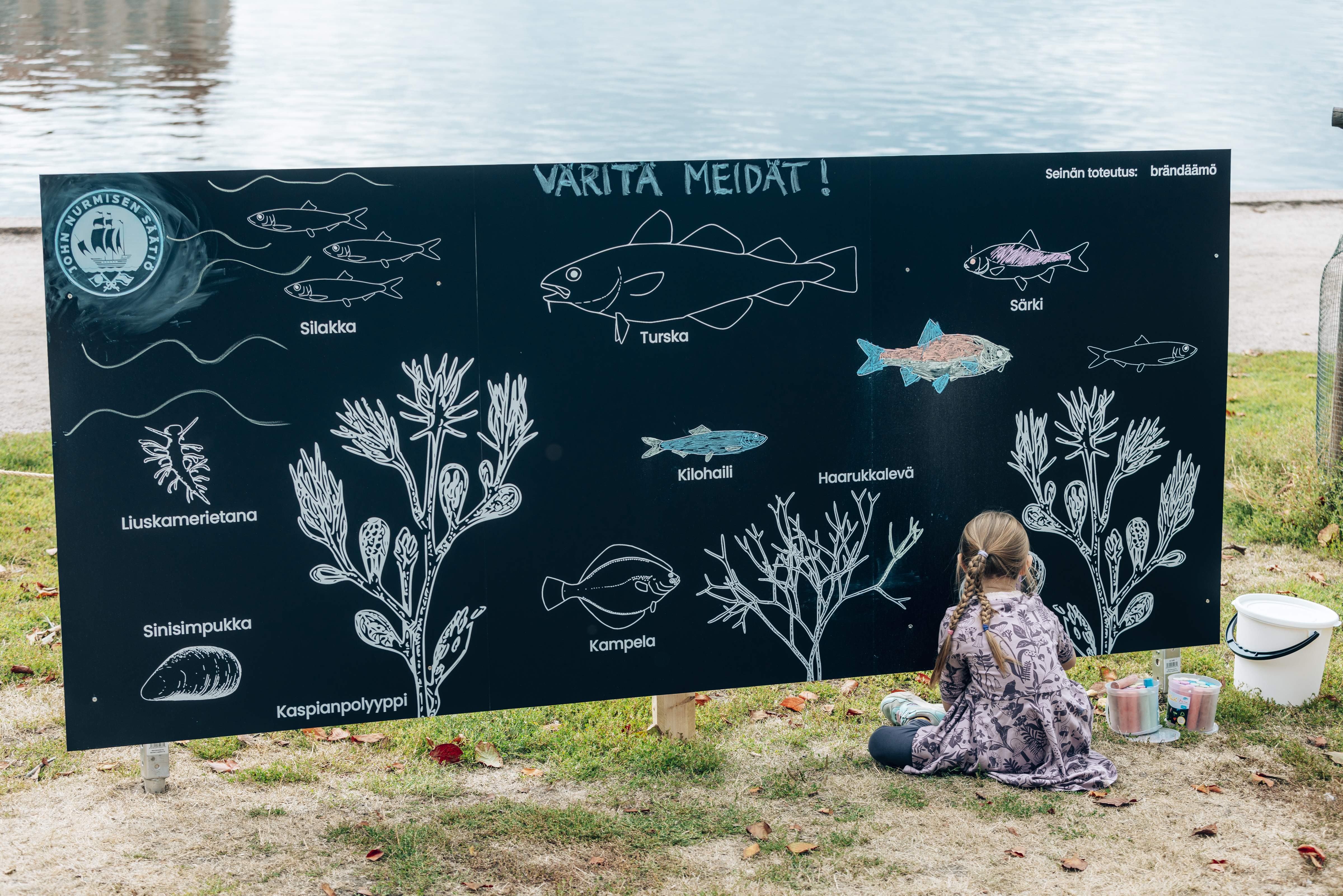
The Baltic Sea Day (BSD) is an initiative launched by Finnish John Nurminen Foundation in 2019. On the last Thursday of every August since, the foundation has celebrated Baltic Sea Day to safeguard the sea environment and to foster an understanding of the sea’s history. The celebration entails a wide variety of activities, hosted by numerous actors around the shores of the sea. The foundation provides support for arrangers and promotes all BSD events that are consistent with their core values[1] and the three themes that the foundation set for the celebration. The purpose of the themes is the experience of the Baltic Sea through several sensory sources. Feeling the water on your skin. Tasting responsibly harvested goods of the sea. And perhaps reading a book by Tove Jansson or August Strindberg that depicts characters interacting with what the John Nurminen Foundation continuously calls our “shared home sea”. Maija Soljanlahti, project manager of Baltic Sea Day, explains the three themes:
“First of all is what we call ‘the plunge’, actually going into the water and feeling it. Secondly, the ‘Baltic Sea menu’, learning what to put on your plate. And the third theme is the ‘Baltic cultural action’, which of course is a very wide concept.”
Soljanlahti encourages musical performances or art exhibitions by the sea, meant to “turn people’s minds towards the Baltic Sea”. Also, historical lectures on our marine dependency fall under Soljanlahti’s cultural category as well as organized conversations about people’s own memories of the Baltic.
The combination of sensations can make possible a closeness to the home sea, leading in turn to a deeper understanding of the natural environment’s needs and ecological boundaries. BSD tries to merge this positive trifold connection process with dissemination of climate research. Realizing the seriousness of the situation while joyfully experiencing the sea might, as ecologist Serge Latouche has suggested,[2] facilitate the readjustments of society necessary for sustainable development. Furthermore, framing crucial acts of climate activism in a joyous context has the potential to counteract the dangers of ecological defaitism.
The John Nurminen Foundation does not refer explicitly to ecological philosophers in their official communication. However, bioregionalist Lewis Mumford’s idea of responsibly “reinhabiting” our abused environments correlates with the BSD ambition of rethinking our way of living with the sea. And, the idea of equality and human rights being connected to the manner in which we treat non-human beings and phenomena is reminiscent of Murray Bookchin’s philosophy of social ecology.
Brasilian philosopher Vladimir Safatle has stated that a belief of autochthony, the feeling of belonging to a certain lot of land, can be reached through aesthetic experience.[3] For example, a national anthem or a romantic landscape painting might create an emotional, albeit non-reciprocal, bond between a human subject and its earthly environment. Because of the common use of autochthonal arguments in justification of superior belonging to a nation, many researchers construe autochthony belief as an enabling factor of nationalism and totalitarianism.[4] Autochthony, meaning “sprung from the soil”,[5] generally refers to a sensed connectedness to a terrestrial area, i.e. on land. However, the term is seldomly employed to describe a felt connectivity to a body of water, or a specific sea.
When Finns speak of “nature”, Maija Soljanlahti asserts, the phrase usually refers to the forest. At times it does signify water, but in those cases mostly Finland’s numerous lakes. The sea, she claims, is more rarely spoken of as something you have a connection to. In general, Soljanlahti continues, the Baltic Sea is thought of mainly as a route for cruise ships you take towards Stockholm. Otherwise, she concludes, it is usually only mentioned in worrisome contexts, such as when its ecological or geopolitical status changes. The Baltic Sea Day is meant to introduce the sea into everyday conversation, preferably carrying a positive connotation.
The John Nurminen Foundation’s thematic framework could be said to foster an aquatic autochthony, a sense of belonging to the home sea. Portraying the Baltic Sea as a collective dominion corresponds with Maija Soljanlahti’s application of the marine citizenship idea:
“Marine citizenship comes with both rights and responsibilities. In my opinion, the rights are to enjoy the Baltic Sea. That’s why I think it is important for cities, for example, to make sure that their citizens can be by the sea without having to pay for it. The responsibilities of marine citizenship come with taking care of the beaches and the water. Small activism can be part of your marine citizenship.”
In Soljanlahti’s view, nurturing the sea can begin with simply talking about it, and getting to know it. She sees a struggle in spreading the Baltic Sea knowledge and sense of belonging to new recipients. In other words, she says, “there is a difficulty in preaching to anyone but the choir”. One of the major challenges for the Baltic Sea Day is maybe the vastness and cultural diversity of the region surrounding the home sea.
“What is important to understand is that people have very different kinds of feelings towards the sea” Maija Soljanlahti says, hoping to be able to expand the workings of the Baltic Sea Day to all countries with a Baltic shore. The ambition is to alter the general attitude regarding the sea, in a homogenous territory governed by varying laws concerning environmental protection. “We cannot do this on our own, we need other actors that share our values” Soljanlahti pleads.
A Baltic Sea Day conference in Stockholm was hosted this August by John Nurminen Foundation’s foremost partner in Sweden, Race For The Baltic, in the offices of law firm Mannheimer-Swartling. The theme of the conference was systemic risks connected to the sea, especially for companies and industries.
In his opening speech, Race For The Baltic CEO Marcin Kotlarek efficiently implemented the BSD vocabulary when calling the Baltic a “special sea, home to 90 million people”. A strategy for instilling aquatic autochthony, perchance? Kotlarek went on to declare that “our sea” is worth both celebrating and protecting, before he shared alarming research on how approximately 97% of the Baltic suffers from eutrophication.
Later in the Stockholm conference, Swedish EU commissioner Jessica Roswall spoke about our shared responsibility in taking care of the water. In Roswall’s opinion, this should be a question for all board meeting rooms. She then recited a snippet of Nobel Prize laureate Tomas Tranströmer’s epic 1974 poem Östersjöar (English: Baltic Seas), celebrating the multitude contained in the notion of the Baltic Sea.
After several more speakers – scientists, politicians, businesspeople and insurance company representatives – Ocean Collective CEO Jörgen Bergqvist took the stage to present a newly developed “ocean paste”, made from fish pieces that are usually discarded in the industrial process. Together with Daniel Novianto, Food & Beverage Manager at law firm Mannheimer-Swartling, industry group Ocean Collective served all conference attendees this paste in the form of “havets Wallenbergare”, a Swedish traditional fish patty accompanied by potato purée and browned butter.
All in all, this conference program checks all BSD boxes (except for “the plunge”). Disquieting research results were communicated, juxtaposed to aesthetic renditions of the home sea connection and teachings of a conscientious way of enjoying Baltic Sea delicacies. Attendees were thoroughly ensured of their marine citizenship and thereby could begin to foster their personal feeling of autochthony in relation to “our sea”. The question is, however, whether the conference speakers were merely preaching to an already devout choir.
References
[1] The Baltic Sea Day values are “The Baltic Sea is more than its ecological status – it is culture, environmental protection, experiences and adventure”, “Our operations are in line with sustainable development”, “We implement actions that turn people’s minds towards the Baltic Sea”, “We encourage all to join in!”, and “We promote equality and respect human rights […].” See: https://balticseaday.com/about/values/
[2] Serge Latouche, Farewell To Growth (Cambridge: Polity, 2009), 33.
[3] Vladimir Safatle, ”Belonging to a land to come: Aesthetic experience, autochthony and social emancipation”, Proceedings of the Paris Institute for Advaced Study, (2025), Accessed October 14, 2026. Available at: https://dx.doi.org/10.5281/zenodo.15469926.
[4] Ruth Marshall-Fratani, “The War of ‘Who Is Who’: Autochthony, Nationalism, and Citizenship in the Ivoirian Crisis”, African Studies Review, vol. 49, no. 2, (2006): 9–43. Accessed October 13, 2026. Available at: http://www.jstor.org/stable/20065239; Olaf Zenker, ”Autochthony, ethnicity, indigeneity and nationalism: Time-honouring and state-oriented modes of rooting individual-territory-group triads in a globalizing world”, Critique of Anthropology, vol. 31, no. 1, (2011): 63–81. Accessed October 14, 2026. Available at: https://doi.org/10.1177/0308275X10393438.
[5] Vincent J. Rosivach, “Autochthony and the Athenians”, The Classical Quarterly vol. 37, no. 2, (1987): 294. Accessed October 13, 2026. Available at: http://www.jstor.org/stable/638830.