
Download back issue of Baltic Worlds
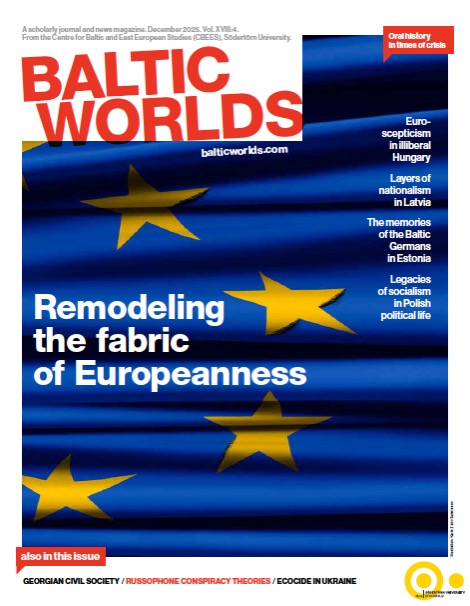 Issue 2025, 4: Download.
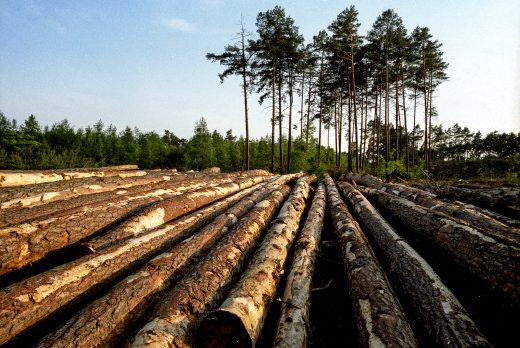
Deforestation and nature loss. Photo:UNSPLASH
Peer-reviewed articles The dynamic of the periphery. The eastern forests of the early 1990s from a Swedish perspective,
The article explores how Sweden’s engagement with the forests of the Baltics and Russia in the early 1990s was shaped by a discourse that cast these regions as peripheral. This discourse, we argue, revived historical narratives tied to 19th-century of Swedish forestry expansion toward the north, similarly, positioning the eastern forests a century later as underutilized spaces that could benefit from Swedish forestry expertise and modernization. We connect to historical phenomena and conceptualizations of center-periphery dynamics as a framework for our analysis. To identify narratives revolving around the forests in the Baltics and Russia under the center-periphery discourse, we conducted a qualitative thematic analysis of media sources from the Swedish forestry organization Skogen [The Forest] and Swedish regional and national newspapers from 1991 to 1994. In this article, we outline two key narratives that surfaced from our empirical findings. One narrative focuses on the notion that forest resources in the Baltics and Russia were finite and increasingly contested due to growing demand and restricted availability. The second narrative presents optimized forest management and professional forestry knowledge as solutions to these constraints, framing the eastern forests as potentially limitless if managed with the right expertise. We conclude our analysis of the historical narratives with a brief outlook on the recent developments of Swedish forestry portrayals of forests in the Baltics and Russia.
Published in the printed edition of Baltic Worlds BW 2025:2, pp 73-86
Published on balticworlds.com on September 23, 2025


abstract
The article explores how Sweden’s engagement with the forests of the Baltics and Russia in the early 1990s was shaped by a discourse that cast these regions as peripheral. This discourse, we argue, revived historical narratives tied to 19th-century of Swedish forestry expansion toward the north, similarly, positioning the eastern forests a century later as underutilized spaces that could benefit from Swedish forestry expertise and modernization. We connect to historical phenomena and conceptualizations of center-periphery dynamics as a framework for our analysis. To identify narratives revolving around the forests in the Baltics and Russia under the center-periphery discourse, we conducted a qualitative thematic analysis of media sources from the Swedish forestry organization Skogen [The Forest] and Swedish regional and national newspapers from 1991 to 1994. In this article, we outline two key narratives that surfaced from our empirical findings. One narrative focuses on the notion that forest resources in the Baltics and Russia were finite and increasingly contested due to growing demand and restricted availability. The second narrative presents optimized forest management and professional forestry knowledge as solutions to these constraints, framing the eastern forests as potentially limitless if managed with the right expertise. We conclude our analysis of the historical narratives with a brief outlook on the recent developments of Swedish forestry portrayals of forests in the Baltics and Russia.
KEYWORDS: Forestry, Sweden, baggböleri, logging, periphery.
DOWNLOAD THE FULL PAPER OA (see upper right corner)