Alexander Abramov, Maria Chernova and Alexander Radygin
Alexander Radygin, Director at the Institute of Applied Economic Research, the Russian Presidential Academy of National Economy and Public Administration (RANEPA), Moscow. He is also head of the Research Department and a board member at the Gaidar Institute for Economic Policy, Moscow.
Alexander Abramov, Professor at the Institute of Applied Economic Research, RANEPA. His main research interests span over the development of financial markets in Russia, with a special focus on institutional investors including pension and mutual funds.
Maria Chernova, Researcher at the Laboratory of Institutions and Financial Markets Analysis at the Institute of Applied Economic Research, RANEPA. Financial markets and financial risk management are her main research filed.
view all contributors
Articles by Alexander Abramov, Maria Chernova and Alexander Radygin
-
Although agencies involved in drug control and regulation are important for the reproduction of differentiated practices of drug use, they formulate a rather homogeneous image of a drug user as an unhealthy deviant and criminal, and an unequivocal threat to society. In the process of policy realization, the most vulnerable groups of users become the main target of public intervention. As a result, stigmatization and violence against these groups becomes institutionalized and legitimized.
-
In the fall, 2016, Färgfabriken organized the symposium “In Search for the Baltic Dimensions”, where researchers, artists, media practitioners, designers, urban planners, and art students outlined some of the burning social and cultural issues related to the Baltic Sea region.
-
In this interview, Laura Sintija Černiauskaitė shares her experience of becoming a writer in the post-Soviet conditions of 1990s Lithuania. Her development as a writer coincided with a drastic change in what it meant to be a writer: from being a political spokesperson to being an economic entity.
-
Although the elections were on the large respecting international standards and fundamental freedoms, the process has showed that Montenegro’s democracy is fragile and deeply divided along two lines, where NATO membership and ultimate geopolitical allegiance is strongly contested. The Montenegrin democracy may face important challenges from within, and is seemingly standing with few defenders among the established political actors.
-
The December 11th 2016 Romanian Parliamentary elections witnessed a dramatic redrawing of the Romanian political map, and confirmed the inability of the radical right populist parties to be serious contenders in parliamentary politics for the coming mandate. The elections also marked the return to a system of proportional electoral representation on party lists.
-
Disinformation tools are not something unique or new and have been used long time ago. But now we are living in times when information became a weapon. Annexation of Crimea, war in Donbas and in Syria have shown a significant role of information.
-
What could be expected from Mirziyoyev’s term in office? First of all, there is no reason to doubt about his promise to follow Karimov’s policies both in domestic and foreign policy domain. His backing comes from the clans and he must continue to balance between the state’s and regional power brokers’ interests, the first and foremost being stability at all costs.
-
Azerbaijan, politically, culturally and sportively, argues it wants to be considered a “European”, modern and admirable country. This becomes problematic, as nation branding can never replace state building. On September 26 the population of Azerbaijan went to the polls to give their opinion on no less than 29 proposed amendments to different chapters of the 1995 Constitution. It is no overstatement that the Referendum went by largely disregarded by the international community – and on average the Azerbaijani population did not care much.
-
The low turnout is one of the most worrying signals in these elections. Only 51.6 percent of the electorate went out to vote. The incumbent party the Georgian Dream – Democratic Georgia (GD) did win a striking mandate with 115 of the total 150 seats in the Georgian Parliament. The party will now be able to govern without support from other parties, and it also passed the 113 seats required to make constitutional changes.
-
Kalle Kniivilä, Sovjets barnbarn: Ryssarna i Baltikum. [The grandchildren of the Soviet Union: The Russians in the Baltic states] Atlas 2016. 320 pages
-

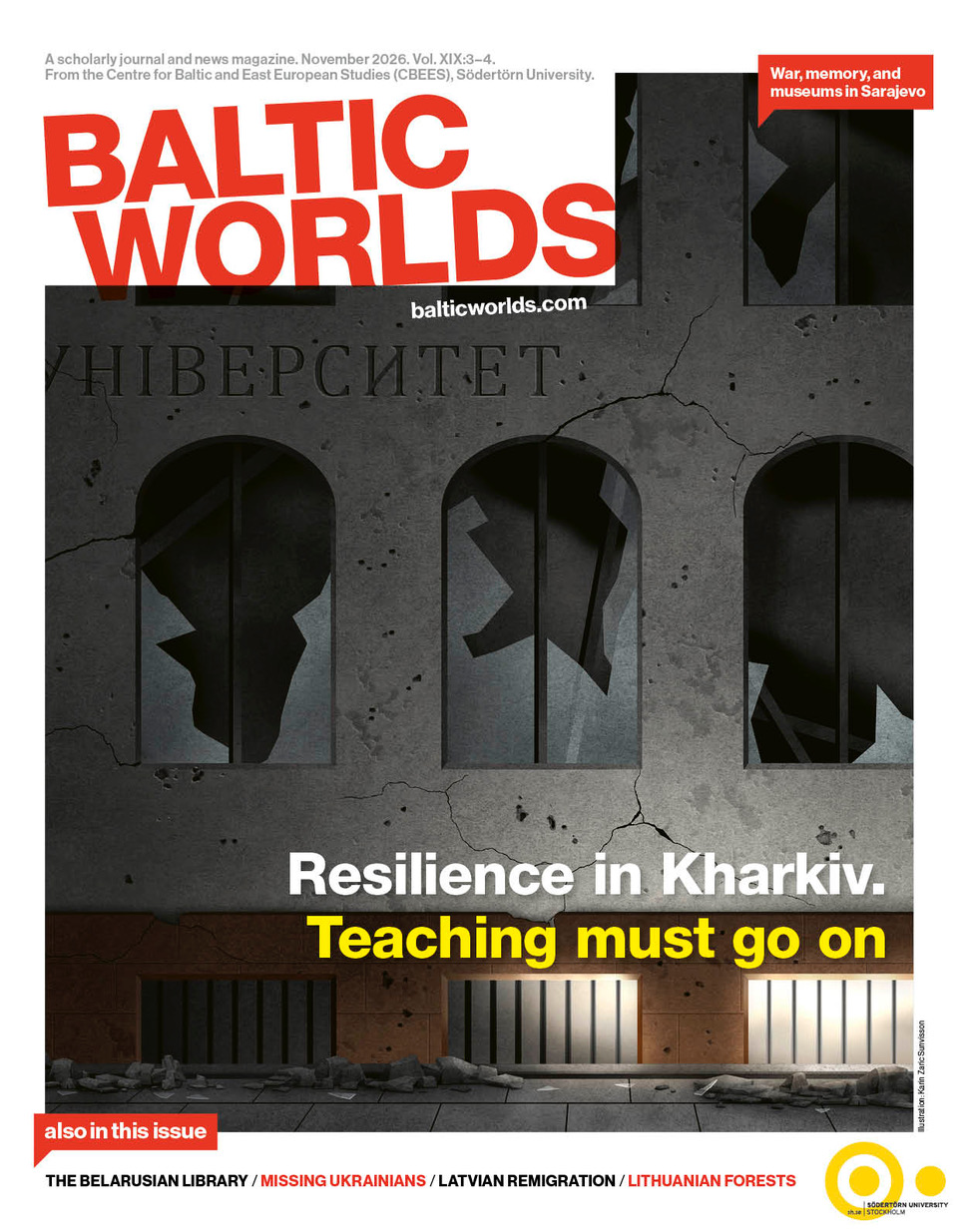 Issue 2026, 3-4: