Alexander Abramov, Maria Chernova and Alexander Radygin
Alexander Radygin, Director at the Institute of Applied Economic Research, the Russian Presidential Academy of National Economy and Public Administration (RANEPA), Moscow. He is also head of the Research Department and a board member at the Gaidar Institute for Economic Policy, Moscow.
Alexander Abramov, Professor at the Institute of Applied Economic Research, RANEPA. His main research interests span over the development of financial markets in Russia, with a special focus on institutional investors including pension and mutual funds.
Maria Chernova, Researcher at the Laboratory of Institutions and Financial Markets Analysis at the Institute of Applied Economic Research, RANEPA. Financial markets and financial risk management are her main research filed.
view all contributors
Articles by Alexander Abramov, Maria Chernova and Alexander Radygin
-
There can be no doubt that Russia has again surprised Western commentators; there had been a good consensus that there would not be major political opposition in Russia,that civil society is weak and there were no alternatives around. Now we have to develop a much more sophisticated analysis. In this article I will concentrate on two issues: legitimacy and interests.
-
Croatia is finally at the doorstep of the EU. Now the door is open and there is no need to knock and wait to get in. Croatia will be part of Eu and be able to participate and be active in social, economic and political projects of common interest.
-
The author has been following the protest against Putin through Facebook and a number of internet portals and claims that "even through the distance that any media technology always creates, one could not help feeling deeply affected by the joyous festivities during the protest events – tens of thousands strong manifestations, marches, flash mobs, and car rallies".
"The idea that a political change must precede an economic discussion prevails. In the absence of a social program, the carnival feature of the protest movement becomes the uniting principle pulling together people who otherwise would have never ever acted together.".
-
Next Sunday, on March 4, presidential elections are held in Russia. The likely winner of the elections, Vladimir Putin, has been known already for five months but during these five months Russian political climate has changed significantly.
-
On February 18, Latvia held a referendum on amendments to the Constitution (Satversme) that would make Russian a second official language. Discussions about this referendum have been very emotional. The sensitivity of the question resulted in the second-highest turnout of voters (71.12% ) for a referendum, just slightly lower than in the 2003 referendum on joining the European Union (71.49%). The proposal was rejected, so Russian did not become the second official language of Latvia and therefore an EU language.
-
Sauli Niinistö, a former finance minister and speaker of the parliament from the conservative National Coalition party received 62,7 per cent of the votes, a result which came as no surprise. Sauli Niinistö has throughout the entire presidential campaign been clear on how the role of the new president is to be played. Since the president has a direct mandate from the people he is entitled to engage also in other policy domains than those prescribed in the Finnish constitution.
-
When the voters go to the polls for the second round of the Finnish presidential election on Sunday February 5, the ultimate winner will be destined for a significantly weakened presidential office. The role of the future president was of the main issues during the first round of electoral campaign and will be further debated during the upcoming week between the two finalists.
-
The first round of the Finnish presidential elections last Sunday both fulfilled expectations and offered surprising results. Sauli Niinistö, the candidate of the National Coalition party, was as expected given the greatest number of votes. The competition about the second ticket to the presidential final turned out to be a much more exciting and a close race than expected.
-
Andres Kasekamp, A History of the Baltic States, London , Palgrave Macmillan 2010, xi + 251 pages, Andrejs Plakans, A Concise History of the Baltic States, Cambridge, Cambridge University Press 2011, xvi + 474 pages
-
Ene Kõresaar (ed.)Soldiers of Memory World War II and its Aftermath in , Estonian Post-Soviet Life Stories, Amsterdam & New York Rodopi 2011, 441 pages
-

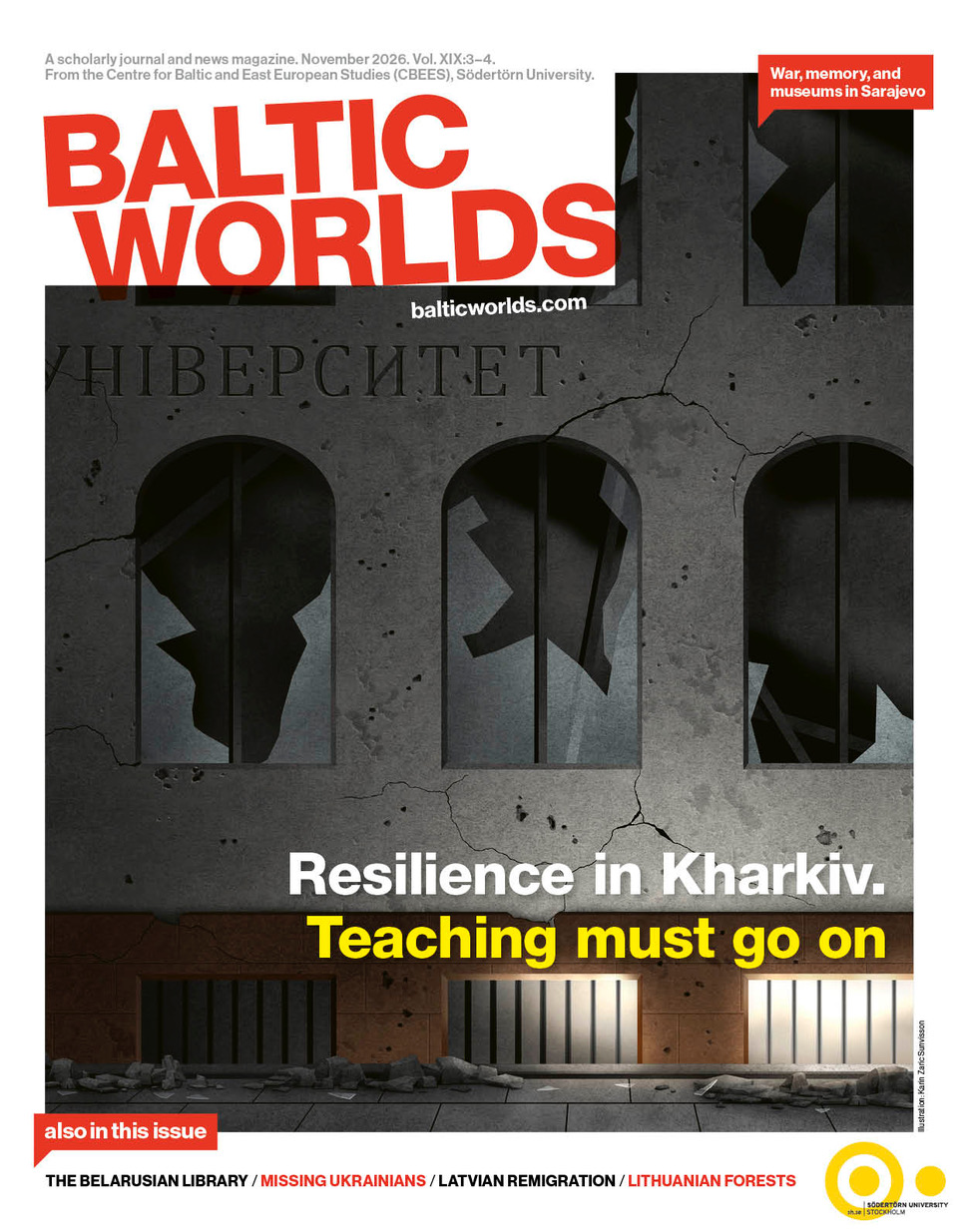 Issue 2026, 3-4: