Freedom & Resistance 2021
There are several recent reports highlighting a worrying trend towards what one could call attacks on democratic values such as independent media and academic freedom.

A scholarly journal from the Centre for Baltic and East European Studies (CBEES) Södertörn University, Stockholm.
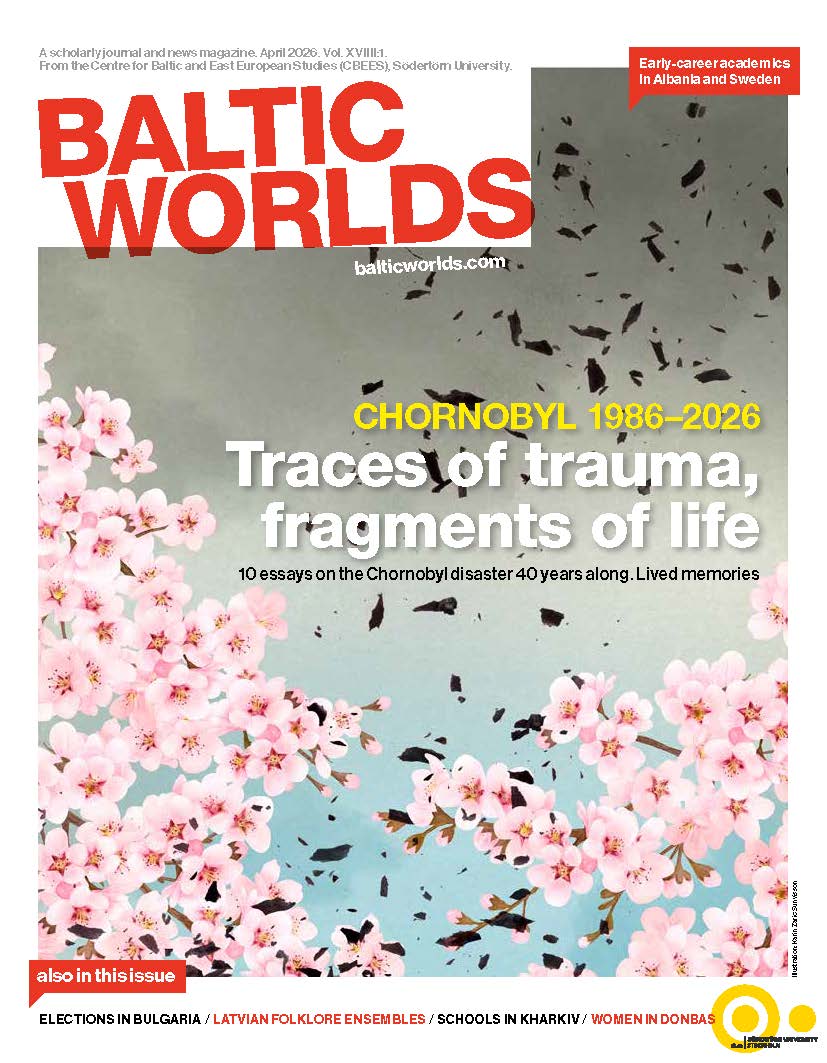 Issue 2026, 1: Download.
Dominika v. Polanska, Institute for Housing and Urban Research (IBF) at Uppsala University and Södertörn University. Leader of a project started in 2015 at Södertörn University, financed by the Foundation for Baltic and East European Studies, called “Challenging the Myths of Weak Civil Society in Post-socialist Settings: ‘Unexpected’ Alliances and Mobilizations in the Field of Housing Activism in Poland”.
Grzegorz Piotrowski is currently a CBEES Fellow; previously involved in three research projects at Södertörn University. PhD in social and political sciences at the European University Institute in 2011. Research interests: issues of anarchism, alterglobalism, squatting, social movements, postsocialism, and urban movements.
There are several recent reports highlighting a worrying trend towards what one could call attacks on democratic values such as independent media and academic freedom.
Cultural Heritage and the Future, Cornelius Holtorf & Anders Högberg, eds., (London & New York: Routledge, 2021), 256 pages.
CBEES Annual Report 2020: Constructions and Instrumentalization of the Past. A Comparative Study on Memory Management in the Region, Eds. Ninna Mörner et al., (Södertörn University: Stockholm, 2021). 186 pages
Ukrainian Neo-pagan groups, known as Ridnoviry, since the 1950s, sought to develop an archaic cosmic piety around nature and primordial traditions, to providing an alternative to the disillusions of Soviet materialist atheism and give meaning to an uprooted nation, Mainly influenced by an environmentalist and Hinduist imaginary, the landscape constitutes the main element of inertia structuring this belief. Indeed, the emotions embedded in the Brahmin knowledge and the aesthetic permanence of territory are the foundations of what could be called a pagan “geopoetics”. This concept, based on environmentalism and poetry, was part of the deployment of a new understanding of nature, and the claim of a Ukrainian ascendance linked with the Vedic and Aryan origins myth. Focusing on the main Neo-pagan groups Ridna Ukrayins’ka Natsional’na Víra (RUN-Vira) and Ob’iednannia Ridnoviriv Ukraïny (ORU), I propose in this article to return to the genealogy of this belief and show the role of geopoetics in the construction of Ukrainian Neo-paganism.
The article observes esoteric spirituality in Bulgaria in a longue dureé frame and argues the existence of a consistent tradition since the late 19th century. Based on biographical research, contemporary sources and archive materials, the article delivers insights into the social and functional dimensions of esotericism in socialist Bulgaria and answers the question of how esoteric and New Age subculture could spread in a supposedly antireligious socialist society.
A conversation with Nemanja Radulović on esotericism and New Age in communist Yugoslavia, and alternative and occult expressions and thinking.
This article describes the New Age version of the dolphinist myth and the practices of human-dolphin communication that developed in the late Soviet Union in the grassroots movement for “home waterbirth and active raising of infants.” The Aquaculture method, authored by the psychic healer and charismatic teacher Igor Charkovsky (1936–2021), included intensive training of pregnant women, giving birth in water, infant swimming, and diving from the first day of life, as well as metaphysical connections with dolphins.
The article summarizes the main findings of a socio-historical study devoted to the question of the political and social handling of “paranormal,” “parapsychological” or “occult” knowledge, experiences, and practices in the German Democratic Republic (GDR). The “scientific worldview” derived from Marxism-Leninism and propagated in the GDR was essentially a scientistic conception of reality. Against this background, all occult or paranormal topics were rigorously rejected in the public discourse of the GDR.
Baltic Worlds has in this special section “New Age and alternative beliefs in socialist Eastern Europe” invited scholars from different disciplines to address topics relating to the diversity of new religious beliefs in Eastern Europe during the socialist era and beyond. The authors, five scholars studying the multiple expressions of New Age spirituality on their own material, propose to view New Age from various angles.
The two-day conference “Political Participation in Central and Eastern Europe during the Pandemic” discussed how the profile of participants and political participation did change compared to the pre-pandemic situation and highlighted the variation in the modes of political representation in Central and Eastern European countries.