Dominika V. Polanska and Grzegorz Piotrowski
Dominika v. Polanska, Institute for Housing and Urban Research (IBF) at Uppsala University and Södertörn University. Leader of a project started in 2015 at Södertörn University, financed by the Foundation for Baltic and East European Studies, called “Challenging the Myths of Weak Civil Society in Post-socialist Settings: ‘Unexpected’ Alliances and Mobilizations in the Field of Housing Activism in Poland”.
Grzegorz Piotrowski is currently a CBEES Fellow; previously involved in three research projects at Södertörn University. PhD in social and political sciences at the European University Institute in 2011. Research interests: issues of anarchism, alterglobalism, squatting, social movements, postsocialism, and urban movements.
view all contributors
Articles by Dominika V. Polanska and Grzegorz Piotrowski
-
For more than a decade the government of Georgia, following consultations with international and transnational actors involved in financial politics and development work, is attempting to stimulate economic development in the countryside by encouraging tourism. The mountainous regions play a specific role in this process. Mountains provide a seemingly good starting point for the development of tourism as they can be defined as being very rich in both cultural heritage and natural landscapes. The main question addressed here is whether the current spatial plans and heritagization strategies of the government for Tusheti are subtle steering mechanisms primarily concerned with encouraging a free market economy. Towards this end, the local population are expected to become entrepreneurs in tourism services. In order to theoretically embed and explain what is happening in Georgia, the concepts of governmentality and heritage regimes will be used. The focus of this paper is on governmentality as it is perceived from the perspective of critical heritage studies and the anthropology of development.
-
Each contribution in this special section here presented, provides different cases and different ways of considering the tensions between local communities and national policies, between pasts that ground people and pasts which hold them back, and between the survival or memorialisation of one form of heritage and its reimagining in another form for other ends. However, for all contributors the heritage itself, and especially various processes of heritagization, are “not about the past but about the use (and abuse) of the past to educate — and at times inculcate — the public.”
-
Two months prior to the collapse of the Berlin Wall, on August 23, 1989, far behind the Iron Curtain, two million Latvians, Lithuanians and Estonians joined hands on the highways that linked their countries in a massive demonstration for national independence. They called it the Baltic Way.
-
The concept of nation is not only, as is often assumed, related to states but to the people who feel that they belong to a community based on a common identity, wherein language and culture are often emphasized as something that knit people together. History, as well as contemporary experience, reveal the notion that state nationalism tends to oppress local languages and cultures. However, in a cultural nation interpretation, all national minorities, while being citizens of their state of domicile, are per definition not members of the majority nationality.
-
On February 9 elections to the National Parliament – Milli Məclis – were held in Azerbaijan, nine months early. The […]
-
Baltic Worlds appears four times a year. The journal publishes scholarly articles but also reviews, essays and commentaries. All content is […]
-
Second World, Second Sex: Socialist Women’s Activism and Global Solidarity during the Cold War. Kristen Ghodsee. Duke University Press, 2019, 328 pages.
-
Seasoned Socialism: Gender and Food in Late Soviet Everyday Life , Ed. by Anastasia Lakhtikova, Angela Brintlinger, and Irina Glushchenko. Bloomington, Indiana: Indiana University Press, 2019, 396 pages
-
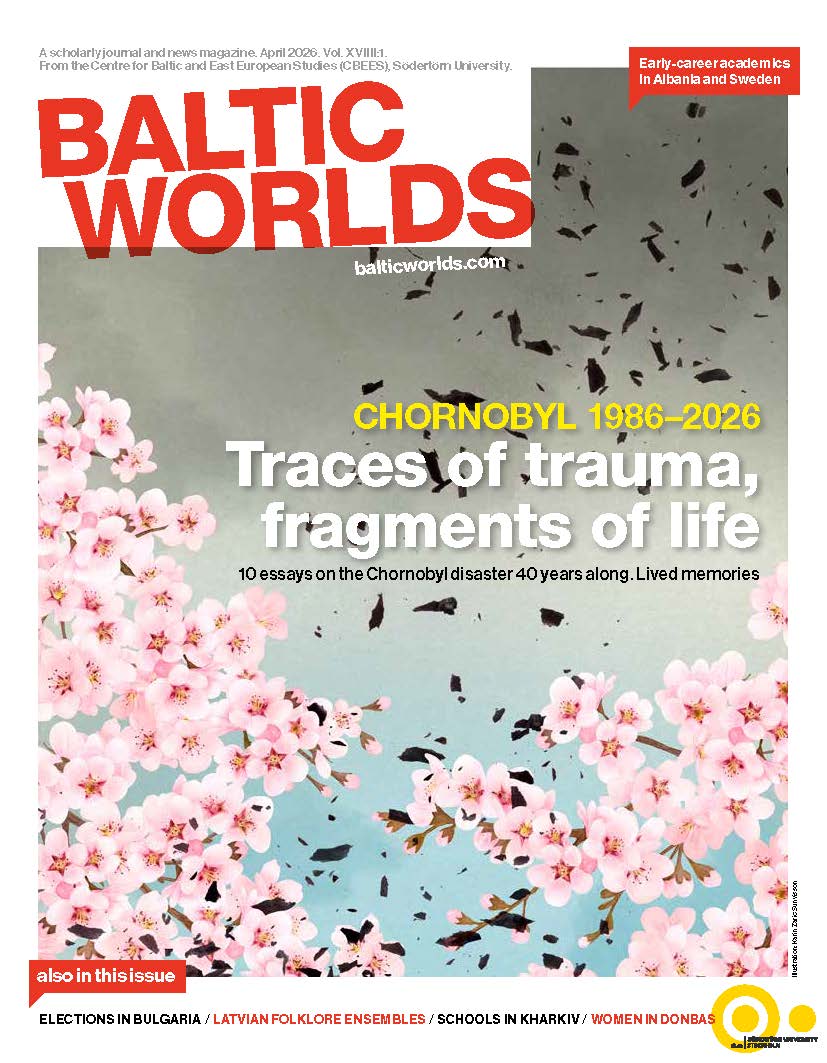
Chernobyl: History of a Tragedy, Serhii Plokhy, Penguin (2019), 432 pages, Winner of the Baillie Gifford Prize 2018
-
We are, as my examples show, tricked into believing that archaeological research, museum practices, and the digitalization of museum objects, archived material, and so on will make a secret world more open and transparent and that this will be positive for the public, democracy, and for the scientific community. The real world is, however, much more dynamic and diverse but always out of reach for the public because of our naïve desire for the Internet. Archive and museum activities are a practice done in reality, not on the Internet, and so is research.
-

 Issue 2026, 1: