WELL-EDUCATED BALTIC STATES MERGERS HAVE BECOME A NECESSITY
In order to ascend another rung on the development ladder, all three Baltic countries are engaged in higher education reform. Latvia has the furthest to go.

A scholarly journal from the Centre for Baltic and East European Studies (CBEES) Södertörn University, Stockholm.
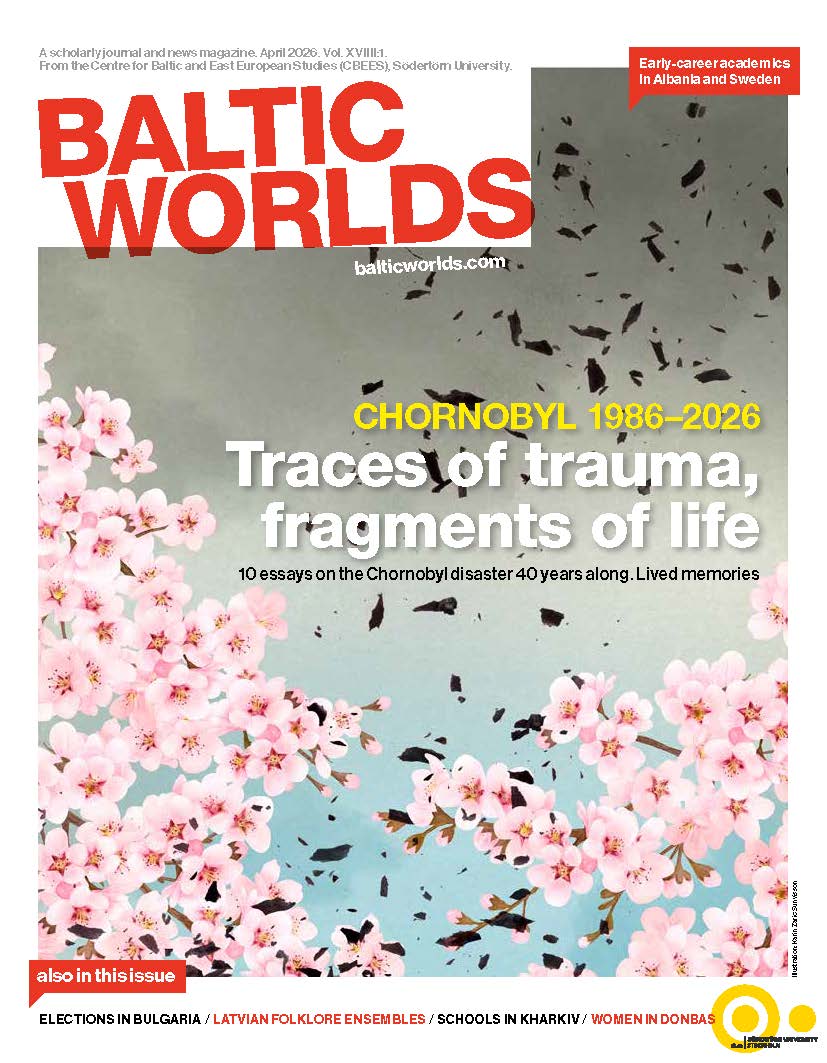 Issue 2026, 1: Download.
Elena Marushiakova is a holder of ERC Advanced Grant 2015, “Roma Civic Emancipation Between the Two World Wars”, and President of the Gypsy Lore Society. She is affiliated to the School of History at the University of St. Andrews. She has published widely on Roma in Bulgaria, Balkans and Central and Eastern Europe.
Vesselin Popov works at the School of History at the University of St. Andrews. Conducts research in frames of ERC Advanced Grant 2015, “Roma Civic Emancipation Between the Two World Wars”. Has published widely on Roma in Bulgaria, Balkans and Central and Eastern Europe.
In order to ascend another rung on the development ladder, all three Baltic countries are engaged in higher education reform. Latvia has the furthest to go.
The Baltic Sea Library is a web-based literary project run by a group of editors from all the countries surrounding the Baltic Sea, plus Iceland. The website resembles an anthology and contains poetry, novel excerpts, and other genres in all the literatures of the region. The unifying aspect is something the editors call “Balticness”, and each text is accompanied by an explanation of its connection to the Baltic Sea.
Edward S. Herman (ed.) The Srebrenica Massacre Evidence, Context, Politics. Foreword by Phillip Corwin, 2011, 300 pages
Journal of Baltic Studies, March 2009, Journal of the Association for the Advancement of Baltic Studies
Orphanage No. 7 in Taganrog was one of the former Soviet orphanages that came into contact with the new charity early on, in the form of summer vacation exchanges with Swedish host families. The reality Swedish visitors encountered in Taganrog and elsewhere, however, was not always of the dreaded kind — a destitute shelter for desperate children abandoned by the world — although such a description was at times apt, especially in reference to homes for the mentally disabled. What they found instead were tangible traces and elements of entirely different plans and ambitions.
Nationalist and anti-Semitic symbols, racist statements and the making of monkey sounds when black players enter the plan are a few examples of what goes on the football fields in Ukraine and Poland. Racism and intolerance are not exclusive problems for the two countries hosting the football championships, but a shared concern for Europe.
The range of evidence and countries involved in doping advises caution against a one-dimensional criticism and demonisation of the ‘Other Europe’.
Södertörn University, where Baltic Worlds is published, now has a chairman of the governing board, a Swedish former Social Democratic career politician, who grew up the Montenegro of Yugoslavia: Ilija Batljan. Here he is profiled in an interview
The UEFA EURO 2012 is big business and corruption is rampant and well entrenched in all aspects of Ukrainian political, economic and social life.
EURO 2012 makes prostitution not just a Ukrainian problem, but an European issue.