POLITICS, CLASS AND FOOTBALL. LOOKING WEST AND EAST FROM STOCKHOLM
The host countries have a lot riding on not just their teams' performances, but also their management of the tournament.

A scholarly journal from the Centre for Baltic and East European Studies (CBEES) Södertörn University, Stockholm.
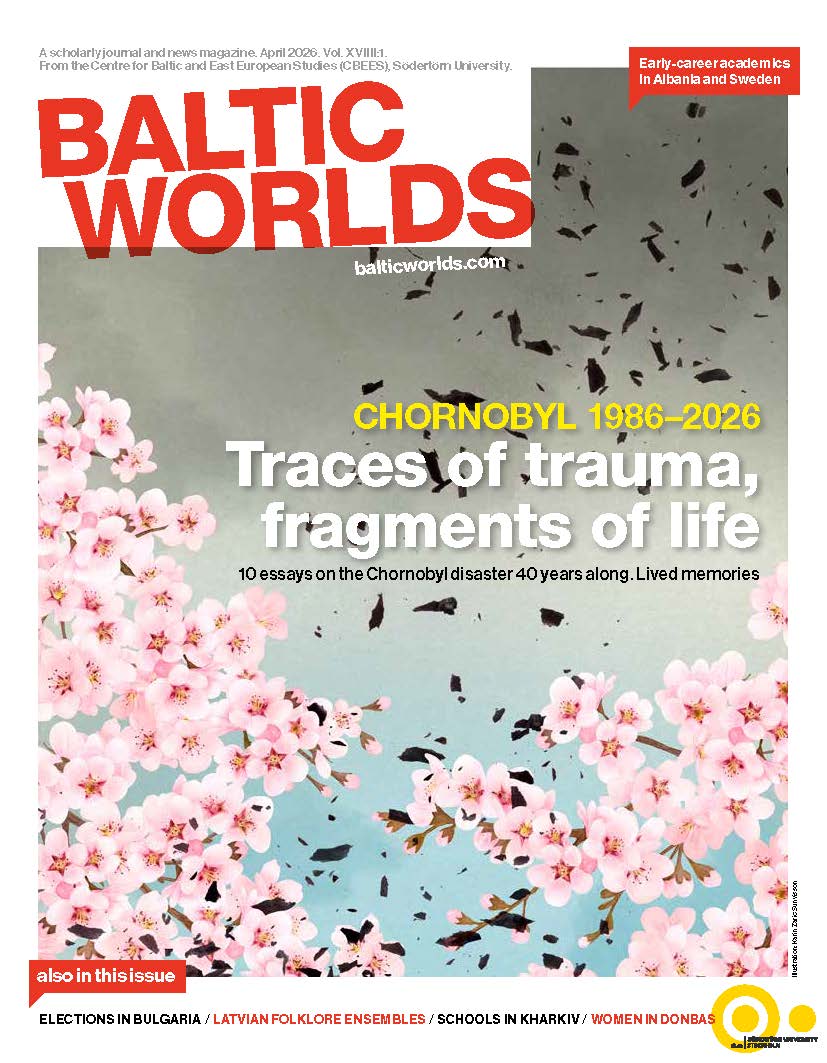 Issue 2026, 1: Download.
Elena Marushiakova is a holder of ERC Advanced Grant 2015, “Roma Civic Emancipation Between the Two World Wars”, and President of the Gypsy Lore Society. She is affiliated to the School of History at the University of St. Andrews. She has published widely on Roma in Bulgaria, Balkans and Central and Eastern Europe.
Vesselin Popov works at the School of History at the University of St. Andrews. Conducts research in frames of ERC Advanced Grant 2015, “Roma Civic Emancipation Between the Two World Wars”. Has published widely on Roma in Bulgaria, Balkans and Central and Eastern Europe.
The host countries have a lot riding on not just their teams' performances, but also their management of the tournament.
Poland has long been working to bring Ukraine closer to the EU, and vice versa. While others have become short of breath, Poland has continued to pass the ball over the border. The goal statistics have not always lived up to expectations, but the game has continued, and the long-term goal remains the same.
A positive effect of placing the Championships in Ukraine is that a more intense debate on the democratic deficit in Ukraine has emerged. On the other hand, this can also lead to a situation where the regime in Ukraine benefit from the Championships.
Baltic Worlds will be monitoring the European Football Championship in June here on Baltic Worlds’ website. A number of articles […]
A week before elections the head of the Armenian Central Election Committee announced that the Armenian parliamentary election would be monitored by over 30 000 observers, both foreign and domestic. The elections in Armenia 2012 were far from revolutionary, but perhaps it was a sign of a gradual evolution of Armenian democracy towards normality. The election results have not yet being challenged and parliament is better representing the political forces in the country and the party system is more consolidated.
Self-restraint will be the key test of Fico’s second government. Fico has periodically demonstrated an ability to take the long view, but Slovakia’s first single-party parliamentary majority will produce strong temptations to opt for short-term institutional gains for himself and financial gains for his supporters. If Fico can resist those temptations, he may secure for himself a long future in politics and a place in Slovakia’s history. If he cannot, then in 2016 he may again find himself on the losing end of electoral calculations.
Andreas Johansson, Dissenting Democrats Nation and Democracy in the Republic of Moldova, Stockholm 2012, Södertörn Doctoral Dissertations 62, 263 pages
Wendy Z. Goldman, Inventing the Enemy, Denunciation and Terror in Stalin’s Russia, Cambridge et al.Cambridge University Press 2011, 320 pages
The critical review of cosmopolitanism as a historical, philosophical, and moral concept was afforded a special place on the agenda, but presentations oriented towards practical policy applications of cosmopolitan ideas were also represented, at the conference arranged by CBEES at Södertörn University November 24—26 "Cosmopolitanism in a Wider Context: Conceptualizing Past and Present".
A journey through Gagauzia, where walnuts and wine are important industries.