The Chernobyl disaster. From the explosion to the closing of the plant
Chernobyl: History of a Tragedy, Serhii Plokhy, Penguin (2019), 432 pages, Winner of the Baillie Gifford Prize 2018

A scholarly journal from the Centre for Baltic and East European Studies (CBEES) Södertörn University, Stockholm.
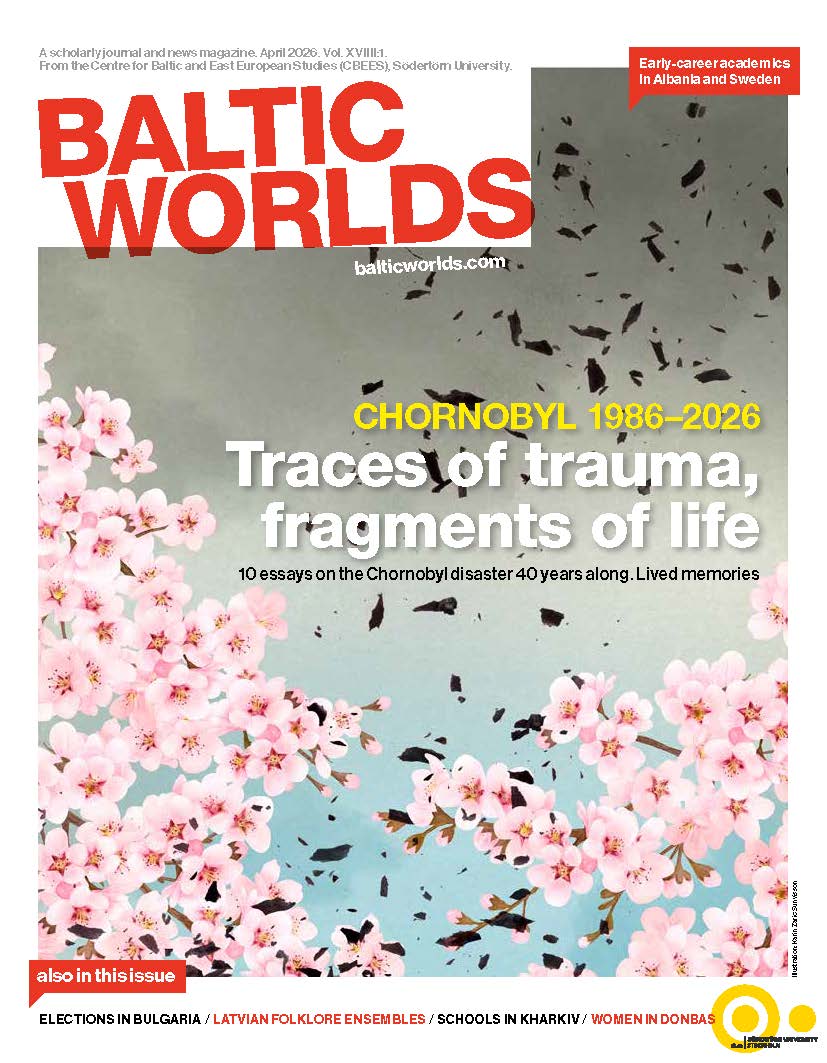 Issue 2026, 1: Download.
Associate professor in sociology at Mälardalen University and is currently affiliated with the Uppsala Centre for Russian and Eurasian Studies as senior research fellow. Her current research explores processes of marginalization in rural Hungary from an intersectional perspective.
Chernobyl: History of a Tragedy, Serhii Plokhy, Penguin (2019), 432 pages, Winner of the Baillie Gifford Prize 2018
We are, as my examples show, tricked into believing that archaeological research, museum practices, and the digitalization of museum objects, archived material, and so on will make a secret world more open and transparent and that this will be positive for the public, democracy, and for the scientific community. The real world is, however, much more dynamic and diverse but always out of reach for the public because of our naïve desire for the Internet. Archive and museum activities are a practice done in reality, not on the Internet, and so is research.
More than anything else, the avant-garde is the area of the production of the past: the colossal amounts of memoirs, artefacts, and photographs that are accumulated in archives — in different kinds of archives, including personal ones, but also state archives, and many others of different kinds.
Irina Sandomirskaja in a conversation with philosophers Jean-Luc Nancy and Peter Trawny on the subject of nationalism and cultural heritage.
There is an emerging regime of international law for protecting cultural heritage that focuses on three things: (1) conflict resolution between disputing parties, (2) safe return of cultural objects to legitimate claimants, and (3) criminal justice meted out to individuals who have acted in bad faith, mala fide.
The property of the disappeared first becomes mere “things” without name, use, or status. Then they turn into museum artifacts of ethnographic, aesthetic, or historical value (at least those of them that are not stolen by the “conquerors” nor rejected by the experts). Then, again, with the collapse of the museum project, what used to be displayed as cultural heritage turns again into “just things”. They burden their custodians who only wish to get rid of them.
In general, social disasters always result in the disproportionate excess of things: while humans perish en masse, artifacts survive in the form of market commodities and museum exhibit; as human life extinguishes in catastrophes, the life of objects gets more and more active in market exchanges, expropriations, and lootings. The history of Eastern Europe in the 20th century has witnessed many such episodes.
Expressions such as “geographical imaginaries” and “utopic worlds” are used to lead people to dream about distant lands, very different from Latvian society and its cultural scene. Based on these premises, the role of the Survival Kit Festival is to bring these imaginaries close to contemporary society in Riga, leading to a transformation of the conception of geographical and mental borders.
In June 2019, scholars came together in Belgrade for the CEEISA-ISA Joint Conference to discuss international relations in the age of anxiety. The current increase in international populist discourse and far-right movements and the democratic regression in Central and Eastern Europe were the focal point of the discussion. Questions that arose revolved around whether there are any prospects for reconciliation as a way to de-escalate the violence in the world.
Perpetuating peace will be a lifelong commitment in Kosovo and many other regions of the world. But for five weeks in historic Pristina, a group of former strangers became friends, collaborators, and confidants, telling stories of our truths, discussing our histories, and spinning worlds from words. Peace, for a while, persists.